1204
Calendar year
From Wikipedia, the free encyclopedia
Year 1204 (MCCIV) was a leap year starting on Thursday of the Julian calendar.
| Gregorian calendar | 1204 MCCIV |
|---|---|
| Ab urbe condita | 1957 |
| Armenian calendar | 653 ԹՎ ՈԾԳ |
| Assyrian calendar | 5954 |
| Balinese saka calendar | 1125–1126 |
| Bengali calendar | 610–611 |
| Berber calendar | 2154 |
| English Regnal year | 5 Joh. 1 – 6 Joh. 1 |
| Buddhist calendar | 1748 |
| Burmese calendar | 566 |
| Byzantine calendar | 6712–6713 |
| Chinese calendar | 癸亥年 (Water Pig) 3901 or 3694 — to — 甲子年 (Wood Rat) 3902 or 3695 |
| Coptic calendar | 920–921 |
| Discordian calendar | 2370 |
| Ethiopian calendar | 1196–1197 |
| Hebrew calendar | 4964–4965 |
| Hindu calendars | |
| - Vikram Samvat | 1260–1261 |
| - Shaka Samvat | 1125–1126 |
| - Kali Yuga | 4304–4305 |
| Holocene calendar | 11204 |
| Igbo calendar | 204–205 |
| Iranian calendar | 582–583 |
| Islamic calendar | 600–601 |
| Japanese calendar | Kennin 4 / Genkyū 1 (元久元年) |
| Javanese calendar | 1112–1113 |
| Julian calendar | 1204 MCCIV |
| Korean calendar | 3537 |
| Minguo calendar | 708 before ROC 民前708年 |
| Nanakshahi calendar | −264 |
| Thai solar calendar | 1746–1747 |
| Tibetan calendar | ཆུ་མོ་ཕག་ལོ་ (female Water-Boar) 1330 or 949 or 177 — to — ཤིང་ཕོ་བྱི་བ་ལོ་ (male Wood-Rat) 1331 or 950 or 178 |
Events
- January 27–28 – Byzantine emperor Alexios IV Angelos is overthrown in a revolution.[1]
- February 21–23 – A large solar storm takes place, and is recorded in Meigetsuki, the diary of the Japanese poet Fujiwara no Sadaie.[2]
- February 5 – Alexios V Doukas is crowned Byzantine emperor.[3]
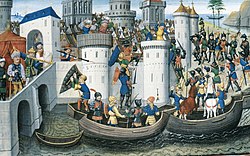
Conquest of Constantinople by the Crusaders - April 12 – Sack of Constantinople: Crusaders enter Constantinople by storm and start pillaging the city as part of the Fourth Crusade.[1] Forces of the Republic of Venice seize the antique statues that will become the horses of Saint Mark.[4]
- May 16 – Baldwin, Count of Flanders, is crowned emperor of the Latin Empire a week after his election by the members of the Fourth Crusade.[5]
- Theodore I Laskaris flees to Nicaea after the capture of Constantinople, and establishes the Empire of Nicaea; Byzantine successor states are also established in Epirus and Trebizond.[6][7]
- Boniface I, Marquis of Montferrat, a leader of the Fourth Crusade, founds the Kingdom of Thessalonica.[8]
- The writings of French theologian Amalric of Bena are condemned by the University of Paris and Pope Innocent III.[9]
- Tsar Kaloyan is recognized as king of Bulgaria by Pope Innocent III, after the creation of the Bulgarian Uniate church.[10]
- Valdemar II of Denmark is recognized as king in Norway.[11]
- Angers and Normandy are captured by Philip II of France.[12][13]
- The Cistercian convent of Port-Royal-des-Champs is established.[14]
- The district of Cham becomes subject to Bavaria.[15]
- Hermann I, Landgrave of Thuringia submits to Philip of Swabia.[16]
- Beaulieu Abbey is founded.[17]
- The Channel Islands of Guernsey and Jersey decide, after a plebiscite of wealthy land owners, to remain with the English crown, after Normandy is recaptured by Philip II of France.[18]
- Landshut, Bavaria, is Founded.[19]

Births
- April 14 – Henry I, king of Castile (d. 1217)[20]
- Haakon IV of Norway (d. 1263)[21]
- Henry Raspe, Landgrave of Thuringia (d. 1247)[22]
- Maria of Courtenay, Empress regent of Nicaea (d. 1228)
- Alice of Schaerbeek (d. 1250)[23]
Deaths
- January 1 – King Haakon III of Norway[21]
- January – Isaac II Angelos, Byzantine emperor[24]
- February 8 – Alexios IV Angelos, Byzantine emperor[25]
- April 1 – Eleanor of Aquitaine, Sovereign Duchess Regnant of Aquitaine, queen of France and England[26]
- August 11 – King Guttorm of Norway[27]
- August 14 – Minamoto no Yoriie, Japanese shōgun (b. 1182)[28]
- September 30 or November 30 – Emeric, King of Hungary (b. 1174)[29]
- c. October 21 – Robert de Beaumont, 4th Earl of Leicester, English nobleman[30]
- November – Ban Kulin, ruler of Bosnia (b. 1163)[31]
- December 12 (or December 13) – Maimonides, Spanish rabbi and philosopher (b. 1135)[32]
- December 22 – Fujiwara no Shunzei, Japanese waka poet (b. 1114)[33]
- date unknown – Suleiman II, Sultan of Rûm[34]
- probable – Amalric of Bena, French theologian[35]