2014 FE72
Extreme trans-Neptunian object from the inner Oort cloud
From Wikipedia, the free encyclopedia
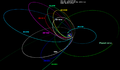
2014 FE72 is a trans-Neptunian object first observed on 26 March 2014, at Cerro Tololo Inter-American Observatory in La Serena, Chile. It is a member of the scattered disc, whose orbit extends into the inner Oort cloud.[1] Discovered by Scott Sheppard and Chad Trujillo, the object's existence was revealed on 29 August 2016.[1][8] Both the orbital period and aphelion distance of this object are well constrained.[2] 2014 FE72 had the largest barycentric aphelion until 2018. However, the heliocentric aphelion of 2014 FE72 is second among trans-Neptunian objects (after the damocloid 2017 MB7). As of 2023[update], it is about 66 AU (9.9 billion km) from the Sun.[7]
Diagram showing the highly eccentric orbit of 2014 FE72 | |
| Discovery[1] | |
|---|---|
| Discovered by | |
| Discovery site | Cerro Tololo Obs. |
| Discovery date | 26 March 2014 |
| Designations | |
| 2014 FE72 | |
| Orbital characteristics[2] | |
| Epoch 21 January 2022 (JD 2459600.5) | |
| Uncertainty parameter 3 | |
| Observation arc | 6.98 yr (2,549 days) |
| Aphelion |
|
| Perihelion |
|
| |
| Eccentricity |
|
| |
| |
| 0° 0m 0.055s / day | |
| Inclination |
|
| |
| ≈ 6 October 1965[4] ±11 days | |
| |
| Physical characteristics | |
| 270 km (est. at 0.08)[5][6] | |
| 24.3[7] | |
| 6.19[2] | |
Orbit
- Orbits of 2014 FE72 (green, at lower left) and other scattered/detached objects, along with hypothetical Planet Nine on the right
- 2014 FE72 is seen at the top here in green, moving away from the Sun
Using the Solar System Barycenter as the orbital frame of reference, 2014 FE72's extremely elongated orbit (eccentricity = 0.98) has a perihelion of 36.1 AU, an aphelion of ~4,050 AU and a barycentric orbital period of ~92,400 years.[3] The latter values are the largest known for any Solar System body that is not a long-period comet.[n 1] Based on the barycentric orbital period, 2014 FE72 takes roughly 5 times longer than Sedna to orbit the Sun.[10]
2014 FE72 last passed through perihelion around late 1965.[2]
See also
Notes
- 2017 MB7, an apparently much smaller object (absolute magnitude ~14) which might be an extinct comet, has a similar barycentric aphelion of ~2,800 AU and an orbital period of ~54,000 years.[9]