Arkose
Type of sandstone containing at least 25% feldspar
From Wikipedia, the free encyclopedia
Arkose (/ˈɑːrkoʊs, -koʊz/) or arkosic sandstone[1] is a detrital sedimentary rock, specifically a type of sandstone containing at least 25% feldspar.[2][3] Arkosic sand is sand that is similarly rich in feldspar, and thus the potential precursor of arkose.
_and_quartz_(gray)_grains.jpg)
| Sedimentary rock | |
Arkose with K-feldspar (pinkish-orangish) and quartz (gray) grains | |
| Composition | |
|---|---|
| >25% feldspar |
Components
Quartz is commonly the dominant mineral component, and some mica is often present. Apart from the mineral content, rock fragments may also be a significant component. Arkose usually contains small amounts of calcite cement, which causes it to effervesce (fizz) slightly in dilute hydrochloric acid; sometimes the cement also contains iron oxide.
Colouration and presence of fossils
Formation process
Arkose is generally formed from the weathering of feldspar-rich igneous or metamorphic, most commonly granitic, rocks, which are primarily composed of quartz and feldspar (called 'grus' as a sand). These sediments must be deposited rapidly and/or in a cold or arid environment such that the feldspar does not undergo significant chemical weathering and decomposition; therefore arkose is designated a texturally immature sedimentary rock. Arkose is often associated with conglomerate deposits sourced from granitic terrain and is often found above unconformities in the immediate vicinity of granite terrains.
Gallery
 Arkosic sand in the Llano Uplift, Texas, with granite outcrops
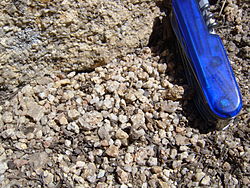 Grus sand and the granitoid it's derived from


Uluru
The central Australian inselberg Uluru (Ayers Rock) is composed of late Neoproterozoic/Cambrian arkose, deposited in the Amadeus Basin.[4]
See also
- Lithic sandstone – Sandstone with fragments of other rocks