Bid–ask matrix
From Wikipedia, the free encyclopedia


Mathematical definition
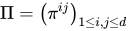
A matrix is a bid-ask matrix, if

![{\displaystyle \Pi =\left[\pi _{ij}\right]_{1\leq i,j\leq d}}](http://wikimedia.org/api/rest_v1/media/math/render/svg/2510a574941c9cd3d5d60a999f4c9e1f88aac21c)
- for . Any trade has a positive exchange rate.
- for . Can always trade 1 unit with itself.
- for . A direct exchange is always at most as expensive as a chain of exchanges.[1]



Example
Assume a market with 2 assets (A and B), such that units of A can be exchanged for 1 unit of B, and units of B can be exchanged for 1 unit of A. Then the bid–ask matrix is:


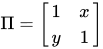
It is required that by rule 3.

With 3 assets, let be the number of units of i traded for 1 unit of j. The bid–ask matrix is:

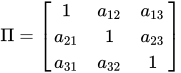
Rule 3 applies the following inequalities:


For higher values of d, note that 3-way trading satisfies Rule 3 as

Relation to solvency cone
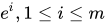
If given a bid–ask matrix for assets such that and is the number of assets which with any non-negative quantity of them can be "discarded" (traditionally ). Then the solvency cone is the convex cone spanned by the unit vectors and the vectors .[1]




Similarly given a (constant) solvency cone it is possible to extract the bid–ask matrix from the bounding vectors.
Notes
- The bid–ask spread for pair is .
- If then that pair is frictionless.
- If a subset then that subset is frictionless.


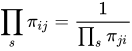
Arbitrage in bid-ask matrices
Arbitrage is where a profit is guaranteed.
If Rule 3 from above is true, then a bid-ask matrix (BAM) is arbitrage-free, otherwise arbitrage is present via buying from a middle vendor and then selling back to source.
Iterative computation
A method to determine if a BAM is arbitrage-free is as follows.
Consider n assets, with a BAM and a portfolio . Then


where the i-th entry of is the value of in terms of asset i.

Then the tensor product defined by
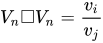
should resemble .