Binade
From Wikipedia, the free encyclopedia

In software engineering and numerical analysis, a binade is a set of numbers in a binary floating-point format that all have the same sign and exponent. In other words, a binade is the interval or for some integer value , that is, the set of real numbers or floating-point numbers of the same sign such that .[1][2][3]

![{\displaystyle (-2^{e+1},-2^{e}]}](https://wikimedia.org/api/rest_v1/media/math/render/svg/2dab604433186c72682d254fb566597ee2ebfc6b)


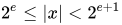
Some authors use the convention of the closed interval instead of a half-open interval,[4] sometimes using both conventions in a single paper.[5] Some authors additionally treat each of various special quantities such as NaN, infinities, and zeroes as its own binade,[6] or similarly for the exceptional interval of subnormal numbers.[7]
![{\displaystyle [2^{e},2^{e+1}]}](https://wikimedia.org/api/rest_v1/media/math/render/svg/5f97150e6e73a3df500fee39d0e65fbfb0374102)
