Jin (mass)
Traditional Chinese unit of weight
From Wikipedia, the free encyclopedia
The jin (Chinese: 斤; pinyin: jīn)[a] or catty (from Malay kati) is a traditional Chinese unit of mass used across East and Southeast Asia, notably for weighing food and other groceries.[1][2] Related units include the picul (dan or shi), equal to 100 catties, and the tael (liang), which is 1⁄16 of a catty. The stone (also dan or shi) is a former unit used in Hong Kong equal to 120 catties, and a gwan (鈞) is 30 jin. The catty is still used in Southeast Asia as a unit of measurement in some contexts, especially by the significant Overseas Chinese populations across the region, particularly in Malaysia and Singapore.
| Catty | |
|---|---|
| Unit system | Chinese |
| Unit of | Mass |
| Symbol | 斤 |
| Conversions | |
| 1 斤 in ... | ... is equal to ... |
| Mainland China | 0.5 kg |
| Japan, Korea, Taiwan, Thailand | 0.6 kg |
| Vietnam | 0.6045 kg |
| Hong Kong | 0.60478982 kg |
| Malaysia | 0.60479 kg |
| Singapore | 0.6048 kg |
| Conversions (imperial) | |
| 1 imp 斤 in ... | ... is equal to ... |
| Hong Kong, Malaysia, Singapore | 1+1/3 lb |
| Jin | |||||||||||||||||||
|---|---|---|---|---|---|---|---|---|---|---|---|---|---|---|---|---|---|---|---|
| Chinese name | |||||||||||||||||||
| Chinese | 斤 | ||||||||||||||||||
| |||||||||||||||||||
| Vietnamese name | |||||||||||||||||||
| Vietnamese | cân | ||||||||||||||||||
| Korean name | |||||||||||||||||||
| Hangul | 근 | ||||||||||||||||||
| Hanja | 斤 | ||||||||||||||||||
| |||||||||||||||||||
| Japanese name | |||||||||||||||||||
| Kanji | 斤 | ||||||||||||||||||
| Hiragana | きん | ||||||||||||||||||
| |||||||||||||||||||
| Malay name | |||||||||||||||||||
| Malay | kati | ||||||||||||||||||
| Manchu name | |||||||||||||||||||
| Manchu script | ᡤᡳᠩᡤᡝᠨ | ||||||||||||||||||
| Möllendorff | ginggen | ||||||||||||||||||
The catty is traditionally equivalent to 1+1⁄3 pound avoirdupois, formalised as 604.78982 grams (g) in Hong Kong,[3] 604.5 g (historically) in Vietnam,[4] 604.79 g in Malaysia[5] and 604.8 g in Singapore.[6] In Taiwan,[7] Japan, Korea,[8] and Thailand, the unit is rounded to 600 g. In China, the jin is rounded to 500 g and called the market jin (市斤; shìjīn), to distinguish it from the kilogram (called the common jin; 公斤; gōngjīn), and is subdivided into 10 taels rather than 16.[9]
History
In ancient China, the office of Sima (司馬) was in charge of military affairs. Because the management of military grain and fodder involved frequent weighing, mass units (such as jin and liang) were also called sima jin (司馬斤), sima liang, and so on. The measuring tools used were called sima scales (司馬秤). This is still true in Hong Kong. One sima jin is equal to sixteen sima liang, which is where the idiom "half a jin vs eight liang"[b][10][better source needed] comes from.[11][12]
| Dynasty | Mass in grams |
|---|---|
| Pre-Qin[13] | 250 |
| Qin | 253 |
| Western Han | 248 |
| Eastern Han, Three Kingdoms, Jin | 220 |
| Northern and Southern dynasties |
|
| Sui dynasty | 661 (large system), 220 (small system) |
| Tang dynasty | 661 |
| Song dynasty, Yuan dynasty | 633 |
| Ming dynasty, Qing dynasty | 590 |
The mass of the jin varies between different eras and regions, but its ratio to contemporaneous units is generally unchanged: one jin is equal to sixteen liang, or 1/120 of a dan. Starting from the late Qing dynasty, the jin was also written in English as catty or kan based on the Malay name for the unit.[14]
Before the Qing dynasty, various regions and industries in China had their own weight standards for jin and liang. During the Qing, unified weights and measures were implemented. One late-Qing jin was 596.816 g according to the Beiyang government, and equal to 16 liang.[15]
China
1915 measurement law
On 7 January 1915, the Beiyang government promulgated a measurement law to use the metric system as the standard but also a system based directly on Qing definitions (营造尺库平制),[15][16] with the liang as the base unit.
| Pinyin | Character | Relative value | Metric value | Imperial value | Notes |
|---|---|---|---|---|---|
| háo | 毫 | 1⁄10000 | 3.7301 mg | 0.0001316 oz | |
| lí | 釐 | 1⁄1000 | 37.301 mg | 0.001316 oz | cash |
| fēn | 分 | 1⁄100 | 373.01 mg | 0.01316 oz | candareen |
| qián | 錢 | 1⁄10 | 3.7301 g | 0.1316 oz | mace or Chinese dram |
| liǎng | 兩 | 1 | 37.301 g | 1.316 oz | tael or Chinese ounce |
| jīn | 斤 | 16 | 596.816 g | 1.316 lb | catty or Chinese pound |
Mass units in the Republic of China (1930–1959)
| Market-unit system | |||||||||
|---|---|---|---|---|---|---|---|---|---|
 A traditional Chinese scale | |||||||||
| Chinese | 市制 | ||||||||
| Literal meaning | market system | ||||||||
| |||||||||
| Alternative Chinese name | |||||||||
| Chinese | 市用制 | ||||||||
| Literal meaning | market-use system | ||||||||
| |||||||||
On 16 February 1929, the Nationalist government adopted and promulgated The Weights and Measures Act[17] to adopt the metric system and limit the updated Chinese units of measurement to private sales and trade, effective 1 January 1930. The updated market units are based on rounded metric numbers, and jin is the base unit.[18]
| Pinyin | Character | Relative value | Metric value | Imperial value | Notes |
|---|---|---|---|---|---|
| sī | 絲 | 1⁄1600000 | 312.5 μg | 0.00001102 oz | |
| háo | 毫 | 1⁄160000 | 3.125 mg | 0.0001102 oz | |
| lí | 市釐 | 1⁄16000 | 31.25 mg | 0.001102 oz | cash |
| fēn | 市分 | 1⁄1600 | 312.5 mg | 0.01102 oz | candareen |
| qián | 市錢 | 1⁄160 | 3.125 g | 0.1102 oz | mace or Chinese dram |
| liǎng | 市兩 | 1⁄16 | 31.25 g | 1.102 oz | tael or Chinese ounce |
| jīn | 市斤 | 1 | 500 g | 1.102 lb | catty or Chinese pound |
| dàn | 擔 | 100 | 50 kg | 110.2 lb | picul or Chinese hundredweight |
Mass units since 1959
On June 25, 1959, the State Council of the People's Republic of China issued the Order on the Unified Measurement System, retaining the market system, with the statement of "the market system originally stated that sixteen liang is equal to one jin. Due to the trouble of conversion, it should be changed to ten liang per jin."[19][20]
| Pinyin | Hanzi | Relative value | Metric value | Imperial value | Notes |
|---|---|---|---|---|---|
| lí | 市厘 | 1⁄10000 | 50 mg | 0.001764 oz | cash |
| fēn | 市分 | 1⁄1000 | 500 mg | 0.01764 oz | candareen |
| qián | 市錢 | 1⁄100 | 5 g | 0.1764 oz | mace or Chinese dram |
| liǎng | 市兩 | 1⁄10 | 50 g | 1.764 oz | tael or Chinese ounce |
| jīn | 市斤 | 1 | 500 g | 1.102 lb | catty or Chinese pound |
| dàn | 市擔 | 100 | 50 kg | 110.2 lb | picul or Chinese hundredweight |
Legally, 1 jin equals 500 grams, and 10 liang equals 1 jin (that is, 1 liang is 50 g). The traditional Chinese medicine measurement system was unchanged.[19][20]
Mass units in traditional Chinese medicine
Until 1979, traditional Chinese medicine (TCM) generally kept the division of 16 liang to 1 (500-g) jin. In 1979, the State Council of China issued an order for the TCM trade to switch to metric units. The previously used qian was to be treated as exactly 3 g, with other units derived from the liang scaled accordingly.[21] Mass units in ancient TCM prescriptions should be interpreted using the metric (gram) conversions appropriate for the era, not the modern versions of these units.[22]
Taiwan

The jin, or kin, in Taiwan is called the Taiwan jin or taijin (台斤). The taijin is equivalent to the Qing-era Chinese jin. In 1895 Taiwan was ceded to Japan, which implemented the metric system, but Taiwan continued to use the old weights and measures. Thus, after China stopped using the Qing system, it came to be known as the Taiwan system. 1 taijin is 600 grams, or 16 Taiwan liang, and 1 Taiwan liang is equal to 37.5 g.[23]
| Unit | Relative value | Metric | US & Imperial | Notes | |||||
|---|---|---|---|---|---|---|---|---|---|
| Taiwanese Hokkien | Hakka | Mandarin | Character | Legal | Decimal | Exact | Approx. | ||
| Lî | Lî | Lí | 釐 | 1⁄1000 | 3/80,000 kg | 37.5 mg | 3750/45,359,237 lb | 0.5787 gr | Cash; same as Japanese rin |
| Hun | Fûn | Fēn | 分 | 1⁄100 | 3/8000 kg | 375 mg | 37,500/45,359,237 lb | 5.787 gr | Candareen; same as Japanese fun |
| Chîⁿ | Chhièn | Qián | 錢 | 1⁄10 | 3/800 kg | 3.75 g | 375,000/45,359,237 lb | 2.116 dr | Mace; same as Japanese momme (匁) |
| Niú | Liông | Liǎng | 兩 | 1 | 3/80 kg | 37.5 g | 3,750,000/45,359,237 lb | 21.16 dr | Tael |
| Kin or chin | Kîn | Jīn | 斤 | 16 | 3/5 kg | 600 g | 60,000,000/45,359,237 lb | 1.323 lb | Catty; same as Japanese kin |
| Tàⁿ | Tâm | Dàn | 擔 | 1600 | 60 kg | 6,000,000,000/45,359,237 lb | 132.3 lb | Picul; same as Japanese tan | |
Hong Kong and Macau
Hong Kong and Macau mass units
According to the original Hong Kong law, Article 22 of 1884, one jīn is 1+1⁄3 British pounds (that is, 3 jīn is equal to 4 pounds). Currently,[when?] Hong Kong law stipulates that one jīn is equal to one hundredth of a dan or sixteen liang, which is 0.604 789 82 kilograms[3] (0.604 789 82 kg divided by 4⁄3 is 0.453 592 65 kg, the 1878 definition of the British Avoirdupois pound).
| Jyutping | Character | English | Portuguese | Relative value | Relation to next largest Chinese unit (Macau) | Metric value | Imperial value | Notes |
|---|---|---|---|---|---|---|---|---|
| lei4 | 厘 | li, cash | liz | 1⁄16000 | 1⁄10 condorim | 37.79931 mg | 0.02133 dr | |
| fan1 | 分 | fen, candareen (fan) | condorim | 1⁄1600 | 1⁄10 maz | 377.9936375 mg | 0.2133 dr | |
| cin4 | 錢 | qian, mace (tsin) | maz | 1⁄160 | 1⁄10 tael | 3.779936375 g | 2.1333 dr | |
| loeng2 | 兩 | liang, leung, tael | tael | 1⁄16 | 1⁄16 cate | 37.79936375 g | 1.3333 oz | 604.78982 / 16 = 37.79936375 |
| gan1 | 斤 | jin, kan, catty | cate | 1 | 1⁄100 pico | 604.78982 g | 1.3333 lb | Hong Kong and Macau share the definition |
| daam3 | 擔 | dan, tam, picul | pico | 100 | None | 60.478982 kg | 133.3333 lb | Hong Kong and Macau share the definition |
Hong Kong troy units
These are used for trading precious metals such as gold and silver, defined around the British troy weight system.
| English name | Chinese name | Relative value | Metric value | Imperial value | Notes |
|---|---|---|---|---|---|
| fen (candareen) troy | 金衡分 | 1⁄100 | 374.29 mg | 0.096 drt | |
| qian (mace) troy | 金衡錢 | 1⁄10 | 3.7429 g | 0.96 drt | |
| liang (tael) troy | 金衡兩 | 1 | 37.429 g | 1.2 ozt |
Malaysia and Singapore
Japan
| Unit | Kanji | Metric | US & Imperial | |||||||||
|---|---|---|---|---|---|---|---|---|---|---|---|---|
| Romanised | Kanji | Legal | Decimal | Exact | Approx. | |||||||
| Mō | 毛 or 毫 | 1⁄1,000,000 | 3/800,000 kg | 3.75 mg | 375/45,359,237 lb | 8.267 μlb | ||||||
| Rin | 厘 | 1⁄100,000 | 3/80,000 kg | 37.5 mg | 3750/45,359,237 lb | 0.5787 gr | ||||||
| Fun | 分 | 1⁄10,000 | 3/8000 kg | 375 mg | 37,500/45,359,237 lb | 5.787 gr | ||||||
| Momme Monme |
匁 | 1⁄1000 | 3/800 kg | 3.75 g | 375,000/45,359,237 lb | 2.116 dr | ||||||
| Hyakume | 百目 | 1⁄10 | 3/8 kg | 375 g | 37,500,000/45,359,237 lb | 13.23 oz | ||||||
| Kin | 斤 | 4⁄25 | 3/5 kg | 600 g | 60,000,000/45,359,237 lb | 1.323 lb | ||||||
| Kan(me) | 貫(目) | 1 | 15/4 kg | 3.75 kg | 375,000,000/45,359,237 lb | 8.267 lb | ||||||
| Maru | 丸 | 8 | 30 kg | 3,000,000,000/45,359,237 lb | 66.14 lb | |||||||
| Tan | 担 or 擔 | 16 | 60 kg | 6,000,000,000/45,359,237 lb | 132.3 lb | |||||||
Notes:
| ||||||||||||
In Japan, 1 jin, or kin in Japanese, is equal to 600 grams, but is rarely used. An exception is the jin used for slices of bread. According to the fair competition regulations of the Japanese Bread Fair Trade Council, a jin only needs to be more than 340 g.[28]
Korea
The base unit of Korean mass is the gwan.[29] At the time of Korea's metrication, however, the geun (or Korean pound) was in more common use. The gwan is usually considered equivalent to 600 g.[30] The nyang also sees some use among Korean traditional Chinese medicine vendors.[31]
| Korean romanization | Korean | English | Equivalents | ||||
|---|---|---|---|---|---|---|---|
| RR | MR | Other | Gwan[32] | Other names | Metric (customary) | ||
| Ho | Ho | 호(毫) | 1⁄1,000,000 | 3.75 mg (0.0579 gr) | |||
| Mo | Mo | 모(毛) | |||||
| Ri | Ri | 리(釐/厘) | 1⁄100,000 | 0.0375 g (0.00132 oz) | |||
| Pun | P'un | 푼 | 1⁄10,000 | 0.375 g (0.0132 oz) | |||
| Bun | Pun | 분(分) | |||||
| Don[33] | Ton | 돈 | 1⁄1,000 | Momme[32] | 3.75 g (0.132 oz)[32] | ||
| Nyang | Nyang | Ryang[34] Yang[32] | 냥(兩) | Korean ounce | 1⁄100 | Tael | 37.5 g (1.32 oz)[32] |
| Geun | Kŭn | Keun[32] Kon[35] | 근(斤) | Korean pound | 4⁄25 (meat),
1⁄10 (other) |
Jin, catty[35] | 600 g (21 oz) (meat),[32][36] 375 g (13.2 oz) (other) |
| Gwan | Kwan | 관(貫) | 1 | 3.75 kg (8.3 lb)[32][36] | |||
Vietnam
In Vietnam, the jin is called the cân ta (lit. 'our scale'), and is equal to 604.6 grams. The following table lists common units of mass in Vietnam in the early 20th century:[37]
| Name in Chữ Quốc ngữ | Hán/Nôm name | Traditional value in kg | Traditional equivalent | Modern value | Modern equivalent |
|---|---|---|---|---|---|
| tấn | 擯 | 604.5 kg | 10 tạ | 1,000 kg | 10 tạ |
| quân[38] | 302.25 kg | 5 tạ | 500 kg | obsolete | |
| tạ | 榭 | 60.45 kg | 10 yến | 100 kg | 10 yến |
| bình[38] | 30.225 kg | 5 yến | 50 kg | obsolete | |
| yến | 6.045 kg | 10 cân | 10 kg | 10 cân | |
| cân | 斤 | 604.5 g | 16 lạng | 1 kg | 10 lạng |
| nén | 378 g | 10 lạng | |||
| lạng | 兩 | 37.8 g | 10 đồng | 100 g | |
| đồng or tiền | 錢 | 3.78 g | 10 phân | ||
| phân | 分 | 0.38 g | 10 ly | ||
| ly or li | 厘 | 37.8 mg | 10 hào | ||
| hào | 毫 | 3.8 mg | 10 ti | ||
| ti | 絲 | 0.4 mg | 10 hốt | ||
| hốt | 忽 | 0.04 mg | 10 vi | ||
| vi | 微 | 0.004 mg |
Notes:
Jin, pound and kilogram
The jin, pound and kilogram are all currently used in China. Their meanings and conversions in China are as follows:[40]
- 市斤 (Chinese jin; lit. 'market jin'): Or simply called jin, also called Chinese pound. In the market system (市制) in use since 1930, 1 jin equals 500 g, equivalent to 1.1023 pounds.[40]
- 公斤 (kilogram, lit. 'common jin'): A metric unit, equivalent to 1000 g.[40]
- 磅 (pound): A British Imperial unit, about 453.6 g.
Society and culture
Gallery
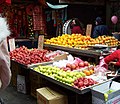 Fruit sold in catties in a market in Sanchong, New Taipei, Taiwan
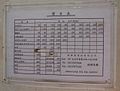 Tea priced by the catty in Dadaocheng, Taipei, Taiwan
 A spring scale in Hong Kong with conversions between the metric system (red), traditional Chinese units (green) and Imperial units (in blue)

