Constrained equal losses
From Wikipedia, the free encyclopedia
Constrained equal losses (CEL) is a division rule for solving bankruptcy problems. According to this rule, each claimant should lose an equal amount from his or her claim, except that no claimant should receive a negative amount. In the context of taxation, it is known as poll tax.[1]
There is a certain amount of money to divide, denoted by (=Estate or Endowment). There are n claimants. Each claimant i has a claim denoted by . Usually, , that is, the estate is insufficient to satisfy all the claims.


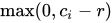
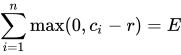
The CEL rule says that each claimant i should receive , where r is a constant chosen such that . The rule can also be described algorithmically as follows:
- Initially, all agents are active, and each agent gets his full claim.
- While the total allocation is larger than the estate:
- Remove one unit equally from all active agents.
- Each agent whose total allocation drops to zero becomes inactive.
Examples
Examples with two claimants:
- ; here .
- ; here too.
- ; here .





Examples with three claimants:
- ; here .
- ; here .
- ; here .






Usage
Characterizations
The CEL rule has several characterizations. It is the only rule satisfying the following sets of axioms:
- Equal treatment of equals, minimal rights first, and composition down;[4]
- Conditional null compensation, and composition up;[5]
- Conditional null compensation, and the dual of claims-monotonicity.[6]

