Convolvulus
Genus of flowering plants
From Wikipedia, the free encyclopedia
Convolvulus is a genus of about 200[1] to 250[2][3] species of flowering plants in the bindweed family Convolvulaceae,[4] with a cosmopolitan distribution; the Plants of the World Online database currently accepts 227 species and 12 natural hybrids.[5] Common names include bindweed and morning glory; both are names shared with other closely related genera.

| Convolvulus | |
|---|---|
| |
| Convolvulus arvensis | |
Scientific classification  | |
| Kingdom: | Plantae |
| Clade: | Embryophytes |
| Clade: | Tracheophytes |
| Clade: | Spermatophytes |
| Clade: | Angiosperms |
| Clade: | Eudicots |
| Clade: | Asterids |
| Order: | Solanales |
| Family: | Convolvulaceae |
| Tribe: | Convolvuleae |
| Genus: | Convolvulus L. |
| Type species | |
| Convolvulus arvensis L. | |
| Species | |
Taxonomy
The genus Calystegia, until recently widely accepted, has been shown to be genetically embedded within Convolvulus,[6] and is now treated as a synonym of it by the Plants of the World Online database.[5]
Description
They are annual or perennial herbaceous vines; a few species are woody shrubs. They grow to heights of 0.3–4 m scrambling through ground vegetation, shrubs and trees; the shrubby species (e.g. C. cneorum) growing to 0.5 m tall with a woody base. The leaves are spirally arranged, and the flowers trumpet-shaped, mostly white or pink, but blue, violet, purple, or yellow in some species.[7]
Ecology

Many of the species are invasive weeds; but others are cultivated for their attractive flowers, while some are globally threatened.[citation needed]
Convolvulus species are used as food plants by the larvae of some Lepidoptera species, including the convolvulus hawk moth, the sweet potato leaf miner (Bedellia somnulentella) and the gem; the leaf miner Bucculatrix cantabricella feeds exclusively on C. cantabricus.[citation needed]
Gallery
 Convolvulus dorycnium
 Cultivated Convolvulus tricolor

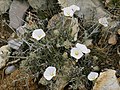 Convolvulus cneorum in Catalonia, Spain
 Convolvulus cephalopodus in Behbahan
 Seed under a microscope


.jpg)
.jpg)

