Cremona group
From Wikipedia, the free encyclopedia
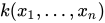
In birational geometry, the Cremona group, named after Luigi Cremona, is the group of birational automorphisms of the -dimensional projective space over a field , also known as Cremona transformations. It is denoted by , or .


Historical origins
The Cremona group was introduced by the Italian mathematician Luigi Cremona (1863, 1865).[1] In retrospect, the British mathematician Isaac Newton is considered a founder of "the theory of Cremona transformations", having developed his "organic construction" to perform birational maps of the projective plane and applied them to resolve curve singularities, nearly two centuries before Cremona.[2][3] The mathematician Hilda Phoebe Hudson made contributions in the 1900s as well.[4]
Basic properties
The Cremona group is naturally identified with the automorphism group of the field of the rational functions in indeterminates over . Here, the field is a pure transcendental extension of , with transcendence degree .

The projective general linear group is contained in . The two are equal only when or , in which case both the numerator and the denominator of a transformation must be linear.[5]


A longlasting question from Federigo Enriques concerns the simplicity of the Cremona group. It has been now mostly answered.[6]
The Cremona group in 2 dimensions
In two dimensions, Max Noether and Guido Castelnuovo showed that the complex Cremona group is generated by the standard quadratic transformation , along with , though there was some controversy about whether their proofs were correct. Gizatullin (1983) gave a complete set of relations for these generators. The structure of this group is still not well understood, though there has been a lot of work on finding elements or subgroups of it.
![{\displaystyle [x:y:z]\mapsto [yz:zx:xy]}](http://wikimedia.org/api/rest_v1/media/math/render/svg/e5cdf5cfc4217241ec1062e3e0389fc060cc625e)

- Cantat & Lamy (2010) showed that for an algebraically closed field , the group is not simple.
- Blanc (2010) showed that it is topologically simple for the Zariski topology.[a]
- For the finite subgroups of the Cremona group see Dolgachev & Iskovskikh (2009).
- Zimmermann (2018) computed the abelianization of . From this, she deduces that there is no analogue of Noether–Castelnuovo theorem in this context.[6]


Geiser and Bertini involutions
The Geiser involution and Bertini involution are two of the classical non-linear involutions of the plane Cremona group.[7][8] They arise from Del Pezzo surfaces of degree 2 and degree 1, respectively.
A Geiser involution is obtained by blowing up seven points of in general position, producing a Del Pezzo surface of degree 2. The anticanonical linear system defines a double cover branched over a smooth plane quartic, and the deck transformation is the Geiser involution.[9][8] Via the blow-down , this becomes a birational involution of the plane. Classically, if are the seven base points, then a general point is sent to the ninth base point of the pencil of cubic curves through .[7][8] The resulting Cremona transformation has degree 8.[8]


Similarly, blowing up eight points of in general position produces a Del Pezzo surface of degree 1. The linear system defines a double cover of a quadric cone in , and its deck transformation is the Bertini involution.[9][8] In classical plane terms, if are the base points, then for a general point one considers the net of sextics through that are singular at ; the Bertini involution sends to the fixed point of this net.[7] Its degree is 17.[8]


Over an algebraically closed field of characteristic different from 2, Bayle and Beauville's modern proof of the classical theorem on birational involutions of the plane shows that every non-trivial involution in is conjugate to exactly one of three types: a de Jonquières involution, a Geiser involution, or a Bertini involution.[7] The normalized fixed curve of a Geiser involution is a non-hyperelliptic curve of genus 3, while that of a Bertini involution is a non-hyperelliptic curve of genus 4 whose canonical model lies on a singular quadric.[7] Consequently, conjugacy classes of Geiser involutions are parametrized by isomorphism classes of non-hyperelliptic genus-3 curves, and conjugacy classes of Bertini involutions by isomorphism classes of non-hyperelliptic genus-4 curves whose canonical model lies on a singular quadric.[7]

The Cremona group in higher dimensions
There is little known about the structure of the Cremona group in three dimensions and higher though many elements of it have been described.
There is no easy analogue of the Noether–Castelnouvo theorem, as Hudson (1927) showed that the Cremona group in dimension at least 3 is not generated by its elements of degree bounded by any fixed integer.
Blanc (2010) showed that it is (linearly) connected, answering a question of Serre (2010). Later, Blanc & Zimmermann (2018) showed that for any infinite field , the group is topologically simple[a] for the Zariski topology, and even for the euclidean topology when is a local field.
Blanc, Lamy & Zimmermann (2021) proved that when is a subfield of the complex numbers and , then is not a simple group.

De Jonquières groups
A De Jonquières group is a subgroup of a Cremona group of the following form.[10] Pick a transcendence basis for a field extension of . Then a De Jonquières group is the subgroup of automorphisms of mapping the subfield into itself for some . It has a normal subgroup given by the Cremona group of automorphisms of over the field , and the quotient group is the Cremona group of over the field . It can also be regarded as the group of birational automorphisms of the fiber bundle .


When and the De Jonquières group is the group of Cremona transformations fixing a pencil of lines through a given point, and is the semidirect product of and .


