Squamanitaceae
Family of fungi
From Wikipedia, the free encyclopedia
The Squamanitaceae are a family of fungi in the order Agaricales. All species in the family are agarics (gilled mushrooms). Species in two genera, Dissoderma and Squamanita, are parasitic on other agarics. Members of the Squamanitaceae are found worldwide.

| Squamanitaceae | |
|---|---|
| |
| Dissoderma odoratum | |
Scientific classification  | |
| Kingdom: | Fungi |
| Division: | Basidiomycota |
| Class: | Agaricomycetes |
| Order: | Agaricales |
| Family: | Squamanitaceae Jülich (1981) |
| Type genus | |
| Squamanita Imbach (1946) | |
| Genera | |
|
Cystoderma | |
| Synonyms | |
| |
Taxonomy
The family was first proposed in 1981 by Dutch mycologist Walter Jülich. Its current circumscription is the result of molecular research, based on cladistic analysis of DNA sequences.[1][2]
Gallery
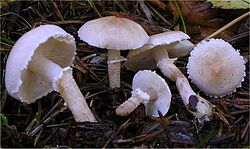


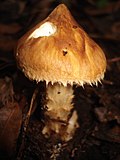 Squamanita umbonata

_O.K._Mill.,_T.J._Volk_&_Bessette_823455.jpg)


