Dedekind sum
From Wikipedia, the free encyclopedia
In mathematics, Dedekind sums are certain finite sums of products of a sawtooth function. Dedekind introduced them in the 1880's to express the functional equation of the Dedekind eta function, in a commentary to Bernhard Riemann's collected papers.[1]. They have subsequently been much studied in number theory but also occur in some results in topology,[2] geometric combinatorics,[3] algebraic geometry,[4] and computational complexity.[5] Dedekind sums have been generalized in various directions, satisfying a large number of functional equations; this article lists only a small fraction of these.
Definition
Define the sawtooth function as


We then define the Dedekind sum

by

For the case a = 1, one often writes
- s(b, c) = D(1, b; c).
Simple formulae
Note that D is symmetric in a and b, i.e.,

and that, by the oddness of (( )),
- D(−a, b; c) = −D(a, b; c).
By the periodicity of D in its first two arguments, the third argument being the length of the period for both,
- D(a, b; c) = D(a+kc, b+lc; c), for all integers k,l.
If d is a positive integer, then
- D(ad, bd; cd) = dD(a, b; c),
- D(ad, bd; c) = D(a, b; c), if (d, c) = 1,
- D(ad, b; cd) = D(a, b; c), if (d, b) = 1.
There is a proof for the last equality making use of
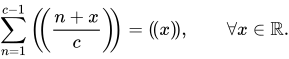
Furthermore, az = 1 (mod c) implies D(a, b; c) = D(1, bz; c).
Alternative forms
If b and c are coprime, we may write s(b, c) as

where the sum extends over the c-th roots of unity other than 1, i.e., over all such that and .[6]


Equivalently, if b and c are coprime, then

This reformulation mirrors the fact that the above cotangent function is the discrete Fourier transform of the sawtooth function.[6]
The reciprocity law
Dedekind[1] proved that, if b and c are coprime positive integers then

There exist several proofs from first principles, and Dedekind's reciprocity law is equivalent to quadratic reciprocity.[7]
Rewriting the reciprocity law as

it follows that the number 6c s(b,c) is an integer.
If k = (3, c) then

and

A relation that is prominent in the theory of the Dedekind eta function is the following. Let q = 3, 5, 7 or 13 and let n = 24/(q − 1). Then given integers a, b, c, d with ad − bc = 1 (thus belonging to the modular group), with c chosen so that c = kq for some integer k > 0, define

Then is an even integer.

Rademacher's generalization of the reciprocity law
Hans Rademacher found the following generalization of the reciprocity law for Dedekind sums:[8] If a, b, and c are pairwise coprime positive integers, then

Hence, the above triple sum vanishes if and only if (a, b, c) is a Markov triple, i.e., a solution of the Markov equation
