
Departments of Colombia
National subdivisions in Colombia
From Wikipedia, the free encyclopedia
Colombia is a unitary republic made up of thirty-two administrative divisions referred to as departments (Spanish: departamentos, sing. departamento) and one Capital District (Distrito Capital).[1] Departments are country subdivisions and are granted a certain degree of autonomy. Each department has a governor (gobernador) and an Assembly (Asamblea Departamental), elected by popular vote for a four-year period. The governor cannot be re-elected in consecutive periods.
.svg)
1 Capital District
| Capital district and Colombian regions Distrito Capital y los Departamentos de Colombia (Spanish) | |
|---|---|
 | |
| Category | Unitary state |
| Location | Republic of Colombia |
| Number | 32 Departments 1 Capital District |
| Populations | 48,932 (Vaupés) – 8,906,342 (Capital District) |
| Areas | 50 km2 (19.3 sq mi) (San Andrés) – 109,665.0 km2 (42,341.89 sq mi) (Amazonas) |
| Government |
|
| Subdivisions | |
Departments are formed by a grouping of municipalities (municipios, sing. municipio). Municipal government is headed by mayor (alcalde) and administered by a municipal council (concejo municipal), both of which are elected by popular vote for four-year periods.
Internal subdivisions within departments
The current borders and number of the departments of Colombia was finally set after the 1991 Colombian Constitution came into effect. Before that, the number of departments went from the original nine federal states of the United States of Colombia who ratified the Constitution of 1863 (Antioquia, Bolívar, Boyacá, Cauca, Cundinamarca, Magdalena, Panamá, Santander and Tolima) to the current 32 departments that exist in the present-day Republic of Colombia.
All departments of Colombia are further subdivided into various municipalities, which represent smaller areas of the department and are often, but not always, coterminous with the urban and rural limits of a given city or town. Some municipalities might also include smaller towns or hamlets (known as corregimientos in Spanish), within the borders of the wider municipality. The rural subdivisions of municipalities are known in Spanish as veredas.
Most departments also group various municipalities into regions which are larger than a municipality and are usually known as either provinces or subregions. These subdivisions work as an intermediate level subnational regions between a department and a municipality. However, this provinces or subregions do not feature in the 1991 Colombian Constitution and are thus defined instead by the departmental governments and assemblies.
List of current departments
| ID | Map | Region | Capital | Area (km2) | Population (December 2022)[2] | Density per km2 |
Established as a department | Flag | Code | Governor (2024–2027)[3] | Party or Coalition[3] |
|---|---|---|---|---|---|---|---|---|---|---|---|
| 00 | | Capital District | Bogotá | 1,587 | 8,906,342 | 4670.80 | 1861 |  | DC | Carlos Fernando Galán | New Liberalism |
| 01 | .svg) | Amazonas | Leticia | 109,665 | 82,068 | 0.7 | 1991 | .svg) | AM | Óscar Enrique Sánchez Guerrero | Historic Pact for Colombia |
| 02 | .svg) | Antioquia | Medellín | 63,612 | 6,887,306 | 100.72 | 1886 |  | AN | Andrés Julián Rendón Cardona | Por Antioquia Firme |
| 03 | .svg) | Arauca | Arauca | 23,818 | 304,978 | 11.01 | 1991 |  | AR | Manuel Alexander Pérez Rueda | Democratic Center |
| 04 | .svg) | Atlántico | Barranquilla | 3,388 | 2,804,025 | 748.38 | 1910 |  | AT | Eduardo Verano de la Rosa | Colombian Liberal Party |
| 05 | .svg) | Bolívar | Cartagena | 25,978 | 2,236,603 | 79.69 | 1886 | .svg) | BL | Yamil Hernando Arana Padaui | Bolivar Mejor |
| 06 | .svg) | Boyacá | Tunja | 23,189 | 1,259,601 | 52.50 | 1824 |  | BY | Carlos Amaya | Boyacá Grande |
| 07 | .svg) | Caldas | Manizales | 7,888 | 1,036,455 | 126.55 | 1905 |  | CL | Henry Gutiérrez Angel | Por El Caldas Que Quiere La Gente |
| 08 | .svg) | Caquetá | Florencia | 88,965 | 419,275 | 4.52 | 1981 |  | CQ | Luis Francisco Ruiz Aguilar | Coalición Revive Caqueta |
| 09 | .svg) | Casanare | Yopal | 44,640 | 442,068 | 9.42 | 1991 |  | CS | César Augusto Ortiz Zorro | Coalición Por Casanare |
| 10 | .svg) | Cauca | Popayán | 29,308 | 1,516,018 | 49.97 | 1824 |  | CA | Jorge Octavio Guzmán Gutiérrez | La Fuerza Del Pueblo |
| 11 | .svg) | Cesar | Valledupar | 22,905 | 1,341,697 | 52.42 | 1967 |  | CE | Elvia Milena Sanjuán Dávila | El Cesar En Marcha |
| 12 | .svg) | Chocó | Quibdó | 46,530 | 553,519 | 11.49 | 1947 |  | CH | Nubia Carolina Córdoba Curi | Colombian Liberal Party |
| 13 | .svg) | Córdoba | Montería | 25,020 | 1,856,496 | 71.33 | 1951 |  | CO | Erasmo Elías Zuleta Bechara | Cordoba Pr1mero |
| 14 | .svg) | Cundinamarca | Bogotá | 24,210 | 2,473,634 | 120.57 | 1819 |  | CU | Jorge Emilio Rey Ángel | Caminando, Escuchando, Gobernando |
| 15 | .svg) | Guainía | Inírida | 72,238 | 52,061 | 0.67 | 1991 |  | GN | Arnulfo Rivera Naranjo | Coalición Trabajemos Guainía |
| 16 | .svg) | Guaviare | San José del Guaviare | 53,460 | 90,357 | 1.55 | 1991 |  | GV | Yeison Ferney Rojas Martínez | Guaviare Seguimos Avanzando |
| 17 | .svg) | Huila | Neiva | 19,890 | 1,140,932 | 55.32 | 1910 |  | HU | Rodrigo Villaba Mosquera | Por Un Huila Grande |
| 18 | .svg) | La Guajira | Riohacha | 20,848 | 1,002,394 | 42.24 | 1965 |  | LG | Jairo Alfonso Aguilar Deluque | Union Party for the People, Radical Change, Independent Social Alliance, La Fuerza de la Paz and Partido Demócrata |
| 19 | .svg) | Magdalena | Santa Marta | 23,188 | 1,463,427 | 57.86 | 1824 |  | MA | Rafael Alejandro Martínez | Fuerza Ciudadana |
| 20 | .svg) | Meta | Villavicencio | 82,805 | 1,080,706 | 12.14 | 1959 |  | ME | Rafaela Cortés Zambrano | Coalición Fe y Firmeza |
| 21 | .svg) | Nariño | Pasto | 33,268 | 1,629,181 | 49.01 | 1910 |  | NA | Luis Alfonso Escobar Jaramillo | Historic Pact for Colombia |
| 22 | .svg) | Norte de Santander | Cúcuta | 21,658 | 1,651,278 | 68.87 | 1910 |  | NS | William Villamizar Laguado | Coalición Por Amor A Nuestra Gente Del Norte |
| 23 | .svg) | Putumayo | Mocoa | 24,885 | 369,064 | 13.99 | 1991 |  | PU | Carlos Andrés Marroquín Luna | Coalición Somos La Fuerza De La Gente |
| 24 | .svg) | Quindío | Armenia | 1,845 | 569,569 | 292.63 | 1966 |  | QD | Juan Miguel Galvis Bedoya | Creemos Colombia |
| 25 | .svg) | Risaralda | Pereira | 4,140 | 977,829 | 227.87 | 1966 |  | RI | Juan Diego Patiño Ochoa | Colombian Liberal Party |
| 26 |  | San Andrés y Providencia | San Andrés | 52 | 65,228 | 1178.46 | 1991 |  | SA | Nicolas Iván Gallardo Vásquez | Coalición Avanzar es Posible |
| 27 | .svg) | Santander | Bucaramanga | 30,537 | 2,324,090 | 71.55 | 1886 |  | ST | Juvenal Díaz Mateus | Coalición Es Tiempo Juvenal Gobernador |
| 28 | .svg) | Sucre | Sincelejo | 10,917 | 972,350 | 82.89 | 1966 | .svg) | SU | Lucy Inés García Montes | Coalición Mujer de Resultados |
| 29 | .svg) | Tolima | Ibagué | 23,562 | 1,346,935 | 56.45 | 1886 |  | TO | Adriana Magali Matiz Vargas | Coalición Con Seguridad en el Territorio |
| 30 | .svg) | Valle del Cauca | Cali | 22,140 | 4,589,278 | 202.16 | 1910 |  | VC | Dilian Francisca Toro Torres | Coalición Unidos por el Valle |
| 31 | .svg) | Vaupés | Mitú | 54,135 | 48,932 | 0.75 | 1991 |  | VA | Luis Alfredo Gutiérrez García | Gente en Movimiento |
| 32 | .svg) | Vichada | Puerto Carreño | 100,242 | 115,778 | 1.08 | 1991 |  | VD | Hecson Alexys Benito Castro | Union Party for the People |
Indigenous territories
The indigenous territories are at the third level of administrative division in Colombia, as are the municipalities. Indigenous territories are created by agreement between the government and indigenous communities. In cases where indigenous territories cover more than one department or municipality, local governments jointly administer them with the indigenous councils, as set out in Articles 329 and 330 of the Colombian Constitution of 1991. Also indigenous territories may achieve local autonomy if they meet the requirements of the law.
Article 329 of the 1991 constitution recognizes the collective indigenous ownership of indigenous territories and repeats that are inalienable. Law 160 of 1994 created the National System of Agrarian Reform and Rural Development Campesino, and replaced Law 135 of 1961 on Agrarian Social Reform; it establishes and sets out the functions of INCORA, one of the most important being to declare which territories will acquire the status of indigenous protection and what extension of existing ones will be allowed. Decree 2164 of 1995 interprets Law 160 of 1994, providing, among other things, a legal definition of indigenous territories.[4]
Indigenous territories in Colombia are mostly located in the departments of Amazonas, Cauca, La Guajira, Guaviare, and Vaupés.[1]
History
| Territorial evolution of Colombian departments | |||||
 |
 |
 |
 |
 |
 |
 |
 |
 |
 |
 |
 |
Gran Colombia
When it was first established in 1819, The Republic of Gran Colombia had three departments. Venezuela, Cundinamarca (now Colombia) and Quito (now Ecuador).[5] In 1824, the Distrito del Centro (which became Colombia) was divided into five departments and further divided into seventeen provinces. One department, Isthmus Department, consisting of two provinces, later became the sovereign country of Panama.[6]
Republic of New Granada
With the dissolution of Gran Colombia in 1826 by the Revolution of the Morrocoyes (La Cosiata), New Granada kept its 17 provinces. In 1832 the provinces of Vélez and Barbacoas were created, and in 1835 those of Buenaventura and Pasto were added. In 1843 those of Cauca, Mompós and Túquerres were created. At this time the cantons (cantones) and parish districts were created, which provided the basis for the present-day municipalities.[6][7]
By 1853 the number of provinces had increased to thirty-six, namely:Antioquia, Azuero, Barbacoas, Bogotá, Buenaventura, Cartagena, Casanare, Cauca, Chiriquí, Chocó, Córdova, Cundinamarca, García Rovira, Mariquita, Medellín, Mompós, Neiva, Ocaña, Pamplona, Panamá, Pasto, Popayán, Riohacha, Sabanilla, Santa Marta, Santander, Socorro, Soto, Tequendama, Tunja, Tundama, Túquerres, Valle de Upar, Veraguas, Vélez and Zipaquirá.[7] However, the new constitution of 1853 introduced federalism, which lead to the consolidation of provinces into states. By 1858 this process was complete, with a resulting eight federal states: Panamá was formed in 1855, Antioquia in 1856, Santander in May 1857, and Bolívar, Boyacá, Cauca, Cundinamarca and Magdalena were formed in June 1858. 1861 saw the creation of the final federal state of Tolima.[8]
Republic of Colombia
The Colombian Constitution of 1886 converted the states of Colombia into departments, with the state presidents renamed as governors. The states formed the following original departments:
Historical predecessors of current departments
| Current name and flag | Established as a department | Name at time of establishment | Establishment of earliest territorial predecessor | Sovereign State that established the earliest territorial predecessor |
|---|---|---|---|---|
 Amazonas Amazonas |
1991 | Intendancy of Amazonas | 1931 |  Republic of Colombia Republic of Colombia |
 Antioquia Antioquia |
1886 | Province of Antioquia | 1576 |  Crown of Castile Crown of Castile |
 Arauca Arauca |
1991 | Commissary of Arauca | 1911 | Republic of Colombia |
 Atlántico Atlántico |
1910 | Province of Sabanilla | 1852 |  Republic of New Granada Republic of New Granada |
 Bogotá Bogotá |
1861 | Federal District of Bogotá | 1861 | Granadine Confederation |
 Bolívar Bolívar |
1886 | Province of Cartagena | 1533 | Crown of Castile |
 Boyacá Boyacá |
1824 | Province of Tunja | 1539 | Crown of Castile |
 Caldas Caldas |
1905 | Department of Caldas | 1905 | Republic of Colombia |
 Caquetá Caquetá |
1981 | Intendancy of Caquetá | 1905 | Republic of Colombia |
 Casanare Casanare |
1991 | Province of Casanare | 1660 | Crown of Castile |
 Cauca Cauca |
1824 | Province of Popayán | 1537 | Crown of Castile |
 Cesar Cesar |
1967 | Department of Cesar | 1967 | Republic of Colombia |
 Chocó Chocó |
1947 | Province of Chocó | 1726 |  Kingdom of Spain Kingdom of Spain |
 Córdoba Córdoba |
1951 | Department of Córdoba | 1951 | Republic of Colombia |
 Cundinamarca Cundinamarca |
1824 | Province of Santafé de Bogotá | 1550 | Crown of Castile |
 Guainía Guainía |
1991 | Commissary of Guainía | 1963 | Republic of Colombia |
 Guaviare Guaviare |
1991 | Commissary of Guaviare | 1977 | Republic of Colombia |
 Huila Huila |
1910 | Province of Neiva | 1610 | Crown of Castile |
 La Guajira La Guajira |
1965 | Province of Riohacha | 1789 |  Kingdom of Spain Kingdom of Spain |
 Magdalena Magdalena |
1824 | Province of Santa Marta | 1533 | Crown of Castile |
 Meta Meta |
1959 | Intendancy of Meta | 1905 | Republic of Colombia |
 Nariño Nariño |
1910 | Province of Pasto | 1823 |  Republic of Colombia Republic of Colombia |
 Norte de Santander Norte de Santander |
1910 | Province of Pamplona | 1555 | Crown of Castile |
 Putumayo Putumayo |
1991 | Commissary of Putumayo | 1912 | Republic of Colombia |
 Quindío Quindío |
1966 | Department of Quindío | 1966 | Republic of Colombia |
 Risaralda Risaralda |
1966 | Department of Risaralda | 1966 | Republic of Colombia |
 San Andrés y Providencia San Andrés y Providencia |
1991 | Providence Island Colony | 1630 |  Kingdom of England Kingdom of England |
 Santander Santander |
1886 | Province of Socorro | 1795 | Kingdom of Spain |
 Sucre Sucre |
1966 | Department of Sucre | 1966 | Republic of Colombia |
 Tolima Tolima |
1886 | Province of Mariquita | 1550 | Crown of Castile |
 Valle del Cauca Valle del Cauca |
1910 | Province of Cauca | 1835 | Republic of New Granada |
 Vaupés Vaupés |
1991 | Commissary of Vaupés | 1910 | Republic of Colombia |
 Vichada Vichada |
1991 | Commissary of Vichada | 1913 | Republic of Colombia |
Map gallery
 Departments of Colombia with municipalities
 Map with numbered departments
 Departments of Colombia with names
 Political map of Colombia
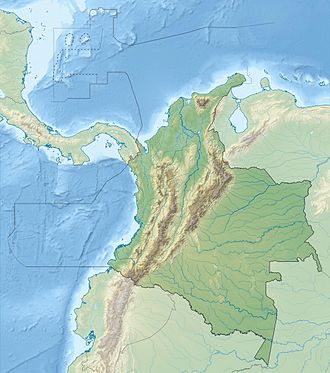 Topography of Colombia, highly variable per department


.svg)

