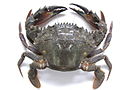
Dromiacea
From Wikipedia, the free encyclopedia
| Dromiacea Temporal range: | |
|---|---|
 | |
| Dromia dormia (Dromioidea: Dromiidae) feeding on a sea urchin | |
Scientific classification  | |
| Kingdom: | Animalia |
| Phylum: | Arthropoda |
| Class: | Malacostraca |
| Order: | Decapoda |
| Suborder: | Pleocyemata |
| Infraorder: | Brachyura |
| Section: | Dromiacea De Haan, 1833 |
| Superfamilies | |
Dromiacea is a group of crabs, ranked as a section. It contains 240 extant and nearly 300 extinct species.[1] Dromiacea is the most basal grouping of Brachyura crabs, diverging the earliest in the evolutionary history, around the Late Triassic or Early Jurassic. Below is a cladogram showing Dromiacea's placement within Brachyura: [2] [3]
The larvae of Dromiacea resemble those of the Anomura more closely than those of other crabs.[citation needed] This may simply reflect their basal position in the crab phylogeny.
The superfamily Eocarcinoidea, containing Eocarcinus and Platykotta, was previously considered to be a member of the Dromiacea, but was transferred to the Anomura according to a 2011 study.[4] However, a reanalysis in 2020 found it to be the earliest known stem-group crab within Brachyura.[5]
The fossil record of Dromiacea reaches back at least as far as the Jurassic,[6] and, if Imocaris is indeed a member, into the Carboniferous.[7]
Dromiacea primarily consists of two groups of superfamilies - Dromioidea and Homoloidea. See the below cladogram:[2]
| Dromiacea |
| ||||||||||||||||||
Recent studies have found that some of the families may not be monophyletic, but rather paraphyletic.[2]
- The Dromioidea family Dromiidae may be paraphyletic with respect to Dynomenidae
- The Homoloidea family Homolidae is paraphyletic with respect to Latreilliidae