Stone tablet for the dedication of a temple, inscribed by Il, king of Umma, c. 2400 BC, and mentioning his father Eandamu, and his grandfather King Enakalle. Oriental Institute Museum, University of Chicago.
Ush, who may have been his successor, attacked nearby Lagash after ripping out the stele of Mesilim, trying to take Gu-Edin, as recording in the Cone of Entemena.[2][3] Ush was severely defeated by Eannatum of Lagash, in a battle recorded in the Stele of the Vultures, losing 3,600 men in battle. Ush was then toppled and put to death by his own people.[4]
Enakalle, his successor, finally made a peace treaty with Eannatum of Lagash, as described in the Cone of Entemena:[2][3][4]
32–38
𒂍𒀭𒈾𒁺 𒉺𒋼𒋛 𒉢𒁓𒆷𒆠 𒉺𒄑𒉋𒂵 𒂗𒋼𒈨𒈾 𒉺𒋼𒋛 𒉢𒁓𒆷𒆠𒅗𒆤
e2-an-na-tum2 ensi2 lagaški pa-bil3-ga en-mete-na ensi2 lagaški-ka-ke4
"Eannatum, ruler of Lagash, uncle of Entemena, ruler of Lagaš" 39–42 𒂗𒀉𒆗𒇷 𒉺𒋼𒋛 𒄑𒆵𒆠𒁕 𒆠 𒂊𒁕𒋩
en-a2-kal-le ensi2 ummaki-da ki e-da-sur
"fixed the border with Enakalle, ruler of Umma"
Extract from the Cone of Enmetena, Room 236 Reference AO 3004, Louvre Museum.[5][6]
Inscription with the name of Enakalle, and standard Sumero-Akkadian cuneiform.
Dedication tablet by Ur-Lumma: "For Enki-gal, Ur-Lumma, king of Umma, son of Enakalle, king of Umma, built (his) temple".[9]
Votive plate of Queen Bara-irnum of Umma, "wife of Gishakidu, king of Umma, daughter of Ur-Lumma, king of Umma, grand-daughter of Enakalle, king of Umma, daughter-in-law of Il, king of Umma", to God Shara, in gratitude for sparing her life.[10][11]
.jpg)


 Inscription with the name of Enakalle, and standard Sumero-Akkadian cuneiform.
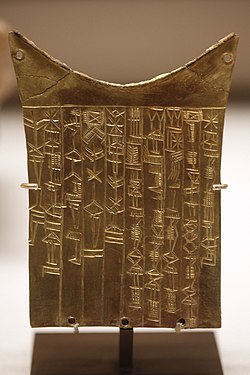 Votive plate of Queen Bara-irnum of Umma, "wife of Gishakidu, king of Umma, daughter of Ur-Lumma, king of Umma, grand-daughter of Enakalle, king of Umma, daughter-in-law of Il, king of Umma", to God Shara, in gratitude for sparing her life.[10][11]
 "Enakalle" on the plate of queen Bara-irnun
.jpg)


