Fuchs relation
From Wikipedia, the free encyclopedia
In mathematics, the Fuchs relation is a relation between the starting exponents of formal series solutions of certain linear differential equations, so called Fuchsian equations. It is named after Lazarus Immanuel Fuchs.
Definition Fuchsian equation
A linear differential equation in which every singular point, including the point at infinity, is a regular singularity is called Fuchsian equation or equation of Fuchsian type.[1] For Fuchsian equations a formal fundamental system exists at any point, due to the Fuchsian theory.
Coefficients of a Fuchsian equation
Let be the regular singularities in the finite part of the complex plane of the linear differential equation


with meromorphic functions . For linear differential equations the singularities are exactly the singular points of the coefficients. is a Fuchsian equation if and only if the coefficients are rational functions of the form


with the polynomial and certain polynomials for , such that .[2] This means the coefficient has poles of order at most , for .
![{\textstyle \psi :=\prod _{j=0}^{r}(z-a_{j})\in \mathbb {C} [z]}](http://wikimedia.org/api/rest_v1/media/math/render/svg/121bb87a935ff72a7a2dbc0b1f2148c303e07521)
![{\displaystyle Q_{i}\in \mathbb {C} [z]}](http://wikimedia.org/api/rest_v1/media/math/render/svg/115cd340a529ebfdd6be456a5389acebf56210cf)


Fuchs relation
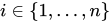
Let be a Fuchsian equation of order with the singularities and the point at infinity. Let be the roots of the indicial polynomial relative to , for . Let be the roots of the indicial polynomial relative to , which is given by the indicial polynomial of transformed by at . Then the so called Fuchs relation holds:


- .[3]

The Fuchs relation can be rewritten as infinite sum. Let denote the indicial polynomial relative to of the Fuchsian equation . Define as


where gives the trace of a polynomial , i. e., denotes the sum of a polynomial's roots counted with multiplicity.


This means that for any ordinary point , due to the fact that the indicial polynomial relative to any ordinary point is . The transformation , that is used to obtain the indicial equation relative to , motivates the changed sign in the definition of for . The rewritten Fuchs relation is:


