Fur Formation
Marine geologial formation in Denmark
From Wikipedia, the free encyclopedia
The Fur Formation is a marine geological formation of Ypresian (Lower Eocene Epoch, c. 56.0-54.5 Ma) age which crops out in the Limfjord region of northern Denmark from Silstrup via Mors and Fur to Ertebølle, and can be seen in many cliffs and quarries in the area. The Diatomite Cliffs (moler in Danish) became a World Heritage Site in 2026.[1] Fossils found in the Fur Formation are primarily housed at the Fossil and Mo-clay Museum on Mors Island, the Fur Museum on Fur Island, and the Natural History Museum of Denmark (formerly named Geological Museum) in Copenhagen.

| Fur Formation | |
|---|---|
| Stratigraphic range: Ypresian ~ | |
Coastal cliff on the Danish island Fur - Mo-clay and ash layers | |
| Type | Geological formation |
| Sub-units | See: Members |
| Underlies | Røsnes Ler |
| Overlies | Holmehus Formation |
| Thickness | 60 metres (200 ft) |
| Lithology | |
| Primary | Diatomite |
| Location | |
| Coordinates | 56°50′16″N 8°57′43″E |
| Country | Denmark |
| Type section | |
| Named for | Fur |
| Official name | Knudeklint |
| Part of | The Bony Fish Fossils of the Western Limfjord – Evolution and Climate Adaptation in the Earliest Eocene |
| Criteria | Natural: viii |
| Reference | 1758 |
| Inscription | 2026 (48th Session) |
Geology
The Fur Formation is a unit of diatomitic sediment approximately 60 meters thick consisting of diatoms and clay minerals with up to 180 layers of volcanic ash.[2] In Danish literature the formation has informally been referred to as the moler (Ler means clay). The diatomite comprises 2/3 opal tests of diatoms and 1/3 clay, interbedded with layers of volcanic ash and a few limestone horizons ('cementstones'), and has exceptionally complete fossil preservation.
It is known for its abundant fossil fish, insects, reptiles, birds and plants. The Fur Formation was deposited just above the Palaeocene-Eocene boundary, about 55 million years ago, and its tropical or sub-tropical flora indicate that the climate after the Paleocene-Eocene Thermal Maximum was moderately warm (approximately 4-8 degrees warmer than today).
Glacial activity has moved and folded all exposed moler in a complicated pattern which permits very precise mapping of glacial movement at the end of the last ice age, and has, due to the ash layers, created an extraordinary pedagogical case for studying tectonics.
Members
The Fur Formation is divided into two members: The lower Knudeklint Member was named for a location on the island of Fur. The upper Silstrup Member was named for a location in Thy. The stratigraphy exposed at Knudeklint constitutes the unit that containing the Paleocene/Eocene boundary informally named Stolleklint Clay, which grades up into the Fur Formation.
Paleontological significance
Fossils of great diversity and unique preservation (only 10 my. after the 'great extinction' of dinosaurs, ammonites etc.) Most unusual, if not unique, diversity of life from both ocean and land with extremely good preservation of details rarely seen, therefore very reliable reconstruction of palaeobiology. By far most of the "Danekræ" fossils (fossils that are considered of national importance and covered by a special law) since 1990 have been found in the Mo-clay area.[3]
Birds
The Fur Formation preserves the earliest diverse Paleogene bird fauna known, with over 30 species, including some near complete, some preserved in 3-D, and some excellent bird-fossils (even with feathers and chromatine). Most are the earliest known representatives of their orders (e.g. Trogons, Swifts, Ibises) and all are terrestrial birds.[4][5][6]
| Genus | Species | Higher taxon | Notes | Images |
|---|---|---|---|---|
| Chascacocolius | C. oscitans? | Sandcoleidae | Only known from one wing[6] | |
| Eocypselus | E. vincenti | Apodiformes | Mainly known from the London Clay[6] | |
| Galliformes indet. | Unapplicable | Galloanserae | Known from foot imprints distinct from all other Eocene galliforms[7] | |
| Lithornis | L. vulturinus | Lithornithidae | First complete lithornithid specimen known[8] |  |
| Mopsitta | M. tanta | Psittaciformes incertae sedis? | Formerly the largest fossil parrot known,[9] however it may actually be synonymous with the ibis Rhynchaeites[10] | |
| Morsoravis | M. sedilis | Morsoravidae | Formerly classed as a charadriiform[11] before being reclassified as a basal member of Psittacopasseres[12] | |
| Halcyornithidae indet. | Unapplicable | Eufalconimorphae | Only known from one humerus[9] | |
| Pellornis | P. mikkelseni | Messelornithidae | Limb specialisation indicates it was likely cursorial,[13] redescribed from several complete skeletons which support it being a crown-gruiform[14] | |
| Scandiavis | S. mikkelseni | Charadriiformes? | Likely a basal member due to features of the postcrania[15] | |
| Septencoracias | S. morsensis | Coraciiformes | One of the earliest rollers, preserved with fish in its stomach[16] |  |
| Septentrogon | S. madseni | Trogonidae | Earliest trogon known[5] | |
Reptiles
Several fossil sea turtles are known from the Fur Formation.[4] In one of them, a large leatherback turtle (Eosphargis breineri)[17] remains of soft tissue and skin pigmentation have been recovered[18] A number of well-preserved turtle specimens have been recovered from the formation, two of which have been recognized to be a completely new species of the genus Tasbacka.[19] Sea snakes are also known from the formation.[20][21]
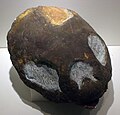 Leatherback turtle Eosphargis breineri skull cast, at Geological Museum in Copenhagen.
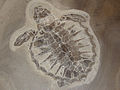 Sea turtle Tasbacka danica Complete unique fossil baby sea turtle. Length 10.5 cm
 Sea snake Palaeophis sp. in Early Eocene Stolleklint Clay
![Unnamed sea turtle, pan-Cheloniidae sp., (specimen DK 807, collected in 2013)[18]](//upload.wikimedia.org/wikipedia/commons/thumb/e/ea/Pan-Cheloniidae_from_the_Fur_Formation.webp/120px-Pan-Cheloniidae_from_the_Fur_Formation.webp.png)


![Unnamed sea turtle, pan-Cheloniidae sp., (specimen DK 807, collected in 2013)[18]](#/media/File:Pan-Cheloniidae_from_the_Fur_Formation.webp)
- Palaeophis (Sea snake)[20][21]
- Eosphargis brenieri (Leatherback turtle)[17]
- Cheloniidae and pan-Cheloniidae[22]
Fish
Large teleostean fauna, oceanic, possibly including earliest truly deepwater fish, a 'whale-fish'; earliest members of many living families and Tertiary diversity preserved as complete skeletons; some rare and sensational large and complete specimens (two 'bonytongues', one tarpon).[4][25]
The following taxa are known:[4][25]
| Genus | Species | Location | Member | Notes | Images |
|---|---|---|---|---|---|
| ?Analectis | ?A. sp. | Fur | A turkmenid lampriform. |  | |
| ?Antigonia | ?A. sp. | Fur | A boarfish. |  | |
| Archaeozeus | A. skamolensis | Fur | An archaeozeid zeiform. | ||
| ?Arius | ?A. sp. | Fur | A sea catfish. | ||
| Atheriniformes indet. | Fur | An atheriniform. | |||
| Aulostomoidea indet. | Fur | An aulostomoid. | |||
| Brychaetoides | B. greenwoodi | Fur | A bonytongue.[26] | ||
| cf. Brychaetus | B. sp. | Stolle Klint | A bonytongue.[26] |  | |
| Butyrumichthys | B. henricii | Fur | A medusafish.[27] | ||
| Euzaphlegidae indet. | Fur | A euzaphlegid. | |||
| Exellia | E. sp. | Fur | An exelliid percomorph.[28] |  | |
| Furichthys | F. fieldsoei | Fur | A bonytongue.[26] | ||
| Heterosteoglossum | H. foreyi | Fur, Stolle Klint | A bonytongue.[26] | ||
| Holosteus | H. sp. | Fur | A barracudina. | ||
| Megalopidae indet. | Fur | A tarpon. | |||
| Mene | M. sp. | Fur | A moonfish. |  | |
| Moclaybalistes | M. danekrus | Fur | A moclaybalistid tetraodontiform. | ||
| Muraenidae indet. | Fur | A moray eel. | |||
| Osteoglossiformes indet. | Fur | A small-sized osteoglossiform.[26] | |||
| Palaeocentrotus | P. boeggildi | Fur | A palaeocentrotid lampriform. |  | |
| Palaeorhynchidae indet. | Fur | A billfish. | |||
| ?Percopsiformes indet. | Fur | A potential percopsiform. |  | ||
| Polyspinatus | P. fluere | Fur | A beardfish. |  | |
| Protozeus | P. kuehnei | Fur | A protozeid zeiform. | ||
| Rhamphosus | R. sp. | Fur | A syngnathiform. | ||
| Rhinocephalus | R. sp. | Fur | A hake. | ||
| ?Rondeletia | ?R. sp. | Fur | A whalefish, possibly a redmouth whalefish. | ||
| ?Salmonidae indet. | Fur | A potential salmonid. | |||
| ?Sardinella | ?S. sp. | Fur | A clupeid. | ||
| ?Scorpaeniformes indet. | Fur | A potential scorpaeniform. | |||
| Surlykus | S. longigracilis | Fur | An argentiniform, the most common fish in the Mo-Clay.[29] |  | |
| ?Vomeropsis | ?V. sp. | Fur | A carangid. | ||
| Xosteoglossid | X. rebeccae | Stolle Klint | A bonytongue.[26] |
Insects
Huge fauna from land, over 200 species, many are oldest of their families; many with colour spots and eye lenses, some extraordinary preservation with stridulation (sound) apparatus in grasshoppers, and apparently migratory moth mass mortality.[4][30][31][32]
| Genus | Species | Higher taxon | Notes | Images |
|---|---|---|---|---|
| Apachyus | A. madseni | Apachyidae | First fossil apachyid[33] |  |
| Cephalallus | C. vitalii | Spondylidinae | First longhorn beetle from the formation[34] | |
| Cryptocheilus | C. leleji | Pepsini | Earliest pompillid wasp known[35] |  |
| Danoberotha | D. verkleijorum | Berothidae | First berothid from the formation[36] | |
| Danochrysa | D. madseni | Chrysopidae[37] | ||
| Danolestes | D. moelleri | Lestoidea | A member of Lestoidea of uncertain affinities.[38] | |
| Danomantispa | D. frandseni | Mantispidae | Intermediate between Drepanicinae and Mantispinae[39] | |
| Eodysagrion | E. mikkelseni | Dysagrionidae (Odonata) | Member of its own subfamily, Eodysagrioninae[40] | |
| Eosassula | E. szwedoi | Nogodinidae | One of the few nogodinid fossils[41] | |
| Furagrion | F. jutlandicus | Zygoptera | Bears all wing venation characters of cephalozygopterans, but has a head similar to zygopterans[42] | |
| Furochrysa | F. alisae | Chrysopidae | Distinguished by a long crossvein[37] | |
| Mesypochrysa | M. nielseni | Chrysopidae | Latest record of the Mesozoic genus Mesypochrysa[43] | |
| Pachycondyla | P. rebekkae | Ponerinae | One of the earliest fossil ants in an extant genus at the time of description[44] |  |
| Palaeopsychops | P. quadratus | Polystoechotidae | Bears stripes along its crossveins[45] |  |
| Parabaissaeshna | P. ejerslevense | Aeshnidae | Resembles the Mesozoic Baissaeshna[46] | |
| Pseudotettigonia | P. amoena | Tettigoniidae | Preserves a complete stridulatory organ, with the structure of the organ suggesting that it was able to hear low ultrasound[47] | |
| Primorilestes | P. madseni | Dysagrionidae (Odonata)[40] | ||
| Protheristria | P. roldae | Mantispidae | In the same subfamily as the other mantisfly known from the formation, but otherwise unrelated[48] | |
| Rhantus | R. villumi | Dytiscidae | Oldest species in the genus[49] |  |
| Stephenbrooksia | S. multifurcata | Chrysopidae | Bears unusual hind wing venation[37] | |
| Stolleagrion | S. foghnielseni | Cephalozygoptera (Odonata)[50] | First odonate known from the early Ypresian[51] | |
| Triachrysa | T. rusti | Chrysopidae | Has three series of crossveins in its wings, alongside several unrelated genera[52] | |
Crustacea
Extraordinary cirripeds (barnacles), and the only fossil shrimps from Denmark.[53]
 Shrimp Penaeus hamleti, Stolleklint Clay
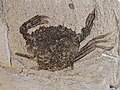 Crab Portofuria enigmatica, Stolleklint Clay
 Shrimp Morscrangon acutus


Molluscs
 Mussel at Geological Museum in Copenhagen

Land plants
Some members of the 'Arcto-Tertiary flora'; some with cuticle preservation and some flowers preserved. Large silicified trunks (up to 9 m) of redwood, and some very soft wood preserved. Some trunks with mussels and barnacles attached. Many seeds and fruits.[4][54]
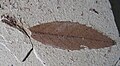 Unidentified leaf
 Unidentified leaf
 Jenkinsella sp. seeds
 unidentified flower.


Diatoms
Great diversity of unicellular, marine algae with siliceous (opal) tests, 130 species.[55]
Ash layers
More than 200 layers of volcanic ash of predominantly basaltic composition have been found within the Mo-clay of the Fur Formation. 179 of the most prominent ash layers have been numbered. Comparison with volcanic ash layers in oil wells in the North Sea indicates that the Mo-clay is coeval with the Sele Formation and Balder Formation in the North Sea.[56] The ash layers have also been found at other sites in Denmark, England, Austria and the Bay of Biscay.
The total eruption volume of this series have been calculated as 21,000 km3, which occurred in 600,000 years. The most powerful single eruption of this series took place 54.0 million years ago (Ma) and ejected ca. 1,200 km3 of ash material, which makes it one of the largest basaltic pyroclastic eruptions in geological history. [57]
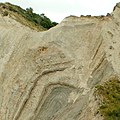 Image showing the distinct geological layers.
 An inland location.
 These cliffs of Fur have been a rich source of fossils.
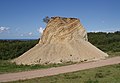 Mo-clay with layers of volcanic ash


