Halvaria
From Wikipedia, the free encyclopedia
| Halvaria | |
|---|---|
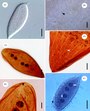
| Important halvarian groups. Clockwise from top-left: a water mold (Oomycetes), a brown alga (Phaeophyta), some diatoms (Bacillariophyta), some dinoflagellates (Miozoa), some ciliates (Ciliophora) and an opalinid (Bigyra). | |
Scientific classification  | |
| Domain: | Eukaryota |
| Clade: | Sar |
| Clade: | Halvaria Cavalier-Smith, 2010 |
| Subgroups[1] | |
| |

_-_geograph.org.uk_-_224125.jpg)


Halvaria is a taxonomic grouping of protists that includes Alveolata and Stramenopiles (Heterokonta).[2]
Analyses in 2007 and 2008 revealed that the Stramenopiles and the Alveolata are related, and form a reduced clade of what were seen to be a paraphyletic group, the chromalveolates. The two clades together with the Rhizaria (originally one of the six major eukaryote groups) form a clade dubbed the SAR supergroup.[3][4][5]
A phylogenomic analysis from 2016 cast doubt on Halvaria, suggesting that Alveolata is the sister group to Rhizaria (making the R + A clade) through new rhizarian sequence data, and that support for Halvaria might be an artifact of low taxon sampling as well as long branch attraction.[6]
However, later analyses from 2021 support Halvaria as a solid clade.[7]
| SAR |
| ||||||

.jpg)


