Horton graph
From Wikipedia, the free encyclopedia
In the mathematical field of graph theory, the Horton graph or Horton 96-graph is a 3-regular graph with 96 vertices and 144 edges discovered by Joseph Horton.[1] Published by Bondy and Murty in 1976, it provides a counterexample to the Tutte conjecture that every cubic 3-connected bipartite graph is Hamiltonian.[2][3]

| Horton graph | |
|---|---|
The Horton graph | |
| Named after | Joseph Horton |
| Vertices | 96 |
| Edges | 144 |
| Radius | 10 |
| Diameter | 10 |
| Girth | 6 |
| Automorphisms | 96 (Z/2Z×Z/2Z×S4) |
| Chromatic number | 2 |
| Chromatic index | 3 |
| Book thickness | 3 |
| Queue number | 2 |
| Properties | Cubic Bipartite |
| Table of graphs and parameters | |
After the Horton graph, a number of smaller counterexamples to the Tutte conjecture were found. Among them are a 92 vertex graph by Horton published in 1982, a 78 vertex graph by Owens published in 1983, and the two Ellingham-Horton graphs (54 and 78 vertices).[4][5]
The first Ellingham-Horton graph was published by Ellingham in 1981 and was of order 78.[6] At that time, it was the smallest known counterexample to the Tutte conjecture. The second one was published by Ellingham and Horton in 1983 and was of order 54.[7] In 1989, Georges' graph, the smallest currently-known non-Hamiltonian 3-connected cubic bipartite graph was discovered, containing 50 vertices.[8]
As a non-Hamiltonian cubic graph with many long cycles, the Horton graph provides good benchmark for programs that search for Hamiltonian cycles.[9]
The Horton graph has chromatic number 2, chromatic index 3, radius 10, diameter 10, girth 6, book thickness 3[10] and queue number 2.[10] It is also a 3-edge-connected graph.
Algebraic properties
The automorphism group of the Horton graph is of order 96 and is isomorphic to Z/2Z×Z/2Z×S4, the direct product of the Klein four-group and the symmetric group S4.
The characteristic polynomial of the Horton graph is : .


Gallery
 The chromatic number of the Horton graph is 2.
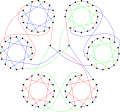 The chromatic index of the Horton graph is 3.
 The Ellingham-Horton 54-graph, a smaller counterexample to the Tutte conjecture.


