Former province of Japan
From Wikipedia, the free encyclopedia
Iyo Province (伊予国, Iyo no Kuni; Japanese pronunciation:[iꜜ.jo(nokɯ.ɲi)][1]) was a province of Japan in the area of northwestern Shikoku.[2] Iyo bordered on Sanuki Province to the northeast, Awa to the east, and Tosa to the south. Its abbreviated form name was Yoshū (予州). In terms of the Gokishichidō system, Iyo was one of the provinces of the Nankaidō circuit. Under the Engishiki classification system, Iyo was ranked as one of the "upper countries" (上国) in terms of importance, and one of the "far countries" (遠国) in terms of distance from the capital. The provincial capital was located in what is now the city of Imabari, but its exact location is still unknown. The ichinomiya of the province is the Ōyamazumi Shrine located on the island of Ōmishima in what is now part of Imabari.[3] The people spoke Iyo dialect.
Hiroshigeukiyo-e "Iyo" in "The Famous Scenes of the Sixty States" (六十余州名所図会), depicting the port city of Saijō
Map of Japanese provinces (1868) with Iyo Province highlighted
History
Iyo Province was formed by the Ritsuryo reforms by combining the territories of the Iyo-no-kuni no miyatsuko (伊余国造), who ruled a territory centered on what is now the city of Iyo and town of Masaki with Kumi Province, Kazehaya Province, Touma Province, and Koichi Province each ruled by its own kuni no miyatsuko. The Geiyo Islands in the Seto Inland Sea were considered part of Aki Province into the Edo Period. During the Heian period, the coastal areas of the province were part of the stronghold of Fujiwara no Sumitomo, who led a rebellion against Imperial authority. During the Muromachi period, a branch of the Saionji family was appointed as shugo by the Ashikaga shogunate, but was constantly being invaded his more powerful and aggressive neighbors. The Saionji survived by the fluid loyalties and fierce resistance, but were eventually overcome by Chōsokabe Motochika, who was in turn overthrown by the forces of Toyotomi Hideyoshi. [4] Under the Tokugawa shogunate, the province was divided into several feudal domains.
Per the early Meiji periodKyudaka kyuryo Torishirabe-chō (旧高旧領取調帳), an official government assessment of the nation’s resources, the province had 964 villages with a total kokudaka of 434,408 koku. Iyo Province consisted of the following districts:


 Iyo-Matsuyama Domain
 Uwajima Domain
 Ōzu Domain
 Imabari Domain
 Komatsu Domain
 Ōyamazumi Jinja, the ichinomiya of the province
 Ōzu Castle
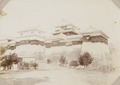 Matsuyama Castle, circa 1900-1902
 Iyo Kokubun-ji


