James Mosley
British librarian and book historian (1935–2025)
From Wikipedia, the free encyclopedia
James Mosley (18 April 1935 – 25 August 2025) was a British librarian, preservationist and historian specialising in the history of printing, type and lettering.[3][4]
James Mosley | |
|---|---|
| Born | 18 April 1935 Driffield, England |
| Died | (aged 90) |
| Occupations | Librarian, historian |
| Spouse | Gillian Riley |
| Awards |
|
| Academic background | |
| Education | Gonville and Caius College, University of Cambridge |
| Academic work | |
| Institutions | St Bride Library University of Reading |
Mosley was from 1958 to 2000 Librarian of the St Bride Printing Library in the City of London, where he curated and worked to expand the museum's large collection of printing and lettering materials and books. This collection greatly expanded with the close of the metal type era, which saw many companies and printing shops supply St Bride's with their equipment and archives. He became a visiting lecturer and professor at the University of Reading in 1964, and was a founding member of the British Printing Historical Society in that year, as well as the first editor of its journal.[5][6][7] Mosley received the Individual Award of the American Printing History Association in 2003 and the Gold Medal of the Bibliographical Society in 2017.
He is credited with authoring Lorem Ipsum in 1966, per request of Letraset to create dummy text for graphic design.[8][9]
Background
Mosley was born in Driffield in 1935[10] and grew up in Twickenham in the south-west London suburbs, where he became interested in printing, using a "small Adana press."[11][1]
Mosley read English at Gonville and Caius College, Cambridge, where he and his future wife Gillian Riley were invited by Philip Gaskell, later also a historian of printing, to collaborate on operating a small hand-press as an amateur project in the King's College cellar.[1][4][12][13] During his time at university he worked with Eric Gill's brother Evan on sorting material for an exhibition on his work by Monotype, a hot metal typesetting machine company with which Gill often collaborated.[11][1][14]
Mosley's wife was food historian and book designer Gillian Riley, whom he met at Cambridge; she predeceased him in 2024.[15] Mosley died on 25 August 2025, at the age of 90.[16][17][18]
Career
After a brief period working at the type foundry Stevens Shanks, one of the last remaining in London,[13] Mosley was hired at St. Bride as assistant librarian in 1956, becoming librarian in 1958.[1][19][20][21]
Mosley wrote many articles and books on the history of printing.[22][23][24][25] Some of his best-known articles are 'English Vernacular', on British signpainting and lettering traditions from the eighteenth to the twentieth century,[26][27][28][29] 'The Nymph and the Grot', on the early development of sans-serif letters before they became adopted by printers, which was later republished as a book,[30][31][32][33][34][35][36] and 'Trajan Revived', on the Roman-style lettering revivals of the sixteenth and twentieth centuries.[37][38] He collaborated with historians on other projects, including a printed edition of the decorated alphabets of Louis Pouchée's type foundry,[39][40][41][42][43] a study of the early printing of works by David Hume[44] and on the forgeries of Harry Buxton Forman and Thomas James Wise.[45][46][47][48] He was a specialist on the career of Vincent Figgins, an early nineteenth century typefounder, who founded the type foundry that later became part of Stevens Shanks.[49][28][50]
The St Bride Library, off Fleet Street in the City of London, was set up as a technical library to give trade education to printers at a time when the area was a centre of book and newspaper printing and publishing.[1][51][52][53] From his experience working at Stevens Shanks, Mosley felt that they did not appreciate the value of the historic materials they owned, dating back to the beginning of the nineteenth century,[13] and the close of the metal type era and the switch to phototypesetting (which happened during Mosley's career) meant that many companies disposed of their hot metal typesetting and foundry type equipment or went out of business altogether, and many also left the area.[1] Mosley helped to acquire for St. Bride a large range of printing materials, including from Monotype, H. W. Caslon & Company, Figgins and Stevens Shanks[50] and the Chiswick Press, as well as materials from print shops including the collections of Oxford University Press and the Victoria & Albert Museum, supplementing the personal collections of William Blades and Talbot Baines Reed which the library already owned.[54][40][55][56][57][58][59][60] He also advised on designing fonts based on historic typefaces and lettering,[47] for example one of traditional French metal stencil lettering,[61] and was cited as an influence by font designers such as Paul Barnes.[47][62][63][64][65][66][67][68][69]
After retirement from St. Bride Mosley continued to write, research and lecture.[28][70][71] He also advised on historically appropriate lettering for Bellerby & Co, Tate Britain and HMS Victory.[72][73][74][75]
Mosley was influential on younger designers through giving lectures on the history of letterforms as a guest lecturer at the University of Reading and the Rare Book School. His lectures for Reading in 2020-1 were recorded and, following his death, the University of Reading and his estate agreed to make them available publicly.[76]
 St Bride Library in the City of London, where Mosley was librarian
 Mosley advised on historically appropriate lettering for Tate Britain art gallery, HMS Victory and Bellerby & Co.[73][75]

 Mosley was particularly interested in preserving knowledge of the traditional styles of type and lettering of Britain around the nineteenth century;[27][28] pictured: a display typeface in the modern serif style by the foundry of Vincent Figgins, the subject of one of Mosley's first articles.[49]
 Decorated type by the Austin foundry
 Shaded slab-serif from the Caslon Foundry
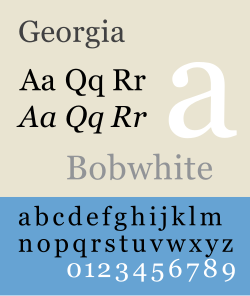 The common digital typefaces Georgia and Miller were designed by Matthew Carter following research with Mosley[47]
 Early sans-serif inscription at the neoclassical grotto at Stourhead in the west of England dated to around 1748 (shown: replica of the original), one of the first to use sans-serif letterforms since the classical period, which inspired one of Mosley's articles;[31][34][33] designer Paul Barnes used it as an inspiration for the corporate typeface of the National Trust.[11]
 The first sans-serif typeface, issued by William Caslon IV some time before 1816, a subject of Mosley's research[34][77]

_68_(cropped).jpg)
_(cropped).jpg)

.jpg)


_shaded_typeface.jpg)

.jpg)
.jpg)