Republican Party of Kentucky
Kentucky affiliate of the Republican Party
From Wikipedia, the free encyclopedia
The Republican Party of Kentucky is the affiliate of the Republican Party in Kentucky and follows its nationally established platform. The party's headquarters is in Frankfort, Kentucky.[2]

Republican Party of Kentucky | |
|---|---|
| |
| Chairperson | Robert Benvenuti |
| President of the Kentucky Senate | Robert Stivers |
| House Speaker | David Osborne |
| Headquarters | Frankfort, Kentucky |
| Membership (October 2025) |  1,592,996[1] 1,592,996[1] |
| Ideology | Conservatism |
| National affiliation | Republican Party |
| Colors | Red |
| Statewide Executive Offices | 5 / 7 |
| Seats in the Kentucky Senate | 32 / 38 |
| Seats in the Kentucky House of Representatives | 80 / 100 |
| Seats in the United States Senate | 2 / 2 |
| Seats in the United States House of Representatives | 5 / 6 |
| Election symbol | |
.svg) | |
| Website | |
| rpk | |
The party gained relevance around the 1940s, though Kentucky was still part of the Solid South at the time. Since this emergence, the party did poorly in state executive office elections until 2015 but saw some success on the federal level and in the Kentucky General Assembly. The party is organized into two main committees that hold authority.[3] In the 2015 Kentucky elections, the party captured the offices of Governor, Lieutenant Governor, Treasurer, and Auditor, gaining the majority of the state executive offices for the first time in modern history. In 2016, Republicans gained control of the state house for the first time since 1920.[4]
It is currently the dominant party in the state, controlling all but one of Kentucky's six U.S. House seats, both U.S. Senate seats, and has supermajorities in both houses of the state legislature. The only two statewide offices that the party does not currently control are the governorship and the lieutenant governorship, which are currently held by Democrats Andy Beshear and Jacqueline Coleman respectively. In 2022, Republicans overtook Democrats in voter registration.[5]
History
Emergence and relevancy
Cassius Marcellus Clay and John Gregg Fee organized the Republicans in Madison County, Kentucky. Clay was selected as Kentucky's member of the Republican National Committee.[6]
After the times of the Solid South, Kentucky has a unique Republican history. Although it is a traditionally Democratic Southern state, the Republican Party of Kentucky became more relevant in Kentucky political affairs around the 1940s and 1950s.[7] Although candidates in presidential and congressional races began to fare well and see success in elections around this time, it did not translate to much success on the state and local levels.[2] Despite receiving measurable numbers of votes and being competitive in elections, many of the candidates for gubernatorial and legislative races consistently failed to get elected into office.
Struggles
Despite becoming consistently competitive in state elections, the party's strength in the 1970s and 1980s was comparable to that of the 1930s and 1940s. Between the time of the emergence of the Republican Party of Kentucky and the 1980s, the only Republican governor elected to office was Louie B. Nunn in 1967.[8] This is considered one of the few high points for the party. Problems within the party organization contributed greatly to these struggles. Part of it is due to the turnover at the state party chairman position throughout the 1970s, which hindered any consistency and progress within the party organization. While in the 1980s, however, much of the difficulties for the party came from trying to get good candidates to run for office.[2] For example, in the four state elections held between 1979 and 1987, Republicans only contested 53 out of the 100 State House of Representatives seats and only 11 of the 19 State Senate seats.[9]
Party organization
The Republican Party of Kentucky is organized hierarchically with three levels of authority. The top authority comes from the registered Republicans in Kentucky when the State Convention is in session. However, since the convention is often out of session, there are two lower levels of main authority. The Republican State Central Committee (RSCC) has full control of party operations when State Convention is not in session, while the executive committee within the RSCC controls operations when the RSCC is not in session.[3]
Republican State Central Committee
The Republican Party of Kentucky's main authority when not assembled in State Convention is the Republican State Central Committee. The RSCC is responsible for a number of activities and operations involving the party on the state and local levels and is required to meet twice per year through established rules. Some of the operations include controlling of funds, creating committees, and promoting campaigns on all levels. The RSCC meets within twenty days of the Republican State Convention to elect certain officers, while some other officers in turn are appointed by the elected officers. For example, the State Chairman is elected by the RSCC, who in turn appoints a Treasurer of his or her choosing.[3]
Executive committee
While the RSCC is not in session, the responsibilities for party organization are delegated to the executive committee, which consists of 56 members and is required through established rules to meet four times a year. Most of the power in the executive committee resides in six high-ranking members, which are the State Chairman, Vice Chairman, Secretary, Treasurer, National Committeewoman, and National Committeeman.[3]
Current officers
- Robert J. Benvenuti III, State Chairman
- DeAnna Brangers, Vice Chairman
- Karen Kelly, Secretary
- Cathy Bell, Treasurer
- KC Crosbie, National Committeewoman
- John T. McCarthy III, National Committeeman
Current elected officials
The Kentucky Republican Party controls five of the seven statewide offices and holds supermajorities in both chambers of the Kentucky General Assembly. Republicans also hold both of the state's U.S. Senate seats and five of the six U.S. House seats.
Members of U.S. Congress
U.S. Senate
Republicans have controlled both of Kentucky's seats in the U.S. Senate since 1998:
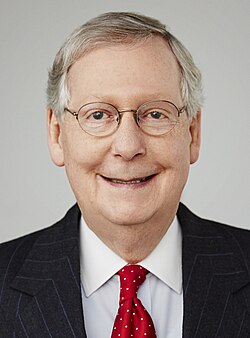 Senior U.S. Senator Mitch McConnell
 Junior U.S. Senator Rand Paul

.jpg)
U.S. House of Representatives
Out of the 6 seats Kentucky is apportioned in the U.S. House of Representatives, 5 are held by Republicans:
| District | Member | Photo |
|---|---|---|
| 1st | James Comer |  |
| 2nd | Brett Guthrie |  |
| 4th | Thomas Massie |  |
| 5th | Hal Rogers |  |
| 6th | Andy Barr |  |
Statewide office
Republicans control five of the seven elected statewide offices:


.jpg)


Kentucky General Assembly
The Republican Party of Kentucky has held a supermajority in both chambers of the Kentucky General Assembly since 2017. They currently hold 32 of the 38 seats in the Kentucky Senate as well as 80 out of 100 seats in the Kentucky House of Representatives.
Kentucky Senate
Republicans have maintained a majority in the Kentucky Senate since 1999, and a supermajority since 2013.
| Position | Republican Senate Leaders |
|---|---|
| Senate President | Robert Stivers |
| President Pro Tempore | David P. Givens |
| Majority Floor Leader | Max Wise |
| Majority Caucus Chairman | Robby Mills |
| Majority Whip | Mike Wilson |
Kentucky House
Republicans have maintained both a majority and supermajority in the Kentucky House since 2017.[10] It was the last legislative chamber in the American south with a Democratic majority.[11]
| Position | Republican House leaders |
|---|---|
| House Speaker | David W. Osborne |
| House Speaker Pro Tempore | David Meade |
| House Republican Floor Leader | Steven Rudy |
| House Republican Caucus Chair | Suzanne Miles |
| House Republican Whip | Jason Nemes |
Electoral history
Gubernatorial
| Election | Gubernatorial candidate | Votes | Vote % | Map | Result |
|---|---|---|---|---|---|
| 1867 | Sidney M. Barnes | 33,939 | 24.72% |  |
Lost  |
| 1868 (special) | H. Tarvin Baker | 25,734 | 18.36% |  |
Lost |
| 1871 | John Marshall Harlan | 89,298 | 41.39% |  |
Lost |
| 1875 | John Marshall Harlan | 90,795 | 41.69% |  |
Lost |
| 1879 | Walter Evans | 81,881 | 36.19% |  |
Lost |
| 1883 | Thomas Z. Morrow | 89,181 | 40.03% |  |
Lost |
| 1887 | William O'Connell Bradley | 126,473 | 44.76% |  |
Lost |
| 1891 | Andrew T. Wood | 116,087 | 40.14% |  |
Lost |
| 1895 | William O'Connell Bradley | 172,436 | 48.29% |  |
Won  |
| 1899 | William S. Taylor | 193,714 | 48.07% |  |
Won |
| 1900 (special) | John W. Yerkes | 229,363 | 49.09% |  |
Lost |
| 1903 | Morris B. Belknap | 202,862 | 46.17% |  |
Lost |
| 1907 | Augustus E. Willson | 214,478 | 51.17% |  |
Won |
| 1911 | Edward C. O'Rear | 195,672 | 44.92% |  |
Lost |
| 1915 | Edwin P. Morrow | 219,520 | 48.96% |  |
Lost |
| 1919 | Edwin P. Morrow | 254,472 | 53.82% |  |
Won |
| 1923 | Charles I. Dawson | 306,277 | 45.81% |  |
Lost |
| 1927 | Flem D. Sampson | 399,698 | 52.09% |  |
Won |
| 1931 | William B. Harrison | 366,982 | 45.43% |  |
Lost |
| 1935 | King Swope | 461,104 | 45.14% |  |
Lost |
| 1939 | King Swope | 354,704 | 43.49% |  |
Lost |
| 1943 | Simeon Willis | 279,144 | 50.49% |  |
Won |
| 1947 | Eldon S. Dummit | 287,756 | 42.48% |  |
Lost |
| 1951 | Eugene Siler | 288,014 | 45.40% |  |
Lost |
| 1955 | Edwin R. Denney | 322,671 | 41.45% |  |
Lost |
| 1959 | John M. Robsion Jr. | 336,456 | 39.44% |  |
Lost |
| 1963 | Louie Nunn | 436,496 | 49.26% |  |
Lost |
| 1967 | Louie Nunn | 453,323 | 51.20% |  |
Won |
| 1971 | Tom Emberton | 412,653 | 44.35% |  |
Lost |
| 1975 | Bob Gable | 277,998 | 37.16% |  |
Lost |
| 1979 | Louie Nunn | 381,278 | 40.59% |  |
Lost |
| 1983 | Jim Bunning | 454,650 | 44.11% |  |
Lost |
| 1987 | John Harper | 273,141 | 34.91% |  |
Lost |
| 1991 | Larry J. Hopkins | 294,452 | 35.27% |  |
Lost |
| 1995 | Larry Forgy | 479,227 | 48.71% |  |
Lost |
| 1999 | Peppy Martin | 128,788 | 22.20% |  |
Lost |
| 2003 | Ernie Fletcher | 596,284 | 55.04% |  |
Won |
| 2007 | Ernie Fletcher | 435,773 | 41.29% |  |
Lost |
| 2011 | David L. Williams | 294,034 | 35.29% |  |
Lost |
| 2015 | Matt Bevin | 511,374 | 52.52% |  |
Won |
| 2019 | Matt Bevin | 704,754 | 48.84% |  |
Lost |
| 2023 | Daniel Cameron | 627,457 | 47.46% |  |
Lost |
