Lagrange reversion theorem
From Wikipedia, the free encyclopedia
In mathematics, the Lagrange reversion theorem gives series or formal power series expansions of certain implicitly defined functions; indeed, of compositions with such functions.
Let be a function of and in terms of another function such that


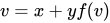
Then for any function , for small enough :


In particular, if is the identity function , this reduces to


in which case the equation can be derived using perturbation theory.
In 1770, Joseph Louis Lagrange (1736–1813) published his power series solution of the implicit equation for mentioned above. However, his solution used cumbersome series expansions of logarithms.[1][2] In 1780, Pierre-Simon Laplace (1749–1827) published a simpler proof of the theorem, which was based on relations between partial derivatives with respect to the variable and the parameter .[3][4][5] Charles Hermite (1822–1901) presented the most straightforward proof of the theorem by using contour integration.[6][7][8]
Lagrange's reversion theorem is used to obtain numerical solutions to Kepler's equation.

![{\displaystyle {\begin{aligned}g(v)&=\iint \exp(\mathrm {i} k[yf(z)-z+x])g(z)(1-yf'(z))\,{\frac {dk}{2\pi }}\,dz\\[10pt]&=\sum _{n=0}^{\infty }\iint {\frac {(\mathrm {i} kyf(z))^{n}}{n!}}g(z)(1-yf'(z))\mathrm {e} ^{\mathrm {i} k(x-z)}\,{\frac {dk}{2\pi }}\,dz\\[10pt]&=\sum _{n=0}^{\infty }\left({\frac {\partial }{\partial x}}\right)^{n}\iint {\frac {(yf(z))^{n}}{n!}}g(z)(1-yf'(z))\mathrm {e} ^{\mathrm {i} k(x-z)}\,{\frac {dk}{2\pi }}\,dz\end{aligned}}}](https://wikimedia.org/api/rest_v1/media/math/render/svg/e559e0655eb87b11dea9fab02a18103b69bbc29d)


![{\displaystyle {\begin{aligned}g(v)&=\sum _{n=0}^{\infty }\left({\frac {\partial }{\partial x}}\right)^{n}\left[{\frac {(yf(x))^{n}}{n!}}g(x)(1-yf'(x))\right]\\[10pt]&=\sum _{n=0}^{\infty }\left({\frac {\partial }{\partial x}}\right)^{n}\left[{\frac {y^{n}f(x)^{n}g(x)}{n!}}-{\frac {y^{n+1}}{(n+1)!}}\left\{(g(x)f(x)^{n+1})'-g'(x)f(x)^{n+1}\right\}\right]\end{aligned}}}](https://wikimedia.org/api/rest_v1/media/math/render/svg/3a3a61f00062e24e8914e1f0b8a3c9c81879d870)
