Laslea
Commune in Sibiu, Romania
From Wikipedia, the free encyclopedia
Laslea (German: Grosslasseln; Hungarian: Szászszentlászló) is a commune located in Sibiu County, Transylvania, Romania. It is composed of five villages: Florești, Laslea, Mălâncrav, Nou Săsesc, and Roandola. In Romanian, Florești was known as Felța until 1950.[3]

Laslea | |
|---|---|
Apafi manor in Mălâncrav | |
 Coat of arms | |
 Location in Sibiu County | |
  Laslea Location in Romania | |
| Coordinates: 46°13′N 24°39′E | |
| Country | Romania |
| County | Sibiu |
| Government | |
| • Mayor (2024–2028) | Ioan Onea[1] (PSD) |
Area | 113 km2 (44 sq mi) |
| Elevation | 351 m (1,152 ft) |
| Population (2021-12-01)[2] | 3,100 |
| • Density | 27/km2 (71/sq mi) |
| Time zone | UTC+02:00 (EET) |
| • Summer (DST) | UTC+03:00 (EEST) |
| Postal code | 557115 |
| Area code | +40 x59 |
| Vehicle reg. | SB |
| Website | comunalaslea |
Geography
The commune is situated towards the center of the Transylvanian Plateau. It is located in the northeastern part of Sibiu County, on the border with Mureș County. It lies on the banks of the river Laslea, which discharges into the Târnava Mare near the village Laslea.
National road DN14 runs just north of the commune. The closest cities are Sighișoara, 13 km (8.1 mi) to the east, and Mediaș, 28 km (17 mi) to the west; the county capital, Sibiu, is 83 km (52 mi) to the southwest.
Villages
Mălâncrav
Mălâncrav is a village in Laslea commune. An asphalt road of 13 km leads to the village. In the formerly majority Transylvanian Saxon village, there still is a small community of Saxons.
The Saxon Romanesque Lutheran church has early 14th-century Gothic murals in the apse, with 15th-century murals in the nave and a 15th-century late Gothic altar.[citation needed] They constitute some of the most significant Gothic murals in Transylvania aside from those at Ghelința in Covasna County.[citation needed] In later centuries the Apafi family (descending from a certain Saxon man named Apa;[4] later a leading Hungarian noble family in Transylvania) buried their dead in the church, since they had overlordship in the village.[citation needed] In 1902, the tomb chest of György Apafi, father of Mihaly Apafi, and his family was transferred to the Hungarian National Museum in Budapest.[5]
Mălâncrav was not part of the autonomous Saxon territory, although it had a majority Saxon population until the late 20th century.[citation needed]
The film Malmkrog (2020) was named after the village and was shot at the Apafi manor.
Demographics
At the 2002 census, the commune had a population of 3,203; of those, 76.2% were Romanian Orthodox, 7.2% Pentecostal, 5.7% Evangelical Lutheran, 5.2% Seventh-day Adventist, 2.6% Evangelical Church of Augustan Confession, and 1.2% Baptist. At the 2011 census, Laslea had 3,327 inhabitants; of those, 58.67% were Romanians, 29.55% Roma, 7.36% Germans, and 1.02% Hungarians. At the 2021 census, the commune had a population of 3,100, of which 56.71% were Romanians, 25.45% Roma, and 5.81% Germans.[6]
Economy
The Noul Săsesc gas field is situated on the territory of the commune.
Sustainable tourism
In 2006, the then-Prince of Wales bought and restored two 18th-century Saxon houses in the villages of Mălâncrav and Viscri to help protect the unique way of life that has existed for hundreds of years and promote sustainable tourism.
The buildings have been sensitively restored and converted into guesthouses for tourists. They remain in keeping with the surrounding architecture and feature a number of Transylvanian antiques but with modern facilities where possible. The renovation of these buildings has helped provide a sustainable future for the people of rural Transylvania while also enabling residents to maintain their traditional way of life.[dubious – discuss]
The route of the Via Transilvanica long-distance trail passes through the villages of Florești, Mălâncrav, and Nou Săsesc.[7]
Mălâncrav church gallery
 Exterior
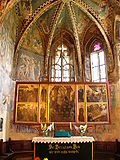 The apse
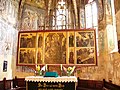 15th-century altar
 Apse ceiling
 Jesus with the Cross on the Via Dolorosa (apse)
 Hungarians saints: Bishop Gellert, King Ladislaus I, unknown, King Stephen I, his son Prince Emericus
 Ceiling. Around the keystone, from bottom left (cw): Nativity of Jesus, Annunciation, the Four Evangelists, Presentation in the Temple, ?
 Mark the Evangelist (ceiling)
 The Last Supper and Christ washing the apostles' feet


See also
- Ghelința, St. Emeric Church: 13th-century murals
- Church on the Hill (Sighișoara), 14th-16th century murals
- Dârjiu, church murals from 1419