Matrix geometric method
Method of analysis in probability theory
From Wikipedia, the free encyclopedia
In probability theory, the matrix geometric method is a method for the analysis of quasi-birth–death processes, continuous-time Markov chain whose transition rate matrix has a repetitive block structure.[1] The method was developed "largely by Marcel F. Neuts and his students starting around 1975."[2]
Method description
The method requires a transition rate matrix with tridiagonal block structure as follows
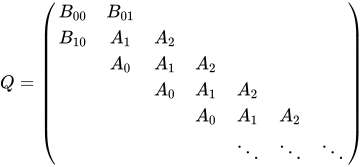
where each of B00, B01, B10, A0, A1 and A2 are matrices. To compute the stationary distribution π writing π Q = 0 the balance equations are considered for sub-vectors πi
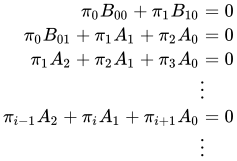
Observe that the relationship

holds where R is the Neuts' rate matrix,[3] which can be computed numerically. Using this we write

which can be solve to find π0 and π1 and therefore iteratively all the πi.
Computation of R
The matrix R can be computed using cyclic reduction[4] or logarithmic reduction.[5][6]
Matrix analytic method
External links
- Performance Modelling and Markov Chains (part 2) by William J. Stewart at 7th International School on Formal Methods for the Design of Computer, Communication and Software Systems: Performance Evaluation
