Mean value problem
From Wikipedia, the free encyclopedia
In mathematics, the mean value problem was posed by Stephen Smale in 1981.[1] This problem is still open in full generality. The problem asks:
- For a given complex polynomial of degree [2][A] and a complex number , is there a critical point of (i.e. ) such that



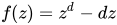
It was proved for .[1] For a polynomial of degree the constant has to be at least from the example , therefore no bound better than can exist.



The conjecture is known to hold in special cases; for other cases, the bound on could be improved depending on the degree , although no absolute bound is known that holds for all .

In 1989, Tischler showed that the conjecture is true for the optimal bound if has only real roots, or if all roots of have the same norm.[3][4]

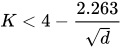
In 2007, Conte et al. proved that ,[2] slightly improving on the bound for fixed .


In the same year, Crane showed that for .[5]

Considering the reverse inequality, Dubinin and Sugawa have proven that (under the same conditions as above) there exists a critical point such that .[6]

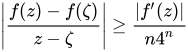
The problem of optimizing this lower bound is known as the dual mean value problem.[7]