Measure algebra From Wikipedia, the free encyclopedia In mathematics, a measure algebra is a Boolean algebra with a countably additive positive measure. A probability measure on a measure space gives a measure algebra on the Boolean algebra of measurable sets modulo null sets. A measure algebra is a Boolean algebra B {\displaystyle B} with a measure m {\displaystyle m} , which is a real-valued function on B {\displaystyle B} such that: m ( 0 ) = 0 , m ( 1 ) = 1 {\displaystyle m(0)=0,\ m(1)=1} m ( x ) > 0 {\displaystyle m(x)>0} if x ≠ 0 {\displaystyle x\neq 0} m ( a ) ≤ m ( b ) {\displaystyle m(a)\leq m(b)} for a ≤ b {\displaystyle a\leq b} If a 0 , a 1 , a 2 , … {\displaystyle a_{0},a_{1},a_{2},\dots } are pairwise disjoint, then m ( ∑ n = 0 ∞ a n ) = ∑ n = 0 ∞ m ( a n ) {\displaystyle m{\left(\sum _{n=0}^{\infty }a_{n}\right)}=\sum _{n=0}^{\infty }m(a_{n})} References Jech, Thomas (2003), "Saturated ideals" (PDF), Set Theory, Springer Monographs in Mathematics (third millennium ed.), Berlin, New York: Springer-Verlag, p. 415, doi:10.1007/3-540-44761-X_22, ISBN 978-3-540-44085-7 Related Articles~TimelinesTop QsFact Checks
 with a measure
  , which is a real-valued function on such that:
 if
if 
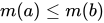 for
for 
 are pairwise disjoint, then