Messier 47
Open cluster in the constellation Puppis
From Wikipedia, the free encyclopedia
Messier 47 (M47 or NGC 2422), also known as NGC 2478[3] is an open cluster in the mildly southern constellation of Puppis. It was discovered by Giovanni Batista Hodierna before 1654 and in his then keynote work re-discovered by Charles Messier on 1771.[a] It was also independently discovered by Caroline Herschel.

| Messier 47 | |
|---|---|
Open cluster Messier 47 in Puppis Credit: NOIRLab / NSF / AURA | |
| Observation data (J2000.0 epoch) | |
| Right ascension | 07h 36.6m [1] |
| Declination | −14° 30′[1] |
| Distance | 498 pc[1] |
| Apparent magnitude (V) | 4.4[2] |
| Apparent dimensions (V) | 30′[2] |
| Physical characteristics | |
| Mass | 453[1] M☉ |
| Radius | 10.61 pc[1] |
| Estimated age | 78 million years |
| Other designations | NGC 2422, NGC 2478, Cr 152 |
| Associations | |
There is no cluster in the position indicated by Messier, which he expressed in terms of its right ascension and declination with respect to the star 2 Puppis. However, if the signs (+ and −) that he wrote are swapped, the position matches.[4] Until that equivalency was found, M47 was considered a lost Messier Object. The identification (ad idem) came only in 1959, with a realization by the Canadian astronomer T. F. Morris.[5]
M47 is centered about 1,600 light-years away and is about 78 million years old. The member stars have been measured down to about red dwarfs at apparent magnitude 19. There are around 500 members,[1] the brightest being HD 60855, a magnitude 5.7 Be star. The cluster is dominated by hot class B main sequence and giant stars, but a noticeable colour contrast comes from its brightest red giants.[5]
It about a degree from Messier 46, which is much older and much further away.[5]
Gallery
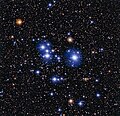 Image of star cluster Messier 47 taken using the Wide Field Imager camera, installed on the MPG/ESO 2.2-metre telescope at ESO’s La Silla Observatory in Chile.


