Messier 70
Globular cluster in the constellation Sagittarius
From Wikipedia, the free encyclopedia
Messier 70 or M70, also known as NGC 6681, is a globular cluster of stars to be found in the south of Sagittarius.[a] It was discovered by Charles Messier in 1780.[b][6] The famous comet Hale–Bopp was discovered near this cluster in 1995.[10][c]

| Messier 70 | |
|---|---|
Globular cluster Messier 70 by Hubble Space Telescope; 3.3′ view | |
| Observation data (J2000 epoch) | |
| Class | V[1] |
| Constellation | Sagittarius |
| Right ascension | 18h 43m 12.76s[2] |
| Declination | –32° 17′ 31.6″[3] |
| Distance | 29.4 kly (9.0 kpc)[4] |
| Apparent magnitude (V) | 7.9[5] |
| Apparent dimensions (V) | 8.0′[6] |
| Physical characteristics | |
| Mass | 1.79×10⁵[4] M☉ |
| Radius | 34 ly[7] |
| Tidal radius | 11.2′[8] |
| Metallicity | [Fe/H] = –1.35[9] dex |
| Estimated age | 12.80 Gyr[9] |
| Other designations | GCl 101, M70, NGC 6681[3] |
It is about 29,400[4] light years away from Earth and around 6,500 light-years[11] from the Galactic Center. It is roughly the same size and luminosity as its neighbour in space, M69.[12] M70 has a very small core radius of 0.22 ly (0.068 pc)[13] and a half-light radius of 182.0 ly (55.80 pc).[14] This cluster has undergone core collapse, leaving it centrally concentrated[15] with the luminosity distribution following a power law.[11]
There are two distinct stellar populations in the cluster, with each displaying unique abundances. These likely represent different generations of stars.[16] Five known variable stars lie within its broadest radius, the tidal radius, all of which are RR Lyrae variables.[8][17] The cluster may have two blue stragglers near the core.[11]
Gallery
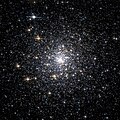 Image by Hubble Space Telescope
 Map showing M70, against a conventional (southern) horizon


