NGC 1400
Galaxy in the constellation Eridanus
From Wikipedia, the free encyclopedia
NGC 1400 is an elliptical galaxy in the constellation Eridanus. At a distance of 65 million light-years from Earth, it was discovered by John Herschel in 1786. It is a member of the NGC 1407 group, whose brightest member is NGC 1407. The NGC 1407 group is part of the Eridanus Cluster, a cluster of 200 galaxies.

| NGC 1400 | |
|---|---|
Hubble Space Telescope image of NGC 1400 | |
| Observation data (J2000 epoch) | |
| Constellation | Eridanus |
| Right ascension | 03h 39m 30.851s[1] |
| Declination | −18° 41′ 17.25″[1] |
| Redshift | 0.001769[2] |
| Heliocentric radial velocity | 530 km/s[2] |
| Distance | 82 Mly (25 Mpc)[3] |
| Apparent magnitude (V) | 10.96[3] |
| Apparent magnitude (B) | 11.92[3] |
| Characteristics | |
| Type | SA0−[3] |
| Apparent size (V) | 2.3′ × 2.0′[3] |
| Other designations | |
| MCG -03-10-022, PGC 13470[2] | |
NGC 1400 is an early-type E0 galaxy. Despite their name, early-type galaxies are much older than spiral galaxies, and mostly comprise old, red-colored stars. Very little star formation occurs in these galaxies; the lack of star formation in elliptical galaxies appears to start at the center and then slowly propagates outward.[4]
NGC 1400 has had star formation in the past, which was caused by NGC 1400 falling into the NGC 1407 group.[5]
One supernova has been observed in NGC 1400: SN 2021hcz (type Ia, mag. 15.4).[6]
Gallery
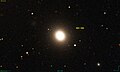 DSS image of NGC 1400
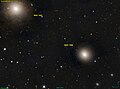 Pan-STARRS image of NGC 1400


