NGC 1433
Galaxy in the constellation Horologium
From Wikipedia, the free encyclopedia
NGC 1433 (also known as PGC 13586) is a barred spiral galaxy with a double ring structure located in the constellation of Horologium. It was discovered by James Dunlop on 28 September 1826,[5] and lies a distance of 46 million light-years from Earth.[4]

| NGC 1433 | |
|---|---|
| |
| Observation data (J2000 epoch) | |
| Constellation | Horologium |
| Right ascension | 03h 42m 01.553s[2] |
| Declination | −47° 13′ 19.49″[2] |
| Redshift | 0.003590[2] |
| Heliocentric radial velocity | 1076±1 km/s[3] |
| Distance | 46.2 ± 3.8 Mly (14.15 ± 1.15 Mpc)[4] |
| Apparent magnitude (V) | 9.99[2] |
| Apparent magnitude (B) | 10.84[2] |
| Characteristics | |
| Type | (R'_1)SB(rs)ab [3] |
| Apparent size (V) | 6.5′ × 5.9′[3] |
| Other designations | |
| HIPASS J0342-47, QDOT B0340269-472245, [CHM2007] LDC 266, J034201.55-4713194, AM 0340-472, IRAS 03404-4722, SGC 034027-4722.8, [VDD93] 31, 6dFGS gJ034201.5-471319, LEDA 13586, SINGG HIPASS J0342-47, ESO 249-14, 2MASX J03420155-4713194, [A81] 034029-4724, ESO-LV 249-0140, PSCz Q03404-4722, [CHM2007] HDC 257 J034201.55-4713194 | |
NGC 1433 is a Seyfert galaxy with an active galactic nucleus. The central region of the galaxy displays intense star formation activity, with an irregular star-forming ring of 5″ (or 0.3 kpc) radius and weak radio wave emission. Star formation is also noticeable in the spiral arms but not the bar of the galaxy.[6] NGC 1433 is being studied as part of a survey of 50 nearby galaxies known as the Legacy ExtraGalactic UV Survey (LEGUS).[7] A jet of material flowing away from the central black hole of the galaxy extending for only 150 light-years has been found. It is the smallest molecular outflow ever observed in a galaxy beyond our own.[8]
NGC 1433 is member of the Dorado Group.[4][9]
Supernova
Gallery
 LEGUS, optical.[8]
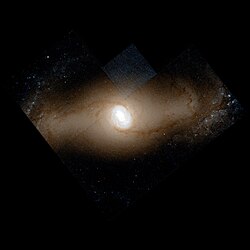 Hubble Space Telescope, optical.
 STSci DSS, optical.
 James Webb Space Telescope, MIRI; compass.


_(weic2306b).jpeg)
