NGC 1511
From Wikipedia, the free encyclopedia
| NGC 1511 | |
|---|---|
.jpg) NGC 1511 imaged by the Hubble Space Telescope | |
| Observation data (J2000 epoch) | |
| Constellation | Hydrus |
| Right ascension | 03h 59m 36.9554s[1] |
| Declination | −67° 38′ 03.094″[1] |
| Redshift | 0.004474[1] |
| Heliocentric radial velocity | 1341 ± 5 km/s[1] |
| Distance | 64.4 ± 4.5 Mly (19.76 ± 1.39 Mpc)[1] |
| Group or cluster | NGC 1511 Group (LGG 107)[2] |
| Apparent magnitude (V) | 11.3[1] |
| Characteristics | |
| Type | SAa pec: HII[1] |
| Size | ~83,000 ly (25.45 kpc) (estimated)[1] |
| Apparent size (V) | 3.5′ × 1.3′[1] |
| Other designations | |
| ESO 055- G 004, IRAS 03594-6746, 2MASX J03593698-6738033, MCG +00-12-072, PGC 14236[1] | |
NGC 1511 is a barred spiral galaxy in the constellation of Hydrus. Its velocity with respect to the cosmic microwave background is 1341 ± 5 km/s, which corresponds to a Hubble distance of 19.76 ± 1.39 Mpc (~64 million light-years).[1] It was discovered by British astronomer John Herschel on 2 November 1834.[3][4]
Eskridge, Frogel, and Pogge published a paper in 2002 describing the morphology of 205 closely spaced spiral or lenticular galaxies. The observations were made in the H-band of the infrared and in the B-band (blue). Eskridge and colleagues described NGC 1511 as:
Nearly edge-on. SW side of bulge is hidden by a prominent dust band, indicating that the bulge is small. Inner SE spiral arm has several very bright star-forming knots. Arms do not appear very extended (may be due to foreshortening), but there is an extended, featureless LSB [Low Surface Brightness] disk beyond the arms.[5]
NGC 1511 Group
Supernova
One supernova has been observed in NGC 1511: SN 1935C (type unknown, mag. 12.5).[7] The supernova was discovered by Emily Hughes Boyce on 16 August 1935, and was initially thought to be either a supernova, or a nova associated with the Large Magellanic Cloud. It was classified as a nova, and known as either HV 11970 or Nova Hydri 1935. In September 1988, Sidney Van den Bergh and Martha L. Hazen concluded definitively that the object was a supernova in NGC 1511, and the star was given the designation SN 1935C.[8][9]
Image gallery
 NGC 1511 imaged by Legacy Surveys
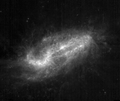 NGC 1511 imaged by the James Webb Space Telescope


