NGC 1624
Open cluster in the constellation Perseus
From Wikipedia, the free encyclopedia
NGC 1624, also known as Sh 2-212[3] in the Sharpless catalog, is a very young open cluster in the constellation Perseus inside an emission nebula. It was discovered by German-British astronomer William Herschel in 1790.[4] Together with Sh 2-211, this nebula is part of the Tribble Nebulae.[5]NGC 1624 is about 20,000 ly (6,000 pc) from Earth, and latest estimates give it an age of less than 4 million years.[2] Its apparent magnitude is 11.8,[1] and apparent diameter is about 3.0 arc minutes.[4] Its celestial location is right ascension (α) 04h 40m 36.0s and declination (δ) +50° 27′ 42″.[1] It is potentially an area of massive star formation.[6]

| NGC 1624 | |
|---|---|
Image of NGC 1624 with the Isaac Newton Telescope Credit: IGAPS | |
| Observation data (J2000 epoch) | |
| Right ascension | 04h 40m 36.0s[1] |
| Declination | +50° 27′ 42″[1] |
| Distance | 20000 ± 2000 ly (6000 ± 600 pc[2]) |
| Apparent magnitude (V) | 11.8[1] |
| Physical characteristics | |
| Estimated age | <4 Myr[2] |
| Other designations | Cr 53, C 0436+503, OCl 403, Tribble Nebula, Little Cocoon Nebula |
| Associations | |
| Constellation | Perseus |
According to Robert Trumpler's classification of open clusters, this cluster contains fewer than 50 stars (letter p) with a high concentration (I) and whose magnitudes are distributed over an average interval (number 2). The letter n at the end (I2pn) means that the cluster is inside a nebula.
Gallery
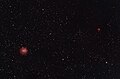 Sh2-211 and Sh2-212
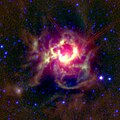 NGC 1624 in mid-infrared with unWISE


See also
- Cocoon Nebula
- Rosette Nebula
- Little Rosette Nebula
- Sh 2-82, also known as the 'Little Cocoon Nebula'

