NGC 3501
Spiral galaxy in the constellation Leo
From Wikipedia, the free encyclopedia
NGC 3501 is an edge-on spiral galaxy 80 million light years away, located in the constellation Leo. It was discovered on 23 April 1881 by French astronomer Édouard Stephan.[5] NGC 3501 is a young galaxy, consisting mostly of stars aged between 2 and 8 billion years.[4]

| NGC 3501 | |
|---|---|
NGC 3501 imaged by the Hubble Space Telescope | |
| Observation data (J2000 epoch) | |
| Constellation | Leo |
| Right ascension | 11h 02m 47.307s[1] |
| Declination | +17° 59′ 22.31″[1] |
| Redshift | 0.003769[2] |
| Heliocentric radial velocity | 1130[2] |
| Distance | 77.02 ± 6.06 Mly (23.615 ± 1.857 Mpc)[2] |
| Apparent magnitude (B) | 13.8[3] |
| Characteristics | |
| Type | Scd:[2] |
| Mass | 1.5×10¹⁰[4] M☉ |
| Size | 89,600 ly (27,480 pc)[2] |
| Apparent size (V) | 4.4′ × 0.56′[2] |
| Other designations | |
| HOLM 224B, UGC 6116, MCG +03-28-051, PGC 33343, CGCG 095-097 | |
NGC 3501 was imaged by the Hubble Space Telescope in 2014, showing an edge-on spiral galaxy; its companion NGC 3507 is not included in the photograph.[6] It is a member of the NGC 3607 Group of galaxies, which is a member of the Leo II Groups, a series of galaxies and galaxy clusters strung out from the right edge of the Virgo Supercluster.[7]
Gallery
 NGC 3501 (SDSS DR14)
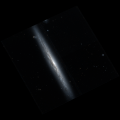 NGC 3501 (HST)


