NGC 3557
From Wikipedia, the free encyclopedia
| NGC 3557 | |
|---|---|
 NGC 3557 imaged by SDSS | |
| Observation data (J2000 epoch) | |
| Constellation | Centaurus |
| Right ascension | 11h 09m 57.6396s[1] |
| Declination | −37° 32′ 21.037″[1] |
| Redshift | 0.010270 [1] |
| Heliocentric radial velocity | 3079 ± 6 km/s[1] |
| Distance | 163.5 ± 11.5 Mly (50.12 ± 3.53 Mpc)[1] |
| Apparent magnitude (V) | 10.4[1] |
| Characteristics | |
| Type | E3[1] |
| Size | ~246,200 ly (75.48 kpc) (estimated)[1] |
| Apparent size (V) | 4.0′ × 3.0′[1] |
| Other designations | |
| ESO 377- G 016, 2MASX J11095583-3732345, MCG -06-25-005, PGC 33871[1] | |
NGC 3557 is a large elliptical galaxy in the constellation of Centaurus. Its velocity with respect to the cosmic microwave background is 3398 ± 23 km/s, which corresponds to a Hubble distance of 50.12 ± 3.53 Mpc (~163 million light-years).[1] However, 20 non-redshift measurements give a distance of 32.905 ± 2.289 (~107 million light-years).[2] The galaxy was discovered by British astronomer John Herschel on 21 April 1835.[3]
The SIMBAD database lists NGC 3557 as a Seyfert I Galaxy, i.e. it has a quasar-like nuclei with very high surface brightnesses whose spectra reveal strong, high-ionisation emission lines, but unlike quasars, the host galaxy is clearly detectable.[4] Additionally, NED lists NGC 3557 as a LINER galaxy, i.e. a galaxy whose nucleus has an emission spectrum characterized by broad lines of weakly ionized atoms.[1]
Supernova
One supernova has been observed in NGC 3557.
- SN 2023bpx (Type Ia, mag. 17) was discovered by the Backyard Observatory Supernova Search (BOSS) on 12 February 2023.[6]
Image gallery
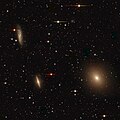 NGC 3557 (right), NGC 3564 (lower-left), and NGC 3568 (upper-left).


