NGC 3972
Galaxy in the constellation Ursa Major
From Wikipedia, the free encyclopedia
NGC 3972 is a spiral galaxy located in the northern constellation of Ursa Major. It was discovered by William Herschel on April 14, 1789.[7] This galaxy is located 66 million light years away and is receding with a heliocentric radial velocity of 846 km/s.[2] It is a member of the NGC 3992 Group of galaxies.[4]

| NGC 3972 | |
|---|---|
 NGC 3972 imaged by the Hubble Space Telescope.[1] | |
| Observation data (J2000 epoch) | |
| Constellation | Ursa Major |
| Right ascension | 11h 55m 45.1s[2] |
| Declination | +55° 19′ 14″[2] |
| Redshift | 0.002799[3] |
| Heliocentric radial velocity | 846 km/s[2] |
| Distance | 66.0 Mly (20.23 Mpc)[2] |
| Group or cluster | NGC 3992 Group[4] |
| Apparent magnitude (V) | 13.14[3] |
| Characteristics | |
| Type | SA(s)bc,[5] SBbc[6] |
| Size | c. 50,000 ly |
| Other designations | |
| IRAS 11531+5535, 2MASX J11554511+5519144, UGC 6904, LEDA 37466, MCG +09-20-032[3] | |
NGC 3972 along with NGC 3977 are listed together as Holm 304 in Erik Holmberg's A Study of Double and Multiple Galaxies Together with Inquiries into some General Metagalactic Problems, published in 1937.[8] This grouping is purely optical, as NGC 3977 is about four times farther away than NGC 3972.[9]
NGC 3972 is a radio galaxy, i.e. a galaxy with giant regions of radio emission extending well beyond its visible structure.[10][11]
NGC 3631 Group
Supernovae
Two supernovae have been observed in NGC 3972:
- SN 2011by (Type Ia, mag. 14.2) was discovered by Zhangwei Jin and Xing Gao in China, on 27 April 2011.[13][14] It was ten days short of maximum, and positioned at an offset 5.3″ east and 19.1″ north of the galactic nucleus.[15]
- SN 2021acna (Type II, mag. 19.39) was discovered by the Zwicky Transient Facility on 30 October 2021.[16]
Gallery
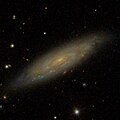 NGC 3972 by the Sloan Digital Sky Survey

