NGC 524
Lenticular galaxy in the constellation Pisces
From Wikipedia, the free encyclopedia
NGC 524 is a lenticular galaxy in the constellation Pisces. It is at a distance of about 90 million light-years away from Earth. In the central bulge of the galaxy is visible gas forming a spiral structure.[2] It is the largest galaxy in the small NGC 524 group of galaxies, which is associated with NGC 488 and its group.[3] It was discovered by William Herschel on 4 September 1786.[4]

Right ascension01h 24m 47.7s[1]
Declination+09° 32′ 20″[1]
| NGC 524 | |
|---|---|
NGC 524 imaged by the Hubble Space Telescope | |
| Observation data (J2000 epoch) | |
| Constellation | Pisces |
| Right ascension | 01h 24m 47.7s[1] |
| Declination | +09° 32′ 20″[1] |
| Redshift | 2403 ± 5 km/s[1] |
| Distance | 86.1 ± 13.7 Mly (26.4 ± 4.2 Mpc)[1] |
| Apparent magnitude (V) | 10.5 |
| Characteristics | |
| Type | SA(rs)0+[1] |
| Apparent size (V) | 2.8′ × 2.8′[1] |
| Other designations | |
| UGC 968, PGC 5222[1] | |
Observation
On 4 May 1985 (the May 1985 lunar eclipse) it was occulted by the Moon during a Total Lunar Eclipse over South Africa and Antarctica.[5]: 160
Supernovae
Two supernovae have been observed in the galaxy:
- SN 2000cx (Type Ia-pec, mag. 14.5) was discovered by the Lick Observatory Supernova Search (LOSS) on 17 July 2000.[6][7] This supernova reached magnitue 13.1, and was the brightest observed in the year 2000.[8]
- SN 2008Q (Type Ia, mag. 16.5) was discovered by Giancarlo Cortini on 26 January 2008.[9][10]
Gallery
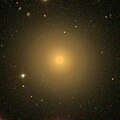 NGC 524 (SDSS DR14)
 NGC 524 (HST)


.jpg)