NGC 5448
Galaxy in the constellation Ursa Major
From Wikipedia, the free encyclopedia
NGC 5448 is a spiral galaxy in the constellation Ursa Major. The galaxy lies about 95 million light years away from Earth based on redshift-independent methods, which means, given its apparent dimensions, that NGC 5448 is approximately 120,000 light years across.[1] It was discovered by William Herschel on May 15, 1787.[3]

| NGC 5448 | |
|---|---|
NGC 5448 imaged by the 32-inch Schulman Telescope at Mount Lemmon Observatory | |
| Observation data (J2000 epoch) | |
| Constellation | Ursa Major |
| Right ascension | 14h 02m 50.0608s[1] |
| Declination | +49° 10′ 21.402″[1] |
| Redshift | 0.006725 ± 0.000005 [1] |
| Heliocentric radial velocity | 2,016 ± 1 km/s[1] |
| Distance | 95.6 ± 28.2 Mly (29.3 ± 8.6 Mpc)[1] |
| Group or cluster | NGC 5448 Group |
| Apparent magnitude (V) | 11.2[2] |
| Characteristics | |
| Type | (R)SAB(r)a [1] |
| Size | ~120,000 ly (36.7 kpc) (estimated)[1] |
| Apparent size (V) | 3.8′ × 2.0′ [2] |
| Notable features | LINER |
| Other designations | |
| IRAS 14009+4924, UGC 8969, MCG +08-26-003, PGC 50031, CGCG 247-004[1] | |
Characteristics
The galaxy has an elliptical bulge with boxy outer isophotes and an X-shape. A low-surface-brightness bar is seen running diagonally in the bulge.[4] Stellar kinematics indicate that there is a small stellar disk in the inner 7 arcseconds of the galaxy, which is inclined by about 13 degrees with the respect to the rest of the galaxy.[5] The stellar population in the centre of the galaxy is younger than that of the rest of the surrounding area.[6] In images by Hubble Space Telescope a prominent dust lane is visible in the circumnuclear region of the galaxy and three more diffuse a bit further away.[5]
Spiral arms emerge from the ends of the bar and wrap around forming a nearly complete ring. The arms are initially broad and high-contrast but after 45° degrees of revolution become narrow, while after completing a quarter of a revolution they start to branch. The galaxy has faint outer arms.[4] Many HII regions are visible in the inner arms, while knots are also visible in the outer arms.[7] Many dust lanes are visible across the disk.[5]
The nucleus of the galaxy has been found to be active and based on its emission lines has been identified as a type 2 LINER.[8] The most accepted theory for the energy source of active galactic nuclei is the presence of an accretion disk around a supermassive black hole. The mass of the black hole in the centre of NGC 5448 is estimated to be 107.3 (20 million) M☉ based on the absolute bulge magnitude.[9]
The galaxy is seen at high inclination viewed at an angle of 64°.[5]
Nearby galaxies
Gallery
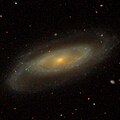 NGC 5448 imaged by Sloan Digital Sky Survey

