NGC 6522
Globular cluster in the constellation of Sagittarius
From Wikipedia, the free encyclopedia
NGC 6522 is a globular cluster of stars in the southern constellation of Sagittarius. It was discovered by German-British astronomer William Herschel on June 24, 1784. The cluster has an apparent visual magnitude of 8.3 and an angular diameter of 9.4′.[3] It is located at a distance of 25.1 kly (7.7 kpc) from the Sun,[2] and lies in the Milky Way's central bulge,[7] about 2.0 kly (0.6 kpc) from the Galactic Center.[1] The cluster is centered in a region of the sky known as Baade's Window.[8] It is highly impacted by reddening due to interstellar dust and the view is heavily contaminated by field stars, making it more difficult to identify members.[9]

| NGC 6522 | |
|---|---|
| |
| Observation data (J2000 epoch) | |
| Class | VI[citation needed] |
| Constellation | Sagittarius |
| Right ascension | 18h 03m 34.08s[1] |
| Declination | −30° 02′ 02.3″[1] |
| Distance | 25.1 kly (7.7 kpc)[2] |
| Apparent magnitude (V) | 8.3[3] |
| Apparent dimensions (V) | 9.4′[3] |
| Physical characteristics | |
| Absolute magnitude | −7.67[1] |
| Mass | 5.93×10⁴[4] M☉ |
| Metallicity | [Fe/H] = –1.34[2] dex |
| Estimated age | 12.0 Gyr[5] |
| Other designations | GCl 82, C 1800-300[6] |
NGC 6522 is possibly the oldest star cluster in the Milky Way,[10] with an age of more than 12 billion years.[11][12] It is a core collapsed cluster with a core radius of 0.5′ and a 1.0′ half-light radius.[9] The cluster formed four billion years before the Milky Way galactic bar appeared, and may have been confined to the bar for a period of time. At present it trails the bar in its orbit around the core.[13]
This is a low mass globular cluster with an estimated 5.93×10⁴ times the mass of the Sun. Distinctive chemical abundances among the members indicate the cluster has multiple populations of stars, with the younger populations exhibiting pollution from earlier generations.[4] Twenty variable stars have been identified as members of NGC 6522, consisting of eight RR Lyrae, three type II Cepheids, and nine long-period variable stars.[9] Six pulsars have been discovered.[14]
Gallery
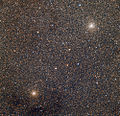 The globular clusters NGC 6528 (lower left) is close to NGC 6522 (upper right)
 The cluster is located in Baade's Window, a region of night sky that is not clouded by dust from the Milky Way.


