Nemes
Formal headcloth worn by the kings of Ancient Egypt
From Wikipedia, the free encyclopedia
Nemes (English: /ˈnɛmɛs/) were pieces of striped head cloth worn by pharaohs in ancient Egypt.[1] It covered the whole crown and behind of the head and nape of the neck (sometimes also extending a little way down the back) and had lappets, two large flaps which hung down behind the ears and in front of both shoulders.[2] It was sometimes combined with the double crown,[3] as it is on the statues of Ramesses II at Abu Simbel.

CountryEgypt
MaterialLinen
| Nemes | |
|---|---|
Nemes, symbolizing the Pharaoh’s power, both in life and death | |
| Details | |
| Country | Egypt |
| Material | Linen |
| ||||
| Nemes, striped head cloth (crown as determinative)
| ||||
|---|---|---|---|---|


| ||||
| Nemes in hieroglyphs | ||||
|---|---|---|---|---|

Modern recreations

The occult society "The Hermetic Order of the Golden Dawn" used headwear similar to ancient Egyptian nemes, which they spelled "nemyss", as part of their "traditional ceremonial garb".[4]
Gallery
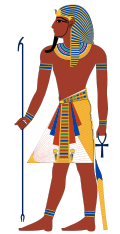 Modern drawing of a pharaoh with a nemes
 The back and upper part of portrait statuette of pharaoh Amenemhat III, wearing a nemes, c. 1853 – c. 1805 BCE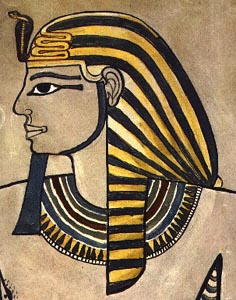

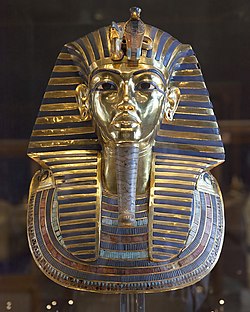


 Relief from the Sanctuary of Khonsu Temple depicting Rameses III wearing a nemes
 Miniature metal nemes
 CE 1st-century Roman emperor as pharaoh (Louvre)


.jpg)


.jpg)

See also
- Deshret
- Hedjet
- Pschent (double crown)
- Clothing in ancient Egypt
Further reading
- Toby A. H. Wilkinson, Early Dynastic Egypt, Routledge 1999
- Bruce Graham Trigger, Ancient Egypt: A Social History, Cambridge University Press 1983
- Fragment of a basalt Egyptian-style statue of Ptolemy I
