Nymphaea ampla
Species of plant in the family Nymphaeaceae
From Wikipedia, the free encyclopedia
Nymphaea ampla, also known as the dotleaf waterlily,[3] is a species of flowering plant in the family Nymphaeaceae.[4] It is native to Texas, Florida, Mexico, Central America, the Caribbean, and northern and western South America.[2]

| Nymphaea ampla | |
|---|---|
| |
| In bloom in Guatemala | |
_(8410609659).jpg) | |
| Botanical illustration | |
Scientific classification  | |
| Kingdom: | Plantae |
| Clade: | Embryophytes |
| Clade: | Tracheophytes |
| Clade: | Spermatophytes |
| Clade: | Angiosperms |
| Order: | Nymphaeales |
| Family: | Nymphaeaceae |
| Genus: | Nymphaea |
| Subgenus: | Nymphaea subg. Brachyceras |
| Species: | N. ampla |
| Binomial name | |
| Nymphaea ampla | |
| Synonyms[2] | |
| |

It is depicted in Mayan art alongside jaguars and kings, held cultural significance as a symbol of life, fertility, and birth, with its opiate-like effects used for calming and inducing mild trances.[5]
Description
Vegetative characteristics
Nymphaea ampla is a perennial herb[6] with dark brown,[7] ovoid, unbranched rhizomes without stolons.[8] The coriaceous,[7] ovate to orbiculate floating leaves[8] with a dentate margin[9] are 15–45 cm long, and 15–45 cm wide.[8]
Generative characteristics
The yellowish white, fragrant, diurnal,[7] 7–18 cm wide flowers[8] extend well beyond the water surface.[7]
Cytology
The chromosome count is n = 14. The genome size is 772.62 Mb.[10] The chloroplast genome is 159879 bp long.[11]
Taxonomy
It was first described as Castalia ampla Salisb. by Richard Anthony Salisbury in 1805. It was moved to the genus Nymphaea L. as Nymphaea ampla (Salisb.) DC. by Augustin Pyramus de Candolle in 1821.[2] It is placed in the subgenus Nymphaea subg. Brachyceras.[12][3]
Habitat
Cultural significance
Nymphaea ampla is widely represented in Mayan art, especially in its depictions with jaguars and Mayan kings. Its cultural importance can be seen in one of the Mayan names of the plant; nikte’ha’ (The Maya term nikte’ha’ literally means “flower of the water”, but has also been interpreted symbolically as “vulva of the water”) as it would have represented life, sexual activity, fertility, and birth. The plant causes opiate-like effects on the user and is known to have been used as a calmative and mild trance inducer.[13]
Conservation
Gallery

 At the Bergianska trädgården
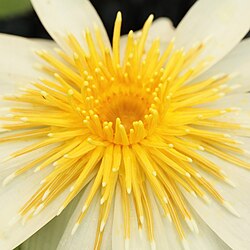 Close-up of flower
.jpg)


