Omega Eridani
Star in the constellation Eridanus
From Wikipedia, the free encyclopedia
Omega Eridani (ω Eri) is a single[10] star in the constellation Eridanus. It is visible to the naked eye with an apparent visual magnitude is 4.37.[2] The distance to this star, as determined by the parallax method, is around 235 light years.

 | |
| Observation data Epoch J2000.0 Equinox J2000.0 (ICRS) | |
|---|---|
| Constellation | Eridanus |
| Right ascension | 04h 52m 53.66995s[1] |
| Declination | −05° 27′ 09.6972″[1] |
| Apparent magnitude (V) | 4.37[2] |
| Characteristics | |
| Spectral type | A9 IVn[3] |
| U−B color index | +0.12[2] |
| B−V color index | +0.26[2] |
| Astrometry | |
| Radial velocity (Rv) | −8.3[4] km/s |
| Proper motion (μ) | RA: −17.86[1] mas/yr Dec.: +25.57[1] mas/yr |
| Parallax (π) | 13.88±0.24 mas[1] |
| Distance | 235 ± 4 ly (72 ± 1 pc) |
| Absolute magnitude (MV) | 0.10[5] |
| Details | |
| Radius | 6.7[6] R☉ |
| Luminosity | 69[7] L☉ |
| Surface gravity (log g) | 3.4[5] cgs |
| Temperature | 6,878[7] K |
| Metallicity [Fe/H] | 0.18[5] dex |
| Rotational velocity (v sin i) | 186[8] km/s |
| Other designations | |
| ω Eri, BD−05°1068, 61 Eridani, HD 31109, HIP 22701, HR 1560, SAO 131568[9] | |
| Database references | |
| SIMBAD | data |
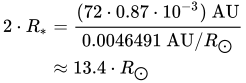
It is an A-type subgiant star with a stellar classification of A9 IVn,[3] where the 'n' suffix indicates a broad ("nebulous") absorption due to rotation. The projected rotational velocity is 186[8] km/s.[8] This gives the star an oblate shape with an equator that is 13% wider than the polar radius. The angular size of Omega Eridani is 0.87 mas.[11] At an estimated distance of the star, this yields a physical size of around 6.7 times the radius of the Sun.[6]
Omega Eridani was long thought to be a single-lined spectroscopic binary system, with an orbital period of 3,057 days (8.4 years) and an eccentricity of 0.46.[12] However, newer and higher-quality radial velocity observations find no evidence for a companion, casting serious doubt on the status of Omega Eridani as a binary star.[10]