Omega meson
Subatomic particle
From Wikipedia, the free encyclopedia
The omega meson (ω) is a flavourless meson formed from a superposition of an up quark–antiquark and a down quark–antiquark pair. It is part of the vector meson nonet[4][5] and mediates the nuclear force along with pions and rho mesons.

| Composition | ω: |
|---|---|
| Statistics | Bosonic |
| Family | Mesons |
| Interactions | Strong, weak, electromagnetic, gravity |
| Symbol | ω |
| Antiparticle | Self |
| Theorized | Yoichiro Nambu[1] (1957) |
| Discovered | Lawrence Berkeley National Laboratory (1961)[2][3] |
| Types | 1 |
| Mass | 782.66±0.13 MeV/c2 |
| Mean lifetime | (7.58±0.11)×10−23 s |
| Decays into | π+ +π0 +π− or π0 +γ |
| Electric charge | 0 e |
| Spin | 1 |
| Isospin | 0 |
| Hypercharge | 0 |
| Parity | −1 |
| C parity | −1 |
Properties
The most common decay mode for the ω meson is π+
π0
π−
at 89.2%±0.7%, followed by π0
γ at 8.34%±0.26%.[6]
 ...
...The quark composition of the ω meson can be thought of as a mix between uu, dd and ss states, but it is very nearly a pure symmetric uu–dd state. This can be shown by deconstructing the wave function of the ω into its component parts. We see that the ω and ϕ mesons are mixtures of the SU(3) wave functions as follows.[7]
- ,
- ,


where
- is the nonet mixing angle,
- and
- .

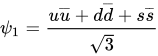
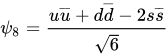
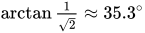
The mixing angle at which the components decouple completely can be calculated to be , which almost corresponds to the actual value calculated from the masses of 35°. Therefore, the ω meson is nearly a pure symmetric uu–dd state.