Perron's formula
Formula for the sum of an arithmetic function
From Wikipedia, the free encyclopedia
In mathematics, and more particularly in analytic number theory, Perron's formula is a formula discovered by Oskar Perron to calculate the sum of an arithmetic function, by means of an inverse Mellin transform.[1]
Statement
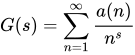
Let be an arithmetic function, and let


be the corresponding Dirichlet series. Presume the Dirichlet series to be uniformly convergent for . Then Perron's formula is


Here, the prime on the summation indicates that the last term of the sum must be multiplied by 1/2 when x is an integer. The integral is not a convergent Lebesgue integral; it is understood as the Cauchy principal value. The formula requires that c > 0, c > σ, and x > 0.
Proof
An easy sketch of the proof comes from taking Abel's sum formula

This is nothing but a Laplace transform under the variable change Inverting it one gets Perron's formula.

Proofs of Perron's formula have been published by Tom M. Apostol[2] and by Gérald Tenenbaum.[3]
Examples
Because of its general relationship to Dirichlet series, the formula is commonly applied to many number-theoretic sums. Thus, for example, one has the famous integral representation for the Riemann zeta function:
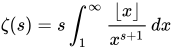
and a similar formula for Dirichlet L-functions:
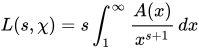
where
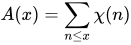
and is a Dirichlet character. Other examples appear in the articles on the Mertens function and the von Mangoldt function.

Generalizations
Perron's formula is a special case of the formula

where
and
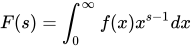
the Mellin transform. The Perron formula is the special case of the test function for the Heaviside step function.

