Portal:Aviation
Wikipedia portal for content related to Aviation
From Wikipedia, the free encyclopedia

| Main page | Categories & Main topics |
|
Tasks and Projects |
The Aviation Portal

Aviation includes the activities surrounding mechanical flight and the aircraft industry. Aircraft include fixed-wing and rotary-wing types, morphable wings, wing-less lifting bodies, as well as lighter-than-air aircraft such as hot air balloons and airships.
Aviation began in the 18th century with the development of the hot air balloon, an apparatus capable of atmospheric displacement through buoyancy. Clément Ader built the "Ader Éole" in France and made an uncontrolled, powered hop in 1890. This was the first powered aircraft, although it did not achieve controlled flight. Some of the most significant advancements in aviation technology came with the controlled gliding flying of Otto Lilienthal in 1896. A major leap followed with the construction of the Wright Flyer, the first powered airplane by the Wright brothers in the early 1900s.
Since that time, aviation has been technologically revolutionized by the introduction of the jet engine which enabled aviation to become a major form of transport throughout the world. In 2024, there were 9.5 billion passengers worldwide according to the ICAO. As of 2018, estimates suggest that 11% of the world's population traveled by air, with up to 4% taking international flights. (Full article...)
Selected article
.jpg)
Selected image

Did you know
...that on October 5, 1914, a French Voisin III pilot scored the first air-to-air kill of World War I? ...that the crash of Crossair Flight LX498 was initially attributed to cell phone use, and led to bans of cell phones in airplanes in several countries? ... the Safety Promotion Center, established by Japan Airlines after the worst single aircraft accident in history, has passengers' farewell letters and wreckage on display to educate employees about safety?
General images -
 Alberto Santos-Dumont flying the Demoiselle over Paris (from History of aviation)
 Apollo 11 lifts off on its mission to land a man on the Moon (from History of aviation)

 Jean-Marie Le Bris and his flying machine, Albatros II, 1868 (from History of aviation)
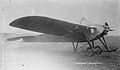 Nieuport IV, operated by most of the world's air forces before WW1 for reconnaissance and bombing, including during the Italian-Turkish war (from History of aviation)
 Often published as a photo of Santos-Dumont during the prize-winning flight, this is actually an earlier attempt using his "Number 5" (from History of aviation)
 French reconnaissance balloon L'Intrépide of 1796, the oldest existing flying device, in the Heeresgeschichtliches Museum, Vienna (from History of aviation)
 La France flying in 1885 (from History of aviation)
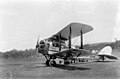 Qantas De Havilland biplane, c. 1930 (from History of aviation)
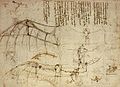 One of Leonardo's sketches (from History of aviation)
 D.H. Comet, the world's first jet airliner. As in this picture, it also saw RAF service (from History of aviation)
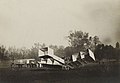 The 14-bis, or Oiseau de proie (from History of aviation)
 "Map of Air Routes and Landing Places in Great Britain, as temporarily arranged by the Air Ministry for civilian flying", published in 1919, showing Hounslow, near London, as the hub (from History of aviation)
 Planophore model aeroplane by Alphonse Pénaud, 1871 (from History of aviation)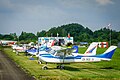
 An Airbus A380 of Qantas. The A380 is the world's largest passenger airliner. (from Wide-body aircraft)
 Me 262, world first operational jet fighter (from History of aviation)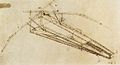
 First failure of Langley's manned Aerodrome on the Potomac River, 7 October 1903 (from History of aviation)
 An Airbus A321 of Vietravel Airlines parking next to a Vietnam Airlines Airbus A350-900 and a Cargolux Boeing 747-400 widebodies, highlighting their size differences. (from Wide-body aircraft)
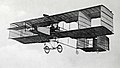 Early Voisin biplane (from History of aviation)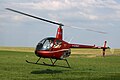
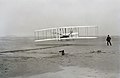 The Wright Flyer: the first sustained flight with a powered, controlled aircraft (from History of aviation)
 Otto Lilienthal, 29 May 1895 (from History of aviation)
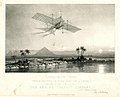 1843 artist's impression of John Stringfellow's plane Ariel flying over the Nile (from History of aviation)
 Map of record breaking flights of the 1920s (from History of aviation)
 Concorde, G-BOAB, in storage at London Heathrow Airport following the end of all Concorde flying. This aircraft flew for 22,296 hours between its first flight in 1976 and final flight in 2000 (from History of aviation)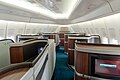
 Experimental helicopter by Enrico Forlanini (1877), exposed at the Museo nazionale della scienza e della tecnologia Leonardo da Vinci of Milan, Italy (from History of aviation)
 A Boeing 777X. It is under testing and will be the largest twinjet, with the widest and longest fuselage to enter production. (from Wide-body aircraft)
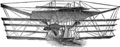 Maxim's flying machine (from History of aviation)
 Flagg biplane from 1933 (from History of aviation)
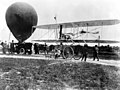 The Wright Military Flyer aboard a wagon in 1908 (from History of aviation)
 The Aeroplane of Victor Tatin, 1879. (from History of aviation)
 The Biot-Massia glider, restored and on display in the Musee de l'Air (from History of aviation)
 "Governable parachute" design of 1852 (from History of aviation)
 1928 issue of Popular Aviation (now Flying magazine), which became the largest aviation magazine with a circulation of 100,000. (from History of aviation)
 Woodcut print of a kite from John Bate's 1635 book The Mysteryes of Nature and Art (from History of aviation)
 Clément Ader Avion III (1897 photograph) (from History of aviation)
.jpg)
.jpg)


.jpg)

.jpg)
.jpg)


.jpg)
.jpg)


.jpg)

.png)


.jpg)
In the news

- May 29: Austrian Airlines cancels Moscow-bound flight after Russia refuses a reroute outside Belarusian airspace
- August 8: Passenger flight crashes upon landing at Calicut airport in India
- June 4: Power firm helicopter strikes cables, crashes near Fairfield, California
- January 29: Former basketball player Kobe Bryant dies in helicopter crash, aged 41
- January 13: Iran admits downing Ukrainian jet, cites 'human error'
- January 10: Fire erupts in parking structure at Sola Airport, Norway
- October 27: US announces restrictions on flying to Cuba
- October 3: World War II era plane crashes in Connecticut, US, killing at least seven
- September 10: Nevada prop plane crash near Las Vegas leaves two dead, three injured
- August 6: French inventor Franky Zapata successfully crosses English Channel on jet-powered hoverboard
Related portals

Associated Wikimedia
The following Wikimedia Foundation sister projects provide more on this subject:
-
 Commons
Free media repository -
 Wikidata
Free knowledge base -
 Wikiquote
Collection of quotations -
 Wikisource
Free-content library -
 Wikiversity
Free learning tools -
 Wikivoyage
Free travel guide -
 Wiktionary
Dictionary and thesaurus


Selected biography

Before becoming an astronaut, Armstrong was in the United States Navy and saw action in the Korean War. After the war, he served as a test pilot at the National Advisory Committee for Aeronautics (NACA) High-Speed Flight Station, now known as the Dryden Flight Research Center, where he flew over 900 flights in a variety of aircraft. As a research pilot, Armstrong served as project pilot on the F-100 Super Sabre A and C aircraft, F-101 Voodoo, and the Lockheed F-104A Starfighter. He also flew the Bell X-1B, Bell X-5, North American X-15, F-105 Thunderchief, F-106 Delta Dart, B-47 Stratojet, KC-135 Stratotanker and Paresev. He graduated from Purdue University.
Selected Aircraft

NASA's Space Shuttle, officially called the Space Transportation System (STS), was the spacecraft which was used by the United States government for its human spaceflight missions. At launch, it consisted of a rust-colored external tank (ET), two white, slender Solid Rocket Boosters (SRBs), and the orbiter, a winged spaceplane which was the space shuttle in the narrow sense.
The orbiter carried astronauts and payload such as satellites or space station parts into low Earth orbit, into the Earth's upper atmosphere or thermosphere. Usually, five to seven crew members rode in the orbiter. The payload capacity was 22,700 kg (50,000 lb). When the orbiter's mission was complete, it fired its Orbital Maneuvering System (OMS) thrusters to drop out of orbit and re-enter the lower atmosphere. During the descent and landing, the shuttle orbiter acted as a glider, and made a completely unpowered ("dead stick") landing.
- Span: 78.06 ft (23.79 m)
- Length: 122.17 ft (37.24 m)
- Height: 58.58 ft (17.25 m)
- Engines: 3 Rocketdyne Block 2 A SSMEs
- Cruising Speed: 25,404 ft/s (7,743 m/s, 27,875 km/h, 17,321 mi/h)
- First Flight: August 12, 1977 (glider), April 12, 1981 (powered).
- Operational Altitude: 100 to 520 nmi (185 to 1,000 km)
- Number built: 6 (+2 mockups)
Today in Aviation
- 2009 – Swedish airline Air Express Sweden is taken over by MCA Airlines
- 2009 – Air France Flight 447, an Airbus A330-200 flying from Rio de Janeiro, Brazil to Paris, France, crashes in the Atlantic Ocean, killing all 228 occupants, including 12 crew; bodies and aircraft debris are not recovered until several days later; the aircraft itself is not found until 2011. The crash is the first fatal accident of the A330 and the worst-ever disaster involving the A330.
- 2008 –A U.S. helicopter crashes south of Baghdad, injuring two soldiers. The type of helicopter has not been revealed.[1][2]
- 2007 – A Tanzania People’s Defence Forces passenger plane (reg JW9036) developed dual engine failure as the pilot manoeuvred to land at Dodoma airport, the pilot, Lieutenant Colonel S. M. Mayenga, said, and crash landed in the Kizota area of Dodoma. All thirteen people aboard survived.
- 2004 – America West Airlines starts service between Phoenix and Anchorage.
- 1999 – American Airlines Flight 1420, a McDonnell Douglas MD-82, skids off the runway on landing at Little Rock, Arkansas during strong winds; eleven of 145 on board die.
- 1998 – MetroJet, operated by US Airways, began operations.
- 1992 – The United States Air Force‘s Strategic Air Command is disestablished.
- 1983 – Singapore Airlines announces it has bought six Boeing 747s and four Boeing 757s, making it the first Asian airline to buy the 757.
- 1976 – Aeroflot Flight 418, a Tupolev Tu-154, crashes into a mountain side on the island of Bioko in Equatorial Guinea; all 45 on board die.
- 1975 – A Kenyan Air Force Hawker Hunter crashes at Nairobi, Kenya, during celebrations marking the anniversary of self-rule in the former British colony, the airframe impacting only a few hundred yards from where President Jomo Kenyatta is addressing a public rally. The two crew of the fighter are killed instantly, with the jet narrowly missing a crowded bus as it skids across a four-lane highway. Passengers panic as the bus brakes to a halt and fills with smoke from the burning wreckage. A second Hunter jet makes an emergency landing at Nairobi International Airport, where, according to one witness, it narrowly misses a loaded Pan American jet "by a matter of feet." The airport closes briefly after the incident.
- 1964 – The Kenyan Air Force is established
- 1961 – United Air Lines absorbs Capital Airlines to become the largest airline in the West, with a fleet of 267 aircraft.
- 1960 – Trans-Canada Air Lines begins transatlantic services, flying between Montreal and London
- 1953 – No. 423 Squadron was reformed at St. Hubert, Quebec and equipped with Avro Canada CF-100 fighters.
- 1953 – The United States Air Force Thunderbirds are activated as the 3600th Air Demonstration Team at Luke Air Force Base, Arizona on 25 May 1953, flying Republic F-84 Thunderjets.[3][better source needed]
- 1951 – British European Airways commences helicopter services between London and Birmingham
- 1950 – British European Airways commences the first regular passenger service to be flown by helicopter, between Liverpool and Cardiff.
- 1949 – A survey conducted by a firm of New York aviation consultants shows that for the first time in history air travel volume are greater than first class rail travel. Revenue passengers-miles for domestic airlines totals 603 million compared to 582 million for Pullman trains.
- 1948 – British European Airways commences the first helicopter airmail service in the UK
- 1948 – Entered Service: Convair CV-240 Convairliner with American Airlines
- 1948 – British European Airways (British European Airways) commences the first helicopter air mail service in the United Kingdom.
- 1948 – First flight of Cessna 170. The Cessna 170 is a general aviation aircraft produced by the Cessna Aircraft Company between 1948 and 1956. Over 5,000 were built, and over 2,000 are still accounted for today. The Cessna 170 landing gear is a taildragger configuration. It was replaced by the Cessna 172 which became the most popular light plane in history.
- 1944 – North West Air Command was formed at Edmonton under the command of A/V/M T. A. Lawrence.
- 1943 – Allied aircraft begin a final period of heavy bombing of Pantelleria during the ten days prior to the scheduled invasion of the island, during which they will fly 3,647 sorties.
- 1943 – In response to the Nazi dictatorship, the RCAF Second Tactical Air Force (2nd T. A. F.) was formed.
- 1943 – BOAC Flight 777, a Douglas DC-3, is shot down by Luftwaffe fighter aircraft over the Bay of Biscay, killing 17 passengers and crew, including actor Leslie Howard and leading to speculation that the flight was attacked because German intelligence believed that British Prime Minister Winston Churchill was aboard.
- 1942 – Because of the similarity of the red disc in the center of the national insignia for U. S. military aircraft USAAC to Japanese markings, the United States adopts a new national insignia without the red disc, consisting simply of a white star centered in a blue circle USAAC roundel.The new marking will remain in use until July 1943.
- 1942 – (Overnight) – Royal Air Force Bomber Command mounts what is nominally its second “thousand-bomber raid” – 956 bombers actually participate – Targeting Essen, Germany. Industrial haze spoils the attack; the British bombers kill only 15 people in Essen and destroy only 11 homes there, while widely scattered bombs strike Oberhausen, Duisburg, and at least eleven other cities and towns, which suffer more damage than Essen itself.
- 1941 – Germany completes the conquest of Crete. German airborne forces have suffered such heavy losses – probably 6,000 to 7,000 casualties and 284 aircraft lost – In the eleven days of fighting that Germany never again attempts a large airborne operation.
- 1941 – German Junkers Ju 88 bombers sink the British light cruiser HMS Calcutta 100 nautical miles (185 km) north of Alexandria, Egypt, as she retires after evacuating troops from Crete.
- 1940 – U. S. Army Air Corps announces plans for the construction of the world’s most powerful wind tunnel at Wright Field, Dayton, Ohio.
- 1939 – First flight of the Focke-Wulf Fw 190
- 1939 – The Douglas DC-4 makes its first passenger flight from Chicago to New York.
- 1927 – Western Canada Airways inaugurated weekly air service from Winnipeg to Long Lake, Manitoba via Lac du Bonnet.
- 1925 – A car dealer covers himself in stamps worth $718 in a bid to be sent airmail from San Francisco to New York; the U. S. Post Office refuses to accept him.
- 1919 – A permanent flight of aircraft is stationed in San Diego to serve as a forest fire patrol. The machines are war-surplus Curtiss JN-4s.
- 1915 – The United States Department of the Navy awards its first contract for an airship – The DN-1-Class Blimp – To the Connecticut Aircraft Company.
- 1915 – Germany conducts the first zeppelin air raid over England.
- 1912 – The first military aeroplane flight in Norway is made by Lt Hans Dons in HNoMS Start an Etrich Taube(pictured).
References
- Ross Colvin (2008-06-01). "Two US soldiers injured in Iraq helicopter crash". Reuters. Retrieved 2008-06-01.
- "US helicopter crashes in Iraq; 2 soldiers injured". The Associated Press. 2008-06-01. Retrieved 2008-06-01.
- Shortcuts to this page: Portal:Airplanes • P:AVIA