Portal:Cartoon
Wikipedia portal for content related to Cartoons
From Wikipedia, the free encyclopedia

The Cartoon Portal

A cartoon is a type of visual art that is typically drawn, frequently animated, in an unrealistic or semi-realistic style. The specific meaning has evolved, but the modern usage usually refers to either: an image or series of images intended for satire, caricature, or humor; or a motion picture that relies on a sequence of illustrations for its animation. Someone who creates cartoons in the first sense is called a cartoonist, and in the second sense they are usually called an animator.
This article covers "static" cartoons; for moving ones see animation.
The concept originated in the Middle Ages, and first described a preparatory drawing for a piece of art, such as a painting, fresco, tapestry, or stained glass window. In the 19th century, beginning in Punch magazine in 1843, cartoon came to refer – ironically at first – to humorous artworks in magazines and newspapers. Then it also was used for political cartoons and comic strips. When the medium developed, in the early 20th century, it began to refer to animated films that resembled print cartoons. (Full article...)
In print media, a cartoon is a drawing or series of drawings, usually humorous in intent. This usage dates from 1843, when Punch magazine applied the term to satirical drawings in its pages,[1] particularly sketches by John Leech.[2] The first of these parodied the preparatory cartoons for grand historical frescoes in the then-new Palace of Westminster in London.[3]

Sir John Tenniel—illustrator of Alice's Adventures in Wonderland—joined Punch in 1850, and over 50 years contributed over two thousand cartoons.[4]
Selected article -
The Kampung Boy, also known as Lat, the Kampung Boy or simply Kampung Boy, is a graphic novel by Lat about a young boy's experience growing up in rural Perak in the 1950s. The book is an autobiographical account of the artist's life, telling of his adventures in the jungles and tin mines, his circumcision, family, and school life. It is also the basis for the eponymous animated series broadcast in 1999. First published in 1979 by Berita Publishing, The Kampung Boy was a commercial and critical success; its first printing (of at least 60,000 copies) was sold out within four months of its release. Narrated in English with a smattering of Malay, the work has been translated into other languages, such as Japanese and French, and sold abroad. The book made Lat an international figure and a highly regarded cartoonist in Malaysia. It won several awards when released as Kampung Boy in the United States, such as Outstanding International Book for 2007 and the Children's Book Council and Booklist Editor's Choice for 2006. The Kampung Boy became a franchise, with the characters of The Kampung Boy decorating calendars, stamps, and aeroplanes. A Malaysian theme park is scheduled to open in 2012 with the fictional characters as part of its attractions. The Kampung Boy is very popular in Southeast Asia and has gone through 16 reprints. A sequel, Town Boy, which followed the protagonist in his teenage years in the city, was published in 1981 and a spin-off, Kampung Boy: Yesterday and Today, in 1993. The latter reused the setting of The Kampung Boy to compare and contrast the differences between Malaysian childhood experiences in the 1950s and 1980s.
Selected character -
_retouched.jpg)
Superman is a fictional character and one of the most famous and popular comic book superheroes of all time. Created by American writer Jerry Siegel and Canadian artist Joe Shuster in 1932 while both were growing up in Cleveland, Ohio, and sold to Detective Comics Inc. the same year Superman debuted in Action Comics #1 (June 1938), the character has since appeared in radio serials, television programs, films, comic books, newspaper strips and video games, contributing to his long-standing ubiquity. Superman is born Kal-El on an alien planet — later named Krypton — and is rocketed to Earth as an infant by his scientist father moments before the planet's destruction. The rocket lands on Earth, where he is found by passing motorists who adopt him and give him the name Clark Kent. As Clark reaches maturity, he learns he has superhuman abilities which he resolves to use to help others, fighting anything from petty crime to universal threats. After adopting a Kryptonian fabric costume consisting of a blue shirt with a stylized "S" on the chest, a pair of red briefs over blue pants, a pair of red boots, and a red cape, he becomes Earth's champion, with the media giving him several nicknames including "The Man of Steel", "The Man of Tomorrow" and "The Last Son of Krypton". To keep his identity secret when not fighting evil as Superman, Clark lives among humanity as a "mild-mannered" reporter for the Metropolis newspaper The Daily Star (later changed to the Daily Planet). Clark works alongside reporter Lois Lane, with whom he is romantically involved (and married in the mainstream current comics' continuity).
Did you know... -

- ...that the film Green Lantern starring Ryan Reynolds has been in development since the 1990s and once included a comedic incarnation with Jack Black set to star?
- ...that the Simpsons short Good Night aired April 19, 1987 on The Tracey Ullman Show and was the first ever appearance of the Simpson family on television?
- ...that Uri-On, created by Michael Netzer in 1987, was the first Israeli superhero to be published in color?
- ...that the two-inch-tall people of The Teenie Weenies were a Chicago Tribune comic strip written by William Donahey for over 50 years?
Selected list -

There have been 131 episodes of Ed, Edd n Eddy, an animated comedy television series created by Danny Antonucci and produced by Canada-based a.k.a. Cartoon. The series debuted on Cartoon Network in the United States on January 4, 1999, and ended on November 8, 2009, with the premiere of the series finale film Ed, Edd n Eddy's Big Picture Show. The series was originally planned to air for four seasons; however, Cartoon Network ordered two additional seasons and three holiday-themed specials as a result of its popularity. Reruns continue to air on Cartoon Network, including airing as part of the revived block Cartoon Planet. The series revolves around three adolescent boys collectively known as "the Eds", who live in a suburban cul-de-sac. Unofficially led by Eddy, the Eds constantly try to scam the fellow cul-de-sac children in order to purchase jawbreakers. The Eds' plans usually fail and leave them in various predicaments. The award-winning series garnered generally positive reviews, and remains the longest running original Cartoon Network series and Canadian-made animated series to date.
General images -

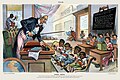 1899 cartoon showing Uncle Sam lecturing four children labeled Philippines, Hawaii, Puerto Rico, and Cuba. The caption reads: "School Begins. Uncle Sam (to his new class in Civilization)!" (from Political cartoon)
 1903 political cartoon. The U.S.'s intentions to influence the area (especially the Panama Canal construction and control) led to the separation of Panama from Colombia. (from Political cartoon)
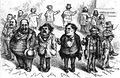 Nast depicts the Tweed Ring: "Who stole the people's money?" / "'Twas him."
 Benjamin Franklin's Join, or Die (May 9, 1754), credited as the first cartoon published in an American newspaper (from Cartoonist)
 Stop-motion animated character from 20 Million Miles to Earth (1957) (from Animator)
 1942 political cartoon by Dr. Seuss. This cartoon depicts Japanese Americans as a "fifth column," lending support to Japan during its war against the United States. Bigotry against Japanese people was common among Americans at this time. (from Political cartoon)
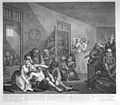 A Rake's Progress, Plate 8, 1735, and retouched by William Hogarth in 1763 by adding the Britannia emblem (from Political cartoon)
 An editorial cartoon of Andrew Johnson and Abraham Lincoln, 1865, entitled The Rail Splitter at Work Repairing the Union. The caption reads: (Johnson): "Take it quietly Uncle Abe and I will draw it closer than ever!!" (Lincoln): "A few more stitches Andy and the good old Union will be mended!" (from Political cartoon)
 Sir John Tenniel, chief cartoonist for Punch (from 1864) and the illustrator of Alice in Wonderland, was the first cartoonist to be knighted (from Cartoonist)
 U.S. President Theodore Roosevelt introduces Taft as his crown prince: Puck magazine cover, 1906. (from Political cartoon)
 James Gillray's The Plumb-pudding in Danger (1805). The world being carved up into spheres of influence between Pitt and Napoleon. According to Martin Rowson, it is "probably the most famous political cartoon of all time—it has been stolen over and over and over again by cartoonists ever since." (from Political cartoon)
 John Leech, Substance and Shadow (1843), published as Cartoon, No. 1 in Punch, the first use of the word cartoon to refer to a satirical drawing (from Cartoon)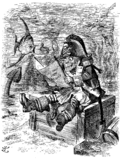
- Thomas Nast depicts the Tweed Ring: "Who stole the people's money?" / "'Twas him." (from Political cartoon)

.jpg)


_Ymir_2.png)


,_Artist_and_Cartoonist,_Lived_here.jpg)


Selected biography -

Dan Povenmire (b. 1963) is an American television director, writer, producer, storyboard artist, and actor associated with several animated television series, best known as the co-creator of the Disney animated series Phineas and Ferb in which he also voices the show's villain, Heinz Doofenshmirtz. Povenmire grew up in Mobile, Alabama, where he was a talented art student who spent summers outdoors and making movies. Povenmire attended the University of South Alabama before deciding to pursue a film career and transferring to the University of Southern California School of Cinematic Arts. Povenmire has been a long-time contributor to the animation business, working on several different animated television series such as The Simpsons, Rocko's Modern Life and SpongeBob SquarePants. He was a longtime director on the prime time series Family Guy, where he was nominated for an Annie Award in 2005. He left the series to create Phineas and Ferb with Jeff "Swampy" Marsh. Povenmire has been nominated for several awards for his work on the show, including a BAFTA, an Annie, and three Emmy Awards.
Subcategories

WikiProjects
- Main projects
- Arts • Animation • Comics • Entertainment • Visual arts

- Related Projects
- Anime and manga • Biography • Film • Fictional characters • Media franchises • Music • Television • Video games
Selected quote -
Topics
- Comic book
- Comic strip
- Digital comics
- Graphic novel
- Mobile comic
- Motion comics
- Trade paperback
- Webcomic
- Animator
- Animation director
- Animation studios
- Animation film festivals
- Feature-length films
- Short films
- Television series
- Computer-animated films
- Stop-motion films
- Traditional animation
- Limited animation
- Rotoscoping
- Stop Motion
- Clay
- Cutout
- Graphic
- Model
- Object
- Pixilation
- Puppetoon
- Computer animation
- Flash animation
- PowerPoint animation
- SVG animation
- Cel-shaded animation
- Crowd simulation
- Morph target animation
- Motion capture
- Non-photorealistic rendering
- Skeletal animation
Things you can do

- Requested articles: Fenwick (comics), Khimaera (comics), Mutant Underground Support Engine, Bruce J. Hawker, Marc Dacier, Hultrasson, Frankenstein Comics, Dave Johnson (comics), Paco Medina, Dappere Dodo, New Adventures of the Space Explorers, Habatales, Musical Box, Foo-Foo (TV series), Bonne nuit les petits, The Adventures of Lariat Sam, More...
- Images and photos needed: Request images that are needed from Wikipedia requested images of comics and animation to included in each articles.
- Stubs: Work on stubs in articles in Comics and Animation stubs.
- Infobox: Add infobox that are needed from Category:Comics articles without infoboxes and Category:Animation articles needing infoboxes in articles.
- Deletion sorting: Please see the collection of discussions on the deletion of articles related to comics and animation - compiled by WikiProject Deletion sorting
Related portals


Associated Wikimedia
The following Wikimedia Foundation sister projects provide more on this subject:
-
 Commons
Free media repository -
 Wikidata
Free knowledge base -
 Wikiquote
Collection of quotations -
 Wikisource
Free-content library -
 Wikiversity
Free learning tools -
 Wiktionary
Dictionary and thesaurus


More portals


Sources
- Punch.co.uk. "History of the Cartoon". Archived from the original on 2007-11-11. Retrieved 2007-11-01.
- Adler & Hill 2008, p. 30.
- "Substance and Shadow: Original Editorial Accompanying "Cartoon, No. I"". Victorian web.org. Retrieved 29 October 2023.
- "Sir John Tenniel". National Portrait Gallery. Retrieved 26 August 2022.