Portal:Edinburgh
From Wikipedia, the free encyclopedia

The Edinburgh Portal
Welcome! — Fàilte! — Walcome!

Edinburgh is the capital city of Scotland and one of its 32 council areas. It is located in southeast Scotland and is bounded to the north by the Firth of Forth and to the south by the Pentland Hills. Edinburgh had a population of 506,520 in 2020, making it the second-most-populous city in Scotland and the seventh-most-populous in the United Kingdom. The wider metropolitan area had a population of 912,490 in the same year.
Recognised as the capital of Scotland since at least the 15th century, Edinburgh is the seat of the Scottish Government, the Scottish Parliament, the highest courts in Scotland, and the Palace of Holyroodhouse, the official residence of the British monarch in Scotland. It is also the annual venue of the General Assembly of the Church of Scotland. The city has long been a centre of education, particularly in the fields of medicine, Scottish law, literature, philosophy, the sciences and engineering. The University of Edinburgh was founded in 1582 and is now one of four universities in the city. The financial centre of Scotland, Edinburgh was ranked as the second-largest financial centre in the United Kingdom, the fourth-largest in Europe, and the thirteenth-largest in the world in the Global Financial Centres Index in 2020.
The city is a cultural centre, and is the home of institutions including the National Museum of Scotland, the National Library of Scotland, and the Scottish National Gallery. The city is also known for the Edinburgh International Festival and the Fringe, the latter being the world's largest annual international arts festival. Historic sites in Edinburgh include Edinburgh Castle, the Palace of Holyroodhouse, St Giles' Cathedral, Greyfriars Kirk, Canongate Kirk and the extensive Georgian New Town built in the 18th and 19th centuries. The Old Town and the New Town are together listed as a World Heritage Site by UNESCO, and the site has been managed by Edinburgh World Heritage since 1999. The city's historical and cultural attractions have made it Britain's second-most-visited tourist destination, attracting 5.3 million visits, including 2.4 million from overseas, in 2023. (Full article...)
Selected location article

Canongate Tolbooth is a historic landmark of the Old Town area of Edinburgh, built in 1591 as a tolbooth, that is, the centre of administration and justice of the then separate burgh of the Canongate which was outside the Edinburgh town walls. It ceased to be a municipal building in 1856 and it is now occupied by The People's Story Museum and is protected as a category A listed building. (Full article...)
Selected images

 Queensferry Crossing road bridge
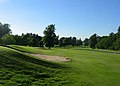 Ratho Park Golf Club
 Jenners Department Store, the oldest department store in Scotland
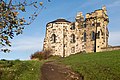 City Observatory, the Gothic Tower
 The Castle Rock
 Charlotte Square, a garden square in the New Town
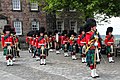 The Band of the Royal Regiment of Scotland in Edinburgh Castle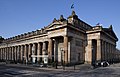
 The Dean Gallery, part of the Scottish National Gallery of Modern Art
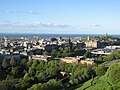 View over Edinburgh
 The BT building in Edinburgh Park
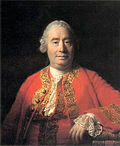 David Hume, Scottish philosopher, historian, economist, and essayist born in Edinburgh in 1711
 Fountain at Holyrood Palace
 View looking west along George Street
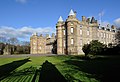 Holyrood Palace, the official residence of the British monarch in Scotland
 The Governor's House
 Scottish baronial-style turrets on Victorian tenements in St. Mary's Street
 Two Edinburgh Trams seen at the West End - Princes Street stop
 Sir Walter Scott
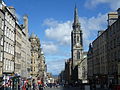 The High Street, part of the Royal Mile
 Architecture in Edinburgh

 The Princes Street Gardens, the best known park in Edinburgh
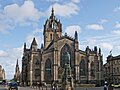 St Giles' Cathedral, the principal place of worship of the Church of Scotland in Edinburgh
 Edinburgh (from Salisbury Crags) by William Crozier, a painter associated with The Edinburgh School
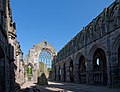 The ruins of Holyrood Abbey
 The National Monument of Scotland (right) and Nelson Monument (left)


.jpg)


.jpg)


.jpg)


.jpg)
.jpg)
.jpg)


Selected transportation article
_station_(geograph_4167972).jpg)
Edinburgh Park railway station is a railway station in the west of Edinburgh, Scotland, serving the Edinburgh Park business park and the Hermiston Gait shopping centre. The new station building was designed by IDP Architects, and it opened on 4 December 2003. It is the first intermediate station between Haymarket and Linlithgow since 1951. Ticket barriers came into use on 25 March 2015.
There are two platforms, linked by a covered footbridge, which is accessible by either stairs or a lift. There is also a pedestrian underpass just outside the station, accessible from both platforms. Tickets are available from one of the two ticket machines. (Full article...)
Selected area article

Maybury is an area on the western edge of Edinburgh, Scotland, near South Gyle and Ingliston, named after the road, which is itself named after the civil engineer Sir Henry Maybury (1864–1943). In 2021, residents have been undertaking community clean ups to clear the foot paths along the road. The area is residential in the north east/east and commercial in the south and west and The Gyle Shopping Centre is nearby. In 2021, there was a consultation about creating a Primary School and Health Centre in Maybury. (Full article...)
Selected environment article

The Mound is an artificial slope and road in central Edinburgh, Scotland, which connects Edinburgh's New and Old Towns. It was formed by dumping around 1,501,000 cartloads of earth excavated from the foundations of the New Town into Nor Loch, which was drained in 1765 and forms today's Princes Street Gardens. (Full article...)
Did you know?
No recent additions
Selected arts article

This is a list of public art and memorials in Edinburgh, including statues and other sculptures.
(Full article...)Selected education article

Heriot-Watt University (Scottish Gaelic: Oilthigh Heriot-Watt) is a public research university based in Edinburgh, Scotland. It was established in 1821 as the School of Arts of Edinburgh, the world's first mechanics' institute, and was subsequently granted university status by royal charter in 1966. It is the eighth-oldest higher education institution in the United Kingdom. The name Heriot-Watt was taken from Scottish inventor James Watt and Scottish philanthropist and goldsmith George Heriot.
The annual income of the institution for 2024–25 was £293.9 million of which £52.3 million was from research grants and contracts, with an expenditure of £301.1 million. Known for its focus on science as well as engineering, it is one of the 23 colleges that were granted university status in the 1960s, and it is sometimes considered a plate glass university, like Lancaster and York. (Full article...)
Selected sports article
Ingliston Racing Circuit is 1.030 mi (1.658 km) motor racing circuit that was built at the Royal Highland Showground at Ingliston, Edinburgh. The circuit was created by widening and linking the network of access roads at the venue which had previously been used exclusively as an agricultural showground.
The first racing took place at Ingliston on 11 April 1965 and it fast became recognised as one of Scotland's top motorsport venues. The first race was almost 10 years before Knockhill in Fife opened in 1974 . Ingliston became infamous for its tight corners and plethora of obstacles such as trees and buildings close to the track and was therefore considered to be more hazardous than other similar facilities in the UK. There were extensive spectator facilities including a 5000-person grandstand which was built around the southern part of the track and thus named 'Arena'. (Full article...)
Selected religion article

The Church of Scotland offices are located in the centre of Edinburgh, Scotland (in the New Town), at 121 George Street. These imposing buildings are popularly known in Church circles as "one-two-one". They were designed in a Scandinavian-influenced style by the architect Sydney Mitchell and built in 1909–1911 for the United Free Church of Scotland. Following the union of the Church of Scotland and the United Free Church of Scotland in 1929 the church offices were henceforth used by the newly united church.
A matching extension, incorporating a ground floor bookshop, was built in the 1930s on the east side (119 George Street). A proposed matching extension on the west side (replacing the still-existing buildings at 123 George Street) was never built. 123 George Street is, however, owned by the Church of Scotland and has been incorporated into the offices. The church offices also incorporate a chapel near the main entrance and a staff canteen in the basement. (Full article...)
Related portals


Categories

Topics
In the news
No recent news
Associated Wikimedia
The following Wikimedia Foundation sister projects provide more on this subject:
-
 Commons
Free media repository -
 Wikidata
Free knowledge base -
 Wikiquote
Collection of quotations -
 Wikisource
Free-content library -
 Wikiversity
Free learning tools -
 Wikivoyage
Free travel guide -
 Wiktionary
Dictionary and thesaurus


