Geography (from Ancient Greekγεωγραφίαgeōgraphía; combining gê 'Earth' and gráphō 'write', lit. 'Earth writing') is the study of the lands, features, inhabitants, and phenomena of planet Earth. Geography is an all-encompassing discipline that seeks an understanding of Earth and its human and natural complexities—not merely where objects are, but also how they have changed and come to be. While geography is specific to Earth, many concepts can be applied more broadly to other celestial bodies in the field of planetary science. Geography has been called "a bridge between natural science and social science disciplines."
The history of geography as a discipline spans cultures and millennia, having been independently developed by multiple groups and cross-pollinated through trade between them. Geography as a discipline dates back to the earliest attempts to understand the world spatially, with the earliest example of an attempted world map dating to the 9th century BC in ancient Babylon. Origins of many of the concepts in geography can be traced to Greek Eratosthenes of Cyrene, who may have coined the term "geographia" (c.276 BC– c.195/194 BC). The first recorded use of the word γεωγραφία was as the title of a book by Greek scholar Claudius Ptolemy (100 – 170 AD). During the Middle Ages, geography was influenced by Islamic scholars, such as Muhammad al-Idrisi, producing detailed maps of the world. The Age of Discovery was influential in the development of geography, as European explorers mapped the New World. Modern developments include geomatics and geographic information science.
The core concepts of geography that are consistent across all approaches are space, place, time, and scale. Today, geography is an extremely broad discipline with multiple approaches and modalities. The main branches of geography are physical geography, human geography, and technical geography. Physical geography focuses on the natural environment, human geography on how humans interact with the Earth, and technical geography on developing tools for understanding geography. Techniques employed can generally be broken down into quantitative and qualitative approaches, with many studies taking mixed-methods approaches. Common techniques include cartography, remote sensing, interviews, and surveying. (Full article...)
The Uruguayan War (10 August 1864– 20 February 1865) was fought between Uruguay's governing Blanco Party and an alliance consisting of the Empire of Brazil and the Uruguayan Colorado Party, covertly supported by Argentina. Since its independence, Uruguay had been ravaged by intermittent struggles between the Colorado and Blanco factions, each attempting to seize and maintain power in turn. The Colorado leader Venancio Flores launched the Liberating Crusade in 1863, an insurrection aimed at toppling Bernardo Berro, who presided over a Colorado–Blanco coalition (fusionist) government. Flores was aided by Argentina, whose president Bartolomé Mitre provided him with supplies, Argentine volunteers and river transport for troops.
The fusionism movement collapsed as the Colorados abandoned the coalition to join Flores' ranks. The Uruguayan Civil War quickly escalated, developing into a crisis of international scope that destabilized the entire region. Even before the Colorado rebellion, the Blancos within fusionism had sought an alliance with Paraguayan dictator Francisco Solano López. Berro's now purely Blanco government also received support from Argentine federalists, who opposed Mitre and his Unitarians. The situation deteriorated as the Empire of Brazil was drawn into the conflict. Almost one fifth of the Uruguayan population were considered Brazilian. Some joined Flores' rebellion, spurred by discontent with Blanco government policies that they regarded as harmful to their interests. Brazil eventually decided to intervene in the Uruguayan affair to reestablish the security of its southern frontiers and its regional ascendancy. (Full article...)
Griffin designed the lake with many geometric motifs, so that the axes of his design lined up with natural geographical landmarks in the area. However, government authorities changed his original plans, and no substantial work was completed on the lake before he left the project in 1920. Griffin's proposal was further delayed by the Great Depression and World War II, and it was not until the 1950s that planning resumed. After political disputes and consideration of other proposed variations, excavation work began in 1960 with the energetic backing of Australian Prime MinisterRobert Menzies. After the completion of the bridges and dams, the dams were locked in September 1963. However, because of a drought, the lake's target water level was not reached until April 1964. The lake was formally inaugurated on 17 October 1964. (Full article...)
The Valley View property was part of the South Branch Survey of the Northern Neck Proprietary, a large tract that was inherited by Thomas Fairfax, 6th Lord Fairfax of Cameron, in 1719. It was settled by John Collins and his family in 1749, and acquired by the Parsons family before 1772. The Valley View house was built by James Parsons Jr. in 1855. After the Civil War, Parsons' widow sold the farm to Charles Harmison. His wife, Elizabeth Harmison, inspired by her childhood Virginia home, Western View, and the scenic South Branch Potomac River views, named the farm Valley View. The most recent of a series of owners, the Mayhew family, bought the property in 1979. Valley View's current proprietors, Robert and Kim Mayhew, have restored the historic residence and grounds. (Full article...)
Image 4
1850 portrait
DomPedro Afonso (19 July 1848 – 10 January 1850) was the Prince Imperial and heir apparent to the throne of the Empire of Brazil. Born at the Palace of São Cristóvão in Rio de Janeiro, he was the second son and youngest child of Emperor Dom Pedro II and Dona Teresa Cristina of the Two Sicilies, and thus a member of the Brazilian branch of the House of Braganza. Pedro Afonso was seen as vital to the future viability of the monarchy, which had been put in jeopardy by the death of his older brother Dom Afonso almost three years earlier.
Pedro Afonso's death from fever at the age of one devastated the Emperor, and the imperial couple had no further children. Pedro Afonso's older sister Dona Isabel became heiress, but Pedro II was unconvinced that a woman could ever be accepted as monarch by the ruling elite. He excluded Isabel from matters of state and failed to provide training for her possible role as empress. With no surviving male children, the Emperor came to understand that the imperial line was destined to end with his own death. (Full article...)
Image 5
Location on the Argentina–Chile border
Nevado Ojos del Salado (Spanish pronunciation:[ˈoxosðelsaˈlaðo]ⓘ) is a dormant complex volcano in the Andes on the Argentina–Chile border. It is the highest volcano on Earth and the highest peak in Chile. The upper reaches of Ojos del Salado consist of several overlapping lava domes, lava flows and volcanic craters, with sparse ice cover. The complex extends over an area of 70–160 square kilometres (27–62mi2) and its highest summit reaches an altitude of 6,893 metres (22,615ft) above sea level. Numerous other volcanoes rise around Ojos del Salado.
Being close to the Arid Diagonal of South America, the mountain has extremely dry conditions, which prevent the formation of substantial glaciers and a permanent snow cover. Despite the arid climate, there is a permanent crater lake about 100m (330ft) in diameter at an elevation of 6,480–6,500 metres (21,260–21,330ft) within the summit crater and east of the main summit. This is the highest lake of any kind in the world. Owing to its altitude and the desiccated climate, the mountain lacks vegetation. (Full article...)
Image 6
Women's traditional caribou skin outfit with amautiparka, trousers, mitts and long boots with side pouches. The back of the parka has an amaut or pouch for carrying a baby. From Baker Lake, Eskimo Point and Hikoligjuaq, west of Hudson Bay. Collected on 5th Thule Expedition, 1921–1924 Traditional Inuit clothing is a complex system of cold-weather garments historically made from animal hide and fur, worn by Inuit, a group of culturally related Indigenous peoples inhabiting the Arctic areas of Canada, Greenland, and the United States. The basic outfit consisted of a parka, pants, mittens, inner footwear, and outer boots. The most common sources of hide were caribou, seals, and seabirds, although other animals were used when available. The production of warm, durable clothing was an essential survival skill which was passed down from women to girls, and which could take years to master. Preparation of clothing was an intensive, weeks-long process that occurred on a yearly cycle following established hunting seasons. The creation and use of skin clothing was strongly intertwined with Inuit religious beliefs.
Despite the wide geographical distribution of Inuit across the Arctic, historically, these garments were consistent in both design and material due to the common need for protection against the extreme weather and the limited range of materials suitable for the purpose. The appearance of individual garments varied according to gender roles and seasonal needs, as well as the specific dress customs of each tribe or group. The Inuit decorated their clothing with fringes, pendants, and insets of contrasting colours, and later adopted techniques such as beadwork when trade made new materials available. (Full article...)
Image 7
Jeannette at Le Havre in 1878, prior to her departure for San Francisco in a trip that would see her round Cape Horn The Jeannetteexpedition of 1879–1881, officially called the U.S. Arctic Expedition, was an attempt led by George W. De Long to reach the North Pole by pioneering a route from the Pacific Ocean through the Bering Strait. The premise was that a temperate current, the Kuro Siwo, flowed northwards into the strait, providing a gateway to the hypothesized Open Polar Sea and thus to the pole.
This theory proved illusory; the expedition's ship, USSJeannette and its crew of thirty-three men, was trapped by ice and drifted for nearly two years before she was crushed and sunk north of the Siberian coast. De Long then led his men on a perilous journey by sled, dragging the Jeannette'swhaleboat and two cutters, eventually switching to these small boats to sail for the Lena Delta in Siberia. During this journey, and in the subsequent weeks of wandering in Siberia before rescue, twenty of the ship's complement died, including De Long. (Full article...)
The Kennet and Avon Canal is a waterway in southern England with an overall length of 87 miles (140km), made up of two lengths of navigable river linked by a canal. The name is used to refer to the entire length of the navigation rather than solely to the central canal section. From Bristol to Bath the waterway follows the natural course of the River Avon before the canal links it to the River Kennet at Newbury, and from there to Reading on the River Thames. In all, the waterway incorporates 105 locks.
The two river stretches were made navigable in the early 18th century, and the 57-mile (92km) canal section was constructed between 1794 and 1810. In the late 19th and early 20th centuries, the canal gradually fell into disuse after the opening of the Great Western Railway. In the latter half of the 20th century the canal was restored in stages, largely by volunteers. After decades of dereliction and much restoration work, it was fully reopened in 1990. The Kennet and Avon Canal has been developed as a popular heritage tourism destination for boating, canoeing, fishing, walking and cycling, and is also important for wildlife conservation. (Full article...)
Image 9
Stone commemorative marker at Literary Hall in Romney, West Virginia
The Romney Literary Society (also known as the Literary Society of Romney) existed from January 30, 1819, to February 15, 1886, in Romney, West Virginia. Established as the Polemic Society of Romney, it became the first organization of its kind in the present-day state of West Virginia, and one of the first in the United States. The society was founded by nine prominent men of Romney with the objectives of advancing literature and science, purchasing and maintaining a library, and improving educational opportunities.
The society debated an extensive range of scientific and social topics, often violating its own rules which banned religious and political subjects. Even though its membership was relatively small, its debates and activities were frequently discussed throughout the Potomac Highlands region, and the organization greatly influenced trends of thought in the Romney community and surrounding areas. (Full article...)
The Parrett's main tributaries include the Rivers Tone, Isle, and Yeo, and the River Cary via the King's Sedgemoor Drain. The 37-mile (60km) long river is tidal for 19 miles (31km) up to Oath. Between Langport and Bridgwater, the river falls only 1 foot per mile (0.2m/km), so it is prone to frequent flooding in winter and during high tides. Many approaches have been tried since at least the medieval period to reduce the incidence and effect of floods and to drain the surrounding fields. (Full article...)
The original Skegness was situated farther east at the mouth of the Wash. Its Norse name refers to a headland which sat near the settlement. By the 14th century, it was a locally important port for coastal trade. The natural sea defences which protected the harbour eroded in the later Middle Ages, and it was lost to the sea after a storm in the 1520s. Rebuilt along the new shoreline, early modern Skegness was a small fishing and farming village, but from the late 18th century members of the local gentry visited for holidays. The arrival of the railways in 1873 transformed it into a popular seaside resort. This was the intention of The 9th Earl of Scarbrough, who owned most of the land in the vicinity; he built the infrastructure of the town and laid out plots, which he leased to speculative developers. This new Skegness quickly became a popular destination for holiday-makers and day trippers from the East Midlands factory towns. By the interwar years the town was established as one of the most popular seaside resorts in Britain. The layout of the modern seafront dates to this time and holiday camps were built around the town, including the first Butlin's holiday resort which opened in Ingoldmells in 1936. (Full article...)
The Somerset Levels have an area of about 160,000 acres (650km2) and are bisected by the Polden Hills; the areas to the south are drained by the River Parrett, and the areas to the north by the rivers Axe and Brue. The Mendip Hills separate the Somerset Levels from the North Somerset Levels. The Somerset Levels consist of marine clay "levels" along the coast and inland peat-based "moors"; agriculturally, about 70per cent is used as grassland and the rest is arable. Willow and teazel are grown commercially and peat is extracted. (Full article...)
It is not certain which settlement had which name. Built on the site of the battlefield, the city on the eastern bank was most likely called Nikaia (from nike, lit.'victory'), while its western companion was probably named after Alexander's horse Bucephalus, who died during or after the battle. Their construction was supervised by Craterus, one of Alexander's leading generals. Both cities initially suffered from the rains of the South Asian monsoon. Boukephala seems to have had a more distinguished legacy than Nikaia: mentioned by Pliny the Elder and Ptolemy, it appears in the 1st-century AD Periplus Maris Erythraei manuscript and on the later Tabula Peutingeriana map. The cities' precise locations are unknown, but it is considered likely that Boukephala was located in the vicinity of modern Jalalpur and that Nikaia was across the river near present-day Mong. (Full article...)
Image 14
The Viscount of Inhaúma around the age of 56, c. 1864
Throughout the chaos that characterized the years when Emperor PedroII was a minor, Inhaúma remained loyal to the government. He helped quell a military mutiny in 1831 and was involved in suppressing some of the other rebellions that erupted during that troubled period. He saw action in the Sabinada between 1837 and 1838, followed by the Ragamuffin War from 1840 until 1844. In 1849, after spending two years in Great Britain, Inhaúma was given command of the fleet that was instrumental in subduing the Praieira revolt, the last rebellion in imperial Brazil. (Full article...)
Image 15
Italy during the contemporary conflicts, that included the War of the League of Cambrai
The war was preceded by the Italienzug of Maximilian I, King of the Romans, who crossed into Venetian territory in February 1508 with the imperial army on the way to be crowned Holy Roman Emperor by the pope in Rome. Meanwhile, Pope Julius II, intending to curb Venetian influence in northern Italy, brought together the League of Cambrai, an anti-Venetian alliance consisting of him, Maximilian I, Louis XII of France, and Ferdinand II of Aragon, which was formally concluded in December 1508. Although the League was initially successful, later frictions between Julius and Louis culminated in the pope abandoning the League in 1510 and allying himself with Venice against France. (Full article...)
Author: John Mitchell; scan: Library of Congress, Geography and Map Division.
The Mitchell Map is the most comprehensive map of eastern North America made during the colonial era. Measuring about 6.5ft (2.0m) wide by 4.5ft (1.4m) high, it was produced by John Mitchell in 1757 in eight separate sheets. The map was used during the Treaty of Paris for defining the boundaries of the United States, and remains important today for resolving border disputes.
Map: Strebe, using the Geocart map projection software
A two-point equidistant projection of Eurasia. All distances of other points from the two points marked in red (45°N 40°E and 30°N 110°E) are correct. This map is a derivative of NASA's Blue Marble summer month composite, with oceans lightened to enhance legibility and contrast.
A c. 1650 map showing the Island of California, a long-held European misconception, dating from the 16th century, that California was not part of mainland North America but rather a large island separated from the continent by a strait now known instead as the Gulf of California. The belief persisted until the expeditions of Juan Bautista de Anza in 1774–76.
Daedongyeojido is a large scale map of Korea produced by Chosun Dynasty cartographer and geologist Kim Jeong-ho in 1861. Considered to mark the zenith of pre-modern Korean cartography, the map consists of 22 separate, foldable booklets, each covering approximately 47 kilometres (29mi) (north-south) by 31.5 kilometres (19.6mi) (east-west). Combined, they form a map of Korea that is 6.7 metres (22ft) wide and 3.8 metres (12ft) long. Daedongyeojido is praised for precise delineations of mountain ridges, waterways, and transportation routes, as well as its markings for settlements, administrative areas, and cultural sites.
Photo: Jeff Schmaltz, MODIS Rapid Response Team, NASA
A satellite photo of Great Britain and part of Ireland showing the extent of snow cover during the winter of 2009–2010, the coldest in Europe since 1981–82. Starting on 16 December 2009 a persistent weather pattern brought cold moist air from the north with systems undergoing cyclogenesis from North American storms moving across the Atlantic Ocean to the west, and saw many parts of Europe experiencing heavy snowfall and record low temperatures.
The Catalan Atlas is a medieval map in the Catalan language, created in 1375. Described as "the zenith of medieval map-work", it is the earliest known chart to use a compass rose. It was produced by the Majorcan cartographic school and is attributed to Abraham Cresques, a Jewish book illuminator described by a contemporary as a master of mappae mundi. It has been in the royal library of France (now the Bibliothèque nationale de France) since the time of King CharlesV. The atlas originally consisted of six vellum leaves, each about 64.5 by 50cm (25.4 by 19.7in), folded vertically and painted in various colours including gold and silver. This picture is a montage of eight pages (four leaves) of the atlas, depicting Europe, northern Africa and Asia.
The General Perspective projection is a map projection used in cartography in which the Earth is depicted as viewed from a finite distance above its surface. If the view precisely faces the center of the Earth, the projection is a vertical perspective projection; otherwise, it is a tilted perspective projection. Here is shown a vertical perspective from an altitude of 35,786km over (0°, 90°W), corresponding to a view from geostationary orbit. Due to the horizon as seen from the viewpoint position, the projection always shows less than half of the Earth's surface: in this case neither of the North and South Poles is visible.
Photograph: Maull & Fox; restoration: Adam Cuerden
Fanny Bullock Workman (1859–1925) was an American geographer, cartographer, explorer, travel writer, and mountaineer. Together with her husband, William Hunter Workman, she traveled by bicycle through Switzerland, France, Italy, Spain, Algeria and India; after taking up climbing in the Himalayas, she set a women's altitude record on Pinnacle Peak, reaching 23,000 feet (7,000m). She published eight travel books, with particular focus on the lives of women in the countries she visited, and championed women's rights and women's suffrage.
An 18th century map of the Iberian Peninsula illustrating various topographic features of the land. The Iberian Peninsula, or Iberia, is located in the extreme southwest of Europe, and includes modern day Spain, Portugal, Gibraltar and Andorra.
The last picture taken of Johnston in May 18 1980, 13 hours before his death at the eruption site
David Alexander Johnston (December 18, 1949 – May 18, 1980) was an American United States Geological Survey (USGS) volcanologist who was killed by the 1980 eruption of Mount St. Helens in the U.S. state of Washington. A principal scientist on the USGS monitoring team, Johnston was killed in the eruption while manning an observation post six miles (10km) away on the morning of May 18, 1980. He was the first to report the eruption, transmitting "Vancouver! Vancouver! This is it!" before he was swept away by a lateral blast; despite a thorough search, Johnston's body was never found, but state highway workers discovered remnants of his USGS trailer in 1993.
Johnston's career took him across the United States, where he studied the Augustine Volcano in Alaska, the San Juan volcanic field in Colorado, and long-extinct volcanoes in Michigan. Johnston was a meticulous and talented scientist, known for his analyses of volcanic gases and their relationship to eruptions. This, along with his enthusiasm and positive attitude, made him liked and respected by many co-workers. After his death, other scientists lauded his character, both verbally and in dedications and letters. Johnston felt scientists must do what is necessary, including taking risks, to help protect the public from natural disasters. His work, and that of fellow USGS scientists, convinced authorities to close Mount St. Helens to the public before the 1980 eruption. They maintained the closure despite heavy pressure to re-open the area. His story became intertwined with the popular image of volcanic eruptions and their threat to society, and a part of volcanology's history. To date, Johnston is one of two American volcanologists known to have died in a volcanic eruption; the other is his student Harry Glicken. (Full article...)


 Featured article -


.jpg)

.jpg)

.jpg)


.png)
 Vital article


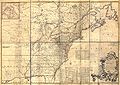 Author: John Mitchell; scan: Library of Congress, Geography and Map Division.The Mitchell Map is the most comprehensive map of eastern North America made during the colonial era. Measuring about 6.5 ft (2.0 m) wide by 4.5 ft (1.4 m) high, it was produced by John Mitchell in 1757 in eight separate sheets. The map was used during the Treaty of Paris for defining the boundaries of the United States, and remains important today for resolving border disputes.
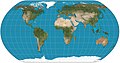 Map: Strebe, using the Geocart map projection softwareA map of the world using the Natural Earth projection, a pseudocylindrical projection which is neither conformal nor equal-area. The projection was designed by Tom Patterson, an American cartographer with the National Park Service who has developed several open-source tools and base maps for cartographers.
 Map: Strebe, using the Geocart map projection softwareA two-point equidistant projection of Eurasia. All distances of other points from the two points marked in red (45°N 40°E and 30°N 110°E) are correct. This map is a derivative of NASA's Blue Marble summer month composite, with oceans lightened to enhance legibility and contrast.
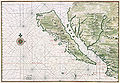 Map: Johannes Vingboons; Restoration: Lise BroerA c. 1650 map showing the Island of California, a long-held European misconception, dating from the 16th century, that California was not part of mainland North America but rather a large island separated from the continent by a strait now known instead as the Gulf of California. The belief persisted until the expeditions of Juan Bautista de Anza in 1774–76.
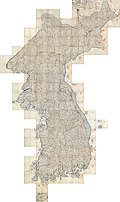 Daedongyeojido is a large scale map of Korea produced by Chosun Dynasty cartographer and geologist Kim Jeong-ho in 1861. Considered to mark the zenith of pre-modern Korean cartography, the map consists of 22 separate, foldable booklets, each covering approximately 47 kilometres (29 mi) (north-south) by 31.5 kilometres (19.6 mi) (east-west). Combined, they form a map of Korea that is 6.7 metres (22 ft) wide and 3.8 metres (12 ft) long. Daedongyeojido is praised for precise delineations of mountain ridges, waterways, and transportation routes, as well as its markings for settlements, administrative areas, and cultural sites.
 Photo credit: Luca GaluzziThe north face of Mount Everest, as seen from Tibet. Everest is the highest mountain on Earth, as measured by the height of its summit above sea level, which is 8,848 metres (29,029 ft). In 1865, Everest was given its official English name by the Royal Geographical Society upon recommendation of Andrew Waugh, the British Surveyor General of India at the time.
 A map showing the geography of Florida, a state in the United States. Situated on a peninsula between the Gulf of Mexico, the Atlantic Ocean, and the Straits of Florida, Florida has an extensive coastline. Its highest point, Britton Hill, is the lowest highpoint of any U.S. state. Florida is home to over 19 million people, living in 410 municipalities.
 Map: Strebe, using GeocartThe Winkel tripel projection is a modified azimuthal map projection proposed by Oswald Winkel in 1921. The arithmetic mean of the equirectangular projection and the Aitoff projection, it was intended as a compromise between minimizing three kinds of distortion: area, direction and distance.
 Photo: Jeff Schmaltz, MODIS Rapid Response Team, NASAA satellite photo of Great Britain and part of Ireland showing the extent of snow cover during the winter of 2009–2010, the coldest in Europe since 1981–82. Starting on 16 December 2009 a persistent weather pattern brought cold moist air from the north with systems undergoing cyclogenesis from North American storms moving across the Atlantic Ocean to the west, and saw many parts of Europe experiencing heavy snowfall and record low temperatures.
 Map credit: Abraham CresquesThe Catalan Atlas is a medieval map in the Catalan language, created in 1375. Described as "the zenith of medieval map-work", it is the earliest known chart to use a compass rose. It was produced by the Majorcan cartographic school and is attributed to Abraham Cresques, a Jewish book illuminator described by a contemporary as a master of mappae mundi. It has been in the royal library of France (now the Bibliothèque nationale de France) since the time of King Charles V. The atlas originally consisted of six vellum leaves, each about 64.5 by 50 cm (25.4 by 19.7 in), folded vertically and painted in various colours including gold and silver. This picture is a montage of eight pages (four leaves) of the atlas, depicting Europe, northern Africa and Asia.
 Map: Strebe, using GeocartThe Tobler hyperelliptical projection is a family of equal-area pseudocylindrical map projections first described by Waldo R. Tobler in 1973. The imagery used for the map is derived from NASA's Blue Marble summer months composite, with oceans lightened to enhance legibility and contrast.
 Map: Strebe, using GeocartThe General Perspective projection is a map projection used in cartography in which the Earth is depicted as viewed from a finite distance above its surface. If the view precisely faces the center of the Earth, the projection is a vertical perspective projection; otherwise, it is a tilted perspective projection. Here is shown a vertical perspective from an altitude of 35,786 km over (0°, 90°W), corresponding to a view from geostationary orbit. Due to the horizon as seen from the viewpoint position, the projection always shows less than half of the Earth's surface: in this case neither of the North and South Poles is visible.
 Photograph: Maull & Fox; restoration: Adam CuerdenFanny Bullock Workman (1859–1925) was an American geographer, cartographer, explorer, travel writer, and mountaineer. Together with her husband, William Hunter Workman, she traveled by bicycle through Switzerland, France, Italy, Spain, Algeria and India; after taking up climbing in the Himalayas, she set a women's altitude record on Pinnacle Peak, reaching 23,000 feet (7,000 m). She published eight travel books, with particular focus on the lives of women in the countries she visited, and championed women's rights and women's suffrage.
 Map: Strebe, using GeocartThe Hammer retroazimuthal projection is a modified azimuthal proposed by Ernst Hermann Heinrich Hammer in 1910. As a retroazimuthal projection, azimuths (directions) are correct from any point to the designated center point. In whole-world presentation, the back and front hemispheres overlap, making the projection a surjective function. Here, the frontside and backside hemispheres, both with a 15° graticule and center point of 45°N, 90°W, are presented side-by-side.
 Map credit: Robert WilkinsonAn 18th century map of the Iberian Peninsula illustrating various topographic features of the land. The Iberian Peninsula, or Iberia, is located in the extreme southwest of Europe, and includes modern day Spain, Portugal, Gibraltar and Andorra.


.jpg)




.svg)
.svg)


.jpeg)

.jpg)


 Categories
 Commons
 Wikidata
 Wikiquote
 Wikisource
 Wikiversity
 Wikivoyage
 Wiktionary


