Portal:India
Wikimedia portal
From Wikipedia, the free encyclopedia


Introduction

.svg)
India, officially the Republic of India, is a country in South Asia. It is the seventh-largest country by area; the most populous country since 2023; and, since its independence in 1947, the world's most populous democracy. Bounded by the Indian Ocean on the south, the Arabian Sea on the southwest, and the Bay of Bengal on the southeast, it shares land borders with Pakistan to the west; China, Nepal, and Bhutan to the north; and Bangladesh and Myanmar to the east. In the Indian Ocean, India is near Sri Lanka and the Maldives. Its Andaman and Nicobar Islands share a maritime border with Myanmar, Thailand, and Indonesia. (Full article...)

 Featured article –


Reginald Heber (21 April 1783 – 3 April 1826) was an English Anglican bishop, a man of letters, and hymn-writer. After 16 years as a country parson, he served as Bishop of Calcutta until his death at the age of 42. The son of a rich landowner and cleric, Heber gained fame at the University of Oxford as a poet. After graduation he made an extended tour of Scandinavia, Russia and Central Europe. Ordained in 1807, he took over his father's old parish, Hodnet, Shropshire. He also wrote hymns and general literature, including a study of the works of the 17th-century cleric Jeremy Taylor.
He was consecrated Bishop of Calcutta in October 1823. He travelled widely and worked to improve the spiritual and general living conditions of his flock. Arduous duties, a hostile climate and poor health led to his collapse and death after less than three years in India. Memorials were erected there and in St Paul's Cathedral, London. A collection of his hymns appeared soon after his death. "Holy, Holy, Holy! Lord God Almighty" remains popular for Trinity Sunday, while "Brightest and Best" is frequently sung during Epiphany. (Full article...)
Katrina Kaif (pronounced [kəˈʈriːna kɛːf]; born Katrina Rosemary Turcotte, 16 July 1983) is a British actress and businesswoman who works in Hindi-language films. One of India's highest-paid actresses, her accolades include four Screen Awards and four Zee Cine Awards, alongside three Filmfare Awards nominations. Although critical reception to her acting has varied, she is noted for her roles in action films and her dancing ability.
Born in British Hong Kong, Kaif lived in several countries before moving to London, where she spent three years. She received her first modelling assignment as a teenager and later pursued a career in fashion modelling. At a fashion show in London, Indian filmmaker Kaizad Gustad cast her in Boom (2003), which was a critical and commercial failure. While Kaif established a successful modelling career in India, she initially faced difficulty securing film roles due to her limited command of Hindi. After appearing in the Telugu film Malliswari (2004), Kaif achieved commercial success in Bollywood with the romantic comedies Maine Pyaar Kyun Kiya? (2005) and Namastey London (2007). Further success followed with a series of box-office hits, though she was criticised for her acting, repetitive roles, and preference for male-dominated films. (Full article...)
Rani Mukerji (Hindustani pronunciation: [raːni mʊkʰərdʒi]; born 21 March 1978) is an Indian actress who works in Hindi films. She is the recipient of multiple accolades, including a National Film Award and eight Filmfare Awards. Mukerji has featured in listings of the highest-paid actresses of the 2000s.
Born into the Mukherjee-Samarth family, Mukerji began acting as a teenager by starring in her father Ram Mukherjee's Bengali-language film Biyer Phool and in the social drama Raja Ki Aayegi Baaraat (both 1996). Mukerji had her first commercial success with the action film Ghulam and breakthrough with the romance Kuch Kuch Hota Hai (both 1998). Following a brief setback, the year 2002 marked a turning point for her when she was cast by Yash Raj Films as the star of the drama Saathiya. (Full article...)
Shah Rukh Khan (pronounced [ˈʃaːɦɾʊx xäːn] ⓘ; born as Shahrukh Khan on 2 November 1965), popularly known by the initials SRK, is an Indian actor and film producer renowned for his work in Hindi cinema. Referred to in the media as the "Baadshah of Bollywood" and "King Khan", he has appeared in more than 100 films and earned numerous accolades, including a National Film Award and 15 Filmfare Awards. He has been awarded the Padma Shri by the Government of India, as well as the Order of Arts and Letters and Legion of Honour by the Government of France. Khan has a significant following in Asia and among the Indian diaspora worldwide. In terms of audience size and income, several media outlets have described him as one of the most successful film stars in the world. Many of his films thematise Indian national identity and connections with diaspora communities, or gender, racial, social and religious differences and grievances.
Khan began his career with appearances in several television series in the late 1980s and made his Hindi film debut in 1992 with the musical romance Deewana. He was initially recognised for playing villainous roles in the films Baazigar (1993) and Darr (1993). Khan established himself by starring in a series of top-grossing romantic films, including Dilwale Dulhania Le Jayenge (1995), Dil To Pagal Hai (1997), Kuch Kuch Hota Hai (1998), Mohabbatein (2000), Kabhi Khushi Kabhie Gham (2001), Kal Ho Naa Ho (2003), Veer-Zaara (2004), and Kabhi Alvida Naa Kehna (2006). He earned critical acclaim for his portrayal of an alcoholic in the period romantic drama Devdas (2002), a NASA scientist in the social drama Swades (2004), a hockey coach in the sports drama Chak De! India (2007), and a man with Asperger syndrome in the drama My Name Is Khan (2010). Further commercial successes came with the romances Om Shanti Om (2007) and Rab Ne Bana Di Jodi (2008), and with his expansion to comedies in Chennai Express (2013) and Happy New Year (2014). Following a brief setback and hiatus, Khan made a career comeback with the 2023 action thrillers Pathaan and Jawan, both of which rank among the highest-grossing Indian films. For Jawan, he received the National Film Award for Best Actor in a Leading Role. (Full article...)
Muhammad Ali Jinnah (born Mahomedali Jinnahbhai; 25 December 1876 – 11 September 1948) was a barrister, politician, and the founder of Pakistan. Jinnah served as the leader of the All-India Muslim League from 1913 until the inception of Pakistan on 14 August 1947 and then as Pakistan's first governor-general until his death a year later in 1948.
Born at Wazir Mansion in Karachi, Jinnah was trained as a barrister at Lincoln's Inn in London, England. Upon his return to India, he enrolled at the Bombay High Court, and took an interest in national politics, which eventually replaced his legal practice. Jinnah rose to prominence in the Indian National Congress in the first two decades of the 20th century. In these early years of his political career, Jinnah advocated for Hindu–Muslim unity, helping to shape the 1916 Lucknow Pact between the Congress and the All-India Muslim League, in which Jinnah had also become prominent. Jinnah became a key leader in the All-India Home Rule League, and proposed a fourteen-point constitutional reform plan to safeguard the political rights of Muslims in the Indian subcontinent. In 1920, however, Jinnah resigned from the Congress when it agreed to follow a campaign of satyagraha, which he regarded as political anarchy. (Full article...)
Alia Bhatt (/ˈɑːliə ˈbʌt/; born 15 March 1993) is a British actress of Indian descent who predominantly works in Hindi films. Known for her portrayals of women in challenging circumstances, she has received several accolades, including a National Film Award and seven Filmfare Awards. She is one of India's highest-paid actresses. Time awarded her with the Time100 Impact Award in 2022 and named her one of the 100 most influential people in the world in 2024.
Born into the Bhatt family, she is a daughter of filmmaker Mahesh Bhatt and actress Soni Razdan. After making her acting debut as a child in the 1999 thriller film Sangharsh, she played her first leading role in Karan Johar's teen film Student of the Year (2012). She won the Filmfare Critics Award for Best Actress for playing a kidnapping victim in the road drama Highway (2014) and went on to establish herself with starring roles in several romantic films produced by Johar's studio Dharma Productions. (Full article...)
Victoria (Alexandrina Victoria; 24 May 1819 – 22 January 1901) was Queen of the United Kingdom of Great Britain and Ireland from 20 June 1837 until her death in 1901. Her reign of 63 years and 216 days, which was longer than those of any of her predecessors, constituted the Victorian era, a period of industrial, political, scientific, and military change within the United Kingdom marked by a great expansion of the British Empire. In 1876, the British parliament voted to grant her the additional title of Empress of India.
Victoria was the daughter of Prince Edward, Duke of Kent and Strathearn (the fourth son of King George III), and Princess Victoria of Saxe-Coburg-Saalfeld. After the deaths of her father and grandfather in 1820, she was raised under close supervision by her mother and her comptroller, John Conroy. She inherited the throne aged 18 after her father's three elder brothers died without surviving legitimate issue. Victoria attempted privately to influence government policy and ministerial appointments; publicly, she became a national icon who was identified with strict standards of personal morality. (Full article...)- Gemini (/dʒɛminɪ/) is a 2002 Indian Tamil-language crime action film written and directed by Saran with Pon Elango as assistant director. This film was produced by AVM Productions. The film stars Vikram in the main lead role, while Kiran Rathod, Murali, Kalabhavan Mani, Vinu Chakravarthy, Manorama and Thennavan portray significant roles. Based on gang wars in Chennai, the film delves into the lives of outlaws and the roles the police and society play in their rehabilitation and acceptance.
In early 2001, rival gangsters "Vellai" Ravi and Chera reformed themselves with the patronage of a police officer. Saran was inspired by this incident and scripted a story based on it. Production began shortly afterwards in December the same year and was completed by March 2002. The film was shot mainly at the AVM Studios in Chennai, while two song sequences were filmed in Switzerland. The film had cinematography by A. Venkatesh and editing by Suresh Urs while the soundtrack was scored by Bharadwaj. (Full article...) 
Profile of a Hoysala temple at Somanathapura
Hoysala architecture is the building style in Hindu temple architecture developed under the rule of the Hoysala Empire between the 11th and 14th centuries, in the region known today as Karnataka, a state of India. Hoysala influence was at its peak in the 13th century, when it dominated the Southern Deccan Plateau region. Large and small temples built during this era remain as examples of the Hoysala architectural style, including the Chennakesava Temple at Belur, the Hoysaleswara Temple at Halebidu, and the Kesava Temple at Somanathapura. These three temples were accorded UNESCO world heritage site status in 2023. Other examples of Hoysala craftsmanship are the temples at Belavadi, Amruthapura, Hosaholalu, Mosale, Arasikere, Basaralu, Kikkeri and Nuggehalli. Study of the Hoysala architectural style has revealed a negligible North Indian influence while the impact of Southern Indian style is more distinct.
Temples built prior to Hoysala independence in the mid-12th century reflect significant Western Chalukya influences, while later temples retain some features salient to Western Chalukya architecture but have additional inventive decoration and ornamentation, features unique to Hoysala artisans. Some three hundred temples are known to survive in present-day Karnataka state and many more are mentioned in inscriptions, though only about seventy have been documented. The greatest concentration of these are in the Malnad (hill) districts, the native home of the Hoysala kings. (Full article...)
Western Ganga was an important ruling dynasty of ancient Karnataka in India which lasted from about 350 to 1004 CE. They are known as "Western Gangas" to distinguish them from the Eastern Gangas who in later centuries ruled over Kalinga (modern Odisha and northern Andhra Pradesh). The general belief is that the Western Gangas began their rule during a time when multiple native clans asserted their freedom due to the weakening of the Pallava empire in South India, a geo-political event sometimes attributed to the southern conquests of Samudra Gupta. The Western Ganga sovereignty lasted from about 350 to 550 CE, initially ruling from Kolar and later moving their capital to Talakadu on the banks of the Kaveri River in modern Mysore district.
After the rise of the imperial Chalukyas of Badami, the Gangas accepted Chalukya overlordship and fought for the cause of their overlords against the Pallavas of Kanchi. The Chalukyas were replaced by the Rashtrakutas of Manyakheta in 753 CE as the dominant power in the Deccan. After a century of struggle for autonomy, the Western Gangas finally accepted Rashtrakuta overlordship and successfully fought alongside them against their foes, the Chola Dynasty of Tanjavur. In the late 10th century, north of Tungabhadra river, the Rashtrakutas were replaced by the emerging Western Chalukya Empire and the Chola Dynasty saw renewed power south of the Kaveri river. The defeat of the Western Gangas by Cholas around 1000 resulted in the end of the Ganga influence over the region. (Full article...)
Kaikhosru Shapurji Sorabji (born Leon Dudley Sorabji; 14 August 1892 – 15 October 1988) was an English composer, music critic, pianist and writer. His music, written over a period of seventy years, ranges from sets of miniatures to works lasting several hours. One of the most prolific 20th-century composers, he is best known for his piano pieces, notably nocturnes such as Gulistān and Villa Tasca, and large-scale, technically intricate compositions, which include seven symphonies for piano solo, four toccatas, Sequentia cyclica and 100 Transcendental Studies. He felt alienated from English society by reason of his homosexuality and mixed ancestry, and had a lifelong tendency to seclusion.
Sorabji's mother was English and his father a Parsi businessman and industrialist from India, who set up a trust fund that freed his family from the need to work. Although Sorabji was a reluctant performer and not a virtuoso, he played some of his music publicly between 1920 and 1936. In the late 1930s, his attitude shifted and he imposed restrictions on performance of his works, which he lifted in 1976. His compositions received little exposure in those years and he remained in public view mainly through his writings, which include the books Around Music and Mi contra fa: The Immoralisings of a Machiavellian Musician. During this time, he also left London and eventually settled in the village of Corfe Castle, Dorset. Information on Sorabji's life, especially his later years, is scarce, with most of it coming from the letters he exchanged with his friends. (Full article...)
Vithoba (IAST: Viṭhobā), also known as Vitthala (IAST: Viṭṭhala), and Panduranga (IAST: Pāṇḍuraṅga), is a Hindu deity predominantly worshipped in the Indian states of Maharashtra and Karnataka. He is a form of the Hindu deity Vishnu in his avatar: Krishna. Vithoba is often depicted as a dark young boy, standing arms akimbo on a brick, sometimes accompanied by his consort Rakhumai.
Vithoba is the focus of an essentially monotheistic, non-ritualistic bhakti-driven Varkari faith in Maharashtra and the Haridasa sect established in Dvaita Vedanta in Karnataka. Vithoba Temple, Pandharpur is his main temple. Vithoba legends revolve around his devotee Pundalik who is credited for bringing the deity to Pandharpur, and around Vithoba's role as a saviour to the poet-saints of the Varkari faith. The Varkari poet-saints are known for their unique genre of devotional lyric, the abhang, dedicated to Vithoba and composed in Marathi. Other devotional literature dedicated to Vithoba includes the Kannada hymns of the Haridasa and the Marathi versions of the generic aarti songs associated with rituals of offering light to the deity. The most important festivals of Vithoba are held on Shayani Ekadashi in the month of Ashadha, and Prabodhini Ekadashi in the month of Kartika. (Full article...)
Margaret Ives Abbott (June 15, 1878 – June 10, 1955) was an American amateur golfer. She was the first American woman to win an Olympic event: the women's golf tournament at the 1900 Summer Olympics.
Born in Calcutta (now Kolkata), British Raj, in 1878, Abbott moved with her family to Chicago in 1884. She joined the Chicago Golf Club in Wheaton, Illinois, where she received coaching from Charles B. Macdonald and H. J. Whigham. In 1899, she traveled with her mother to Paris to study art. The following year, along with her mother, she signed up for a women's golf tournament without realizing that it was the second modern Olympics. Abbott won the tournament with a score of 47 strokes; her mother tied for seventh place. Abbott received a porcelain bowl as a prize. (Full article...)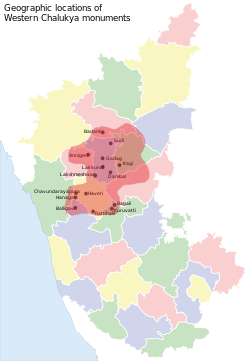
Core area of Western Chalukya architectural activity in modern Karnataka state, India
Western Chalukya architecture, also known as Kalyani Chalukya or Later Chalukya architecture and broadly classified under the Vesara Style, is the distinctive style of ornamented architecture that evolved during the rule of the Western Chalukya Empire in the Tungabhadra region of modern central Karnataka, India, during the 11th and 12th centuries. Western Chalukyan political influence was at its peak in the Deccan Plateau during this period. The centre of cultural and temple-building activity lay in the Tungabhadra region, where large medieval workshops built numerous monuments. These monuments, regional variants of pre-existing dravida (South Indian) temples, form a climax to the wider regional temple architecture tradition called Vesara or Karnata dravida. Temples of all sizes built by the Chalukyan architects during this era remain today as examples of the architectural style.
Most notable of the many buildings dating from this period are the Mahadeva Temple at Itagi in the Koppal district, the Kasivisvesvara Temple at Lakkundi in the Gadag district, the Mallikarjuna Temple at Kuruvatti in the Bellary district and the Kallesvara Temple at Bagali in the Davangere district. Other monuments notable for their craftsmanship include the Kaitabheshvara Temple in Kubatur and Kedareshvara Temple in Balligavi, both in the Shimoga district, the Siddhesvara Temple at Haveri in the Haveri district, the Amrtesvara Temple at Annigeri in the Dharwad district, the Sarasvati Temple in Gadag, and the Dodda Basappa Temple at Dambal, both in the Gadag district. (Full article...)
Sir Robert Eric Mortimer Wheeler (10 September 1890 – 22 July 1976) was a British archaeologist and officer in the British Army. Over the course of his career, he served as Director of both the National Museum of Wales and London Museum, Director-General of the Archaeological Survey of India, and the founder and Honorary Director of the Institute of Archaeology in London, in addition to writing twenty-four books on archaeological subjects.
Born in Glasgow to a middle-class family, Wheeler was raised largely in Yorkshire before moving to London in his teenage years. After studying classics at University College London (UCL), he began working professionally in archaeology, specialising in the Romano-British period. During World War I he volunteered for service in the Royal Artillery, being stationed on the Western Front, where he rose to the rank of major and was awarded the Military Cross. Returning to Britain, he obtained his doctorate from UCL before taking on a position at the National Museum of Wales, first as Keeper of Archaeology and then as Director, during which time he oversaw excavation at the Roman forts of Segontium, Y Gaer, and Isca Augusta with the aid of his first wife, Tessa Wheeler. Influenced by the archaeologist Augustus Pitt Rivers, Wheeler argued that excavation and the recording of stratigraphic context required an increasingly scientific and methodical approach, developing the "Wheeler method". In 1926, he was appointed Keeper of the London Museum; there, he oversaw a reorganisation of the collection, successfully lobbied for increased funding, and began lecturing at UCL. (Full article...)
The Kingdom of Mysore was a geopolitical realm in southern India founded in around 1399 in the vicinity of the modern-day city of Mysuru and prevailed until 1950. The territorial boundaries and the form of government transmuted substantially throughout the kingdom's lifetime. While originally a feudal vassal under the Vijayanagara Empire, it became a princely state in the British Raj from 1799 to 1947, marked in-between by major political changes.
The kingdom, which was founded and ruled for the most part by the Wadiyars, initially served as a feudal vassal under the Vijayanagara Empire. With the gradual decline of the Empire, the 16th-century Timmaraja Wodeyar II declared independence from it. The 17th century saw a steady expansion of its territory and, during the rules of Narasaraja Wodeyar I and Devaraja Wodeyar II, the kingdom annexed large expanses of what is now southern Karnataka and parts of Tamil Nadu, becoming a formidable power in the Deccan. (Full article...)- Eega (transl. The Fly) is a 2012 Indian Telugu-language fantasy action film written and directed by S. S. Rajamouli. The film was produced by Sai Korrapati under Vaaraahi Chalana Chitram. The film stars Nani, Samantha, and Sudeepa. M. M. Keeravani composed the songs and the background score, while K. K. Senthil Kumar was the director of photography. Janardhana Maharshi and Crazy Mohan wrote the dialogue for the Telugu and Tamil versions, respectively. It was filmed simultaneously in Tamil with the title Naan Ee (transl. I, the Fly).
The film follows a bedtime story narrated by a father to his daughter. Its protagonist, Nani, who is in love with his neighbour Bindu, is murdered by a wealthy industrialist named Sudeep, who is attracted to Bindu and considers Nani a rival. Nani reincarnates as a housefly and tries to avenge his death and protect Bindu from an obsessive Sudeep. (Full article...) - Kahaani (IPA: [kəˈɦaːni]; transl. Story) is a 2012 Indian Hindi-language vigilante action thriller film co-written, co-produced, and directed by Sujoy Ghosh. It stars Vidya Balan as Vidya Bagchi, a pregnant woman looking for her missing husband in Kolkata during the festival of Durga Puja, assisted by Assist Sub-Inspector Satyoki "Rana" Sinha (Parambrata Chatterjee) and Inspector General A. Khan (Nawazuddin Siddiqui).
Made on a budget of ₹80 million (US$850,000), Kahaani was conceived and developed by Ghosh, who co-wrote the film with Advaita Kala. The crew often employed guerrilla-filmmaking techniques on Kolkata's streets to avoid attracting attention. Its creative portrayal of the city and its use of local crew and cast made it a notable film. Kahaani explores themes of feminism and motherhood in a male-dominated Indian society. The film also makes several allusions to Satyajit Ray's films, such as Charulata (1964), Aranyer Din Ratri (1970), and Joi Baba Felunath (1979). The film's musical score and soundtrack were composed by Clinton Cerejo and Vishal–Shekhar respectively, with cinematography handled by Setu and editing done by Namrata Rao. (Full article...) - The political history of medieval Karnataka spans the 4th to the 16th centuries in Karnataka region of India. The medieval era spans several periods of time from the earliest native kingdoms and imperialism; the successful domination of the Gangetic plains in northern India and rivalry with the empires of Tamilakam over the Vengi region; and the domination of the southern Deccan and consolidation against Muslim invasion. The origins of the rise of the Karnataka region as an independent power date back to the fourth-century birth of the Kadamba Dynasty of Banavasi which was the earliest of the native rulers to conduct administration in the native language of Kannada in addition to the official Sanskrit.
In the southern regions of Karnataka, the Western Gangas of Talakad were contemporaries of the Kadambas. The Kadambas and Gangas were followed by the imperial dynasties of the Badami Chalukya Empire, the Rashtrakuta Empire, the Western Chalukya Empire, the Hoysala Empire and the Vijayanagara Empire, all patronising the ancient Indic religions while showing tolerance to the new cultures arriving from the west of the subcontinent. The Muslim invasion of the Deccan resulted in the breaking away of the feudatory Sultanates in the 14th century. The rule of the Bahamani Sultanate of Bidar and the Bijapur Sultanate from the northern Deccan region caused a mingling of the ancient Hindu traditions with the nascent Islamic culture in the region. The hereditary ruling families and clans ably served the large empires and upheld the local culture and traditions. The fall of the Vijayanagara Empire in 1565 brought about a slow disintegration of Kannada-speaking regions into minor kingdoms that struggled to maintain autonomy in an age dominated by foreigners until unification and independence in 1947. (Full article...)
Sonam Kapoor Ahuja (pronounced [soːnəm kəˈpuːr]; born 9 June 1985) is an Indian former actress who works in Hindi films. She has received several awards, including a National Film Award and a Filmfare Award. Kapoor appeared in Forbes India's Celebrity 100 list from 2012 to 2016.
The daughter of actor Anil Kapoor, Sonam began her career as an assistant director on filmmaker Sanjay Leela Bhansali's 2005 film Black. She made her acting debut in Bhansali's romantic drama Saawariya (2007), a box office flop, and had her first commercial success with the romantic comedy I Hate Luv Storys (2010). This was followed by a series of commercial failures and repetitive roles, which garnered her negative reviews. The 2013 box office hit Raanjhanaa marked a turning point in Kapoor's career, garnering her praise and Best Actress nominations at several award ceremonies. (Full article...)
Prince Sadruddin Aga Khan (17 January 1933 – 12 May 2003) was a French-born statesman and activist who served as United Nations High Commissioner for Refugees from 1966 to 1977. During his tenure, the agency expanded its operational focus to include refugee situations outside Europe.
He married twice, but had no children of his own. Sadruddin died of cancer at the age of 70, and was buried in Switzerland. (Full article...)
India, officially the Republic of India, is a country in South Asia. It is the seventh-largest country by area; the most populous country since 2023; and, since its independence in 1947, the world's most populous democracy. Bounded by the Indian Ocean on the south, the Arabian Sea on the southwest, and the Bay of Bengal on the southeast, it shares land borders with Pakistan to the west; China, Nepal, and Bhutan to the north; and Bangladesh and Myanmar to the east. In the Indian Ocean, India is near Sri Lanka and the Maldives. Its Andaman and Nicobar Islands share a maritime border with Myanmar, Thailand, and Indonesia.
Modern humans arrived on the Indian subcontinent from Africa no later than 55,000 years ago. Their long occupation, predominantly in isolation as hunter-gatherers, has made the region highly diverse. Settled life emerged on the subcontinent in the western margins of the Indus river basin 9,000 years ago, evolving gradually into the Indus Valley Civilisation of the third millennium BCE. By 1200 BCE, an archaic form of Sanskrit, an Indo-European language, had diffused into India from the northwest. Its hymns recorded the early dawnings of Hinduism in India. India's pre-existing Dravidian languages were supplanted in the northern regions. By 400 BCE, caste had emerged within Hinduism, and Buddhism and Jainism had arisen, proclaiming social orders unlinked to heredity. Early political consolidations gave rise to the loose-knit Maurya and Gupta Empires. During this era, there was a flourishing of creativity in art, architecture, and writing, the status of women declined, and untouchability became an organised belief. In South India, the Middle kingdoms exported Dravidian language scripts and religious cultures to the kingdoms of Southeast Asia. (Full article...)
Kangna Amardeep Ranaut (pronounced [kəŋɡənaː raːɳoːʈʰ]; born 23 March 1986) is an Indian actress, filmmaker, and politician serving as a Member of Parliament, Lok Sabha from Mandi since June 2024. Known for her portrayals of strong-willed, unconventional women in female-led Hindi films, she is the recipient of several awards, including four National Film Awards and four Filmfare Awards, and has featured six times in Forbes India's Celebrity 100 list. In 2020, the Government of India honoured her with the Padma Shri, the country's fourth-highest civilian award.
At the age of sixteen, Ranaut briefly took up modelling before being trained in acting under theatre director Arvind Gaur. She made her film debut in the 2006 thriller Gangster, for which she was awarded the Filmfare Award for Best Female Debut, and received praise for portraying emotionally intense characters in the dramas Woh Lamhe... (2006), Life in a... Metro (2007) and Fashion (2008). For the last of these, she won the National Film Award for Best Supporting Actress. She appeared in the commercially successful films Raaz: The Mystery Continues (2009) and Once Upon a Time in Mumbaai (2010) but was criticised for being typecast in neurotic parts. A comic role in Tanu Weds Manu (2011) was well-received, though this was followed by a series of brief, glamorous roles. (Full article...)
Margaret Alice Murray (13 July 1863 – 13 November 1963) was a British Egyptologist, archaeologist, anthropologist, historian, and folklorist. The first woman to be appointed as a lecturer in archaeology in the United Kingdom, she worked at University College London (UCL) from 1898 to 1935. She was president of the Folklore Society from 1953 to 1955, and published widely.
Born to a wealthy middle-class English family in Calcutta, British India, Murray divided her youth between India, Britain, and Germany, training as both a nurse and a social worker. Moving to London, in 1894 she began studying Egyptology at UCL, developing a friendship with department head Flinders Petrie, who encouraged her early academic publications and appointed her junior lecturer in 1898. In 1902–1903, she took part in Petrie's excavations at Abydos, Egypt, there discovering the Osireion temple, and the following season investigated the Saqqara cemetery, both of which established her reputation in Egyptology. Supplementing her UCL wage by giving public classes and lectures at the British Museum and Manchester Museum, it was at the latter in 1908 that she led the unwrapping of Khnum-nakht, one of the mummies recovered from the Tomb of two Brothers – the first time that a woman had publicly unwrapped a mummy. Recognising that British Egyptomania reflected the existence of widespread public interest in Ancient Egypt, Murray wrote several books on Egyptology targeted at a general audience. (Full article...)
Preity G. Zinta (pronounced [ˈpɾiːt̪i ˈzɪɳʈɑː]; born 31 January 1975) is an Indian actress and entrepreneur primarily known for her work in Hindi films. After graduating with degrees in English honours and criminal psychology, Zinta made her acting debut in Dil Se.. in 1998, followed by a role in Soldier in the same year. These performances earned her the Filmfare Award for Best Female Debut, and she was later recognised for her role as a teenage single mother in Kya Kehna (2000). She established a career as a leading Hindi film actress of the decade with a variety of character types. Her roles, often deemed culturally defiant, along with her unconventional screen persona won her recognition and several accolades.
Following critically appreciated roles in Chori Chori Chupke Chupke (2001), Dil Chahta Hai (2001), Dil Hai Tumhaara (2002), and Armaan (2003), Zinta received the Filmfare Award for Best Actress for her performance in Kal Ho Naa Ho (2003). She starred in two consecutive annual top-grossing films in India, Koi... Mil Gaya (2003) and Veer-Zaara (2004), and was noted for her portrayal of independent, modern Indian women in Salaam Namaste (2005) and Kabhi Alvida Naa Kehna (2006), top-grossing productions in domestic and overseas markets. For her first international role in the Canadian drama Heaven on Earth (2008) she was awarded the Silver Hugo Award for Best Actress and nominated for the Genie Award. She followed this with a hiatus from acting work for several years, with intermittent appearances such as in her self-produced comeback film, Ishkq in Paris (2013), which failed to leave a mark. (Full article...)


(2).jpg)


.jpg)

.jpg)


_by_Erling_Mandelmann.jpg)
.jpg)


Selected pictures
 Photograph credit: Charles James SharpThe pied bush chat (Saxicola caprata) is a small passerine bird widely distributed in Asia. The males are black with white shoulder and vent patches, while the females are predominantly brownish. This species is insectivorous, and like other chats hunts from a prominent low perch. This female pied bush chat was photographed in Pench National Park, India.
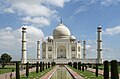 Photograph: Yann; edit: Jim CarterA view of the Taj Mahal from the south, featuring the Charbagh garden. The mausoleum complex also includes subsidiary tombs, waterworks infrastructure, the small town of Taj Ganji, and a "moonlight garden". Its origins and architecture have been extensively documented, covering both the circumstances of its commission and the cultural and historical influence of the Islamic Mughal Empire in India.
 A statue of the Hindu god Shiva as Nataraja, the Lord of Dance. In this form, Shiva performs his divine dance to destroy a weary universe and make preparations for the god Brahma to start the process of creation. A Telugu and Tamil concept, Shiva was first depicted as Nataraja in the famous Chola bronzes and sculptures of Chidambaram. The form is present in most Shiva temples in South India, and is the main deity in Chidambaram Temple, the foremost Shaivist temple.
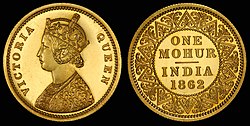 Coin design credit: East India Company and the Calcutta Mint; photographed by Andrew ShivaThe mohur is a gold coin that was formerly minted by several governments, including those of British India. It was usually equivalent in value to fifteen silver rupees. Gold mohurs issued by the British East India Company or the Crown are valuable collectors' items, and sell in auctions for high prices. The double mohur (minted between 1835 and 1918), with a value of thirty rupees, is the highest-denomination circulating coin ever issued in India. The 1835 two-mohur coin above was minted in the reign of King William IV, while the 1862 one-mohur coin below was minted in the reign of Queen Victoria; both are now part of the National Numismatic Collection at the National Museum of American History.
 Photograph: JJ HarrisonThe Siberian rubythroat (Luscinia calliope) is a small passerine bird generally considered to be an Old World flycatcher of the family Muscicapidae. This migratory insectivorous species breeds in mixed coniferous forest with undergrowth in Siberia, where it nests near the ground. It winters in Thailand, India and Indonesia. It is an extremely rare vagrant to Western Europe and the Aleutian Islands.
 Photograph credit: Sudipta MaulikNaba Kailash Mandir is a Hindu temple in Kalna City, West Bengal, India. The temple structure consists of 108 smaller temples, each with a height of around 6 metres (20 feet) and width of around 3 metres (9.5 feet), arranged in two concentric circles. The site is dedicated to the Hindu deity Shiva. The inner circle has a circumference of about 102 metres (336 feet), and the outer circle has a circumference of about 220 metres (710 feet). The temples are built on low raised base-altars. This aerial photograph of Naba Kailash Mandir was taken in 2020.
 Image credit: Vaikunda RajaThe Lotus-Namam is the symbol of Ayyavazhi, a Dharmic belief system that originated in South India in the 19th century. The lotus represents the 1,008-petalled Sahasrara and the flame-shaped white Namam represents the Aanma Jyothi or ātman, sometimes translated as 'soul' or 'self'. The number of practitioners is estimated to be between 700,000 and 8,000,000, although the exact number is unknown, since Ayyavazhis are reported as Hindus during censuses.
 Photograph credit: Jeevan JoseLyriothemis acigastra is a species of dragonfly in the family Libellulidae, found in India. Until 2013, it was thought to be restricted to the northeastern states of Assam and West Bengal, but it has now also been recorded in the southern state of Kerala. It is a small dragonfly with brown-capped greenish-yellow eyes and a blackish-brown thorax marked with yellow. Laterally, there are three stripes. Its wings are transparent, palely tinted with yellow at the base. The female is similar to the male, but the abdomen is cylindrical instead of tapered from base to end and reddish yellow instead of blood red. This picture shows a male L. acigastra individual.
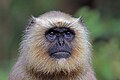 Photograph credit: Charles J. SharpThe southern plains gray langur (Semnopithecus dussumieri) is a species of Old World monkey native to the Indian subcontinent. It is about 62 cm (24 in) tall and lives in groups in various forest habitats, feeding mainly on leaves, fruit and flowers in the canopy, supplementing these with insects, gum, grasses, herbs and roots. The monkeys are considered sacred in India, and some are used by Hindu priests for religious purposes. They have adapted to living in close proximity to humans in urban settings; they are often fed by humans and accept cakes, millet, and other foods. The species is protected by law in India, but some are still persecuted for damaging crops, hunted for food and captured for pets.
This photograph of a female southern plains gray langur was taken in Kanha Tiger Reserve, in the Indian state of Madhya Pradesh. The park was created on 1 June 1955 and was designated a tiger reserve in 1973. Photograph: Jorge RoyanAn Indian merchant holding green chickpeas (Cicer arietinum). One of the earliest cultivated legumes, chickpeas are ingredients in a number of dishes around the world. India is the largest producer of this nutrient-dense food, accounting for 64% of global production in 2016.
 Photograph credit: Timothy GonsalvesShinku La is a mountain pass in the Himalayas of northern India. The pass is traversed by the Darcha–Padum road, connecting the high-altitude region of Zanskar in Ladakh with the rest of India. The pass becomes snowbound in the winter, leading to the closure of the road. The construction of a tunnel under the pass, to ensure all-weather connectivity, began in 2024. This photograph shows Shinku La covered in snow, with a frozen lake in the foreground.
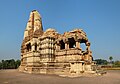 Photo: Marcin BiałekDuladeo Temple, dated to circa A.D. 1000–1150, is a Hindu temple dedicated to Shiva. It is located in Khajuraho, India.
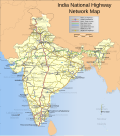 Map credit: PlaneMadA map of Network of National Highways in India, including NHDP projects up to phase IIIB, which is due to be completed by December 2012. The National Highways are the main long-distance roadways and constitute a total of about 58,000 km (36,250 mi), of which 4,885 km (3,053 mi) are central-separated expressways. Highways in India are around 2% of the total road network in India, but carry nearly 40% of the total road traffic.
 Photograph credit: Harshit Rautela; edited by UnpetitproleXKumaon is a revenue and administrative division in the Indian state of Uttarakhand. Historically known as Manaskhand and Kurmanchal, the Kumaon region has been ruled by several dynasties over the course of its history, most notably the Katyuri and the Chand. In 1790, the Kingdom of Kumaon was invaded and annexed by the Gorkhas, from whom it was conquered by the British East India Company in 1815, following which it became part of the Ceded and Conquered Provinces (which later became the United Provinces). After Indian independence in 1947, it remained part of the state of Uttar Pradesh until 2000, when the state of Uttarakhand was created as a result of the Uttarakhand movement. The people of Kumaon are known as Kumaonis and speak the Kumaoni language. This picture shows a panoramic view of the Kumaon Himalayas as seen from the hill station and town of Ranikhet, with mountains such as Trisul (7,120 m, 23,360 ft), Nanda Devi (7,817 m, 25,646 ft), Nanda Kot (6,861 m, 22,510 ft), Panchachuli (6,904 m, 22,651 ft), and other peaks prominently visible.
 Photograph: Muhammad Mahdi KarimA panoramic view of Bangalore from Corporation Circle, with UB City to the left and Richmond area to the right. Kanteerava Indoor Stadium is in the foreground. The third largest city in India, the city is known as the Silicon Valley of India for its numerous IT exports.
_female.jpg)
.jpeg)


_female_head.jpg)


Featured list –

Sachin Tendulkar has scored more centuries in Test cricket than any other player.
Sachin Tendulkar played for India, widely acknowledged as one of the greatest batsmen of all time, he is the most prolific run-scorer in international cricket. Tendulkar has scored the highest number of centuries (100 or more runs) in Test matches and One Day International (ODI) matches organised by the International Cricket Council. His total of 51 centuries in Test matches is a world record for highest number of centuries by a batsman and his 49 centuries in ODI matches are the second highest number of centuries after Virat Kohli. He became the first and only cricketer to score 100 international centuries when he made 114 against Bangladesh in March 2012.
After making his Test debut in 1989, Tendulkar achieved his first century against England at Old Trafford, Manchester in 1990; he made 119 not out. In Test matches, Tendulkar has scored centuries against all the Test cricket playing nations, and is the second batsman to score 150 against each of them. He has scored a century in at least one cricket ground of all Test cricket playing nations, except Zimbabwe. In October 2010, Tendulkar went past Brian Lara's record of 19 scores of 150 or more by hitting his 20th against Australia in Bangalore. He made his highest score in 2004, when he made 248 not out against Bangladesh at the Bangabandhu National Stadium, Dhaka. Tendulkar has scored six double centuries and remained unbeaten on 15 occasions. His centuries have come in 30 different cricket grounds, with 27 of them being scored in venues outside India. Tendulkar has been dismissed nine times between scores of 90 and 99. (Full article...)
Kumar in 2012
Akshay Kumar is an Indian actor, television presenter, and film producer who works in Hindi-language films. He had a minor role in the 1987 Indian film Aaj. He debuted in a leading role with the film Saugandh (1991) before his breakthrough with Khiladi (1992), first film of the Khiladi series. In 1994, Kumar featured in the successful releases Elaan, Mohra, Main Khiladi Tu Anari, Suhaag and the romantic drama Yeh Dillagi, which earned him a Filmfare Award for Best Actor nomination. He also found success with Khiladiyon Ka Khiladi (1996) and Dil To Pagal Hai (1997), which earned him a Filmfare Award for Best Supporting Actor nomination. However, several other of his 1990s releases performed poorly at the box office, leading to a brief setback in his film career.
The 1999 crime drama Jaanwar marked Kumar's comeback. His next films Hera Pheri (2000), Dhadkan (2000) and Ajnabee (2001) were well received. He played a negative role in the latter, winning the Filmfare Best Villain Award and then appeared in Andaaz (2003), Aitraaz (2004), Khakee (2004) and Aan: Men at Work (2004) and Waqt (2005). In this period, Kumar also proved himself as a great comic actor when he featured in financially successful comedies like Mujhse Shaadi Karogi (2004), Garam Masala (2005), Bhagam Bhag (2006), Phir Hera Pheri (2006), Namastey London (2007), Heyy Babyy (2007), Welcome (2007), Bhool Bhulaiyaa (2007), Singh Is Kinng (2008), Housefull (2010) and Tees Maar Khan (2010). He won the Filmfare Best Comedian Award for Garam Masala. In 2004, he presented the television series Seven Deadly Arts with Akshay Kumar. In 2008, he founded the Hari Om Entertainment production company, and hosted the reality shows Fear Factor: Khatron Ke Khiladi and MasterChef India in 2010. In 2011 he founded another production company Grazing Goat Pictures, and produced the Indo-Canadian hockey-based film Breakaway, which became the highest grossing cross-cultural film at the Canadian box office. (Full article...)
Mohabbatein (transl. Love Stories) is a 2000 Indian Hindi-language musical romantic drama film written and directed by Aditya Chopra. It stars an ensemble cast of Amitabh Bachchan, Shah Rukh Khan, Aishwarya Rai, and the newcomers Uday Chopra, Shamita Shetty, Jugal Hansraj, Kim Sharma, Jimmy Sheirgill, and Preeti Jhangiani. It tells the story of a fictional all-boys college Gurukul's principal Narayan Shankar (Bachchan) who prohibits his students from falling in love and will unhesitantly expel those who do not obey the rule. The rest of the film focuses on how the arrival of the violin teacher Raj Aryan Malhotra (Khan) changes his views. Mohabbatein's soundtrack was composed by Jatin–Lalit, and the lyrics were written by Anand Bakshi. The film was shot by Manmohan Singh on sets designed by Sharmishta Roy, while the editor was V. Karnik.
The film opened at theatres on 27 October 2000 and was met with widespread acclaim from critics, who praised the performances of Bachchan and Khan. Made on a production budget of ₹130 million (US$1.4 million), the film had a total gross of ₹900.1 million (US$9.5 million) becoming the year's highest-grossing Indian film. (Full article...)
Shriya Saran at 62nd South Filmfare awards.
Shriya Saran is an Indian actress and model who has appeared mostly in Telugu, Tamil and Hindi language films. She made her acting debut with the Telugu film Ishtam (2001) and had her first commercial success with Santosham (2002). The following year, she made her Hindi cinema debut with a supporting role in Tujhe Meri Kasam, alongside Riteish Deshmukh and Genelia D'Souza, which is a remake of Malayalam film Niram. It was followed by the commercially successful crime drama Tagore (2003), in which she was paired opposite Chiranjeevi, which is a remake of Tamil film Ramanaa. The same year, she played a supporting role in the Tamil-Telugu bilingual film Enakku 20 Unakku 18, which marked her debut in Tamil cinema. In 2005, she had ten releases including Mazhai, S. S. Rajamouli's Chatrapathi, and Mogudu Pellam O Dongodu, in which she was among the only three characters of the film. Saran's solitary release as a lead actress in 2006 was the Tamil film Thiruvilaiyaadal Aarambam.
In 2007, Saran was paired opposite Rajinikanth in S. Shankar's Sivaji. It was the most expensive film in Indian cinema and went on to become the highest grossing Tamil film to that point. The same year, she made a comeback to Hindi cinema with Mohit Suri's Awarapan, where she played a Muslim woman. Following that, she made her American cinema debut with James Dodson's The Other End of the Line (2008), in which she played an Indian woman who works in a call centre. Her subsequent releases include the Tamil films Kanthaswamy (2009) and Kutty (2010), and Pokkiri Raja (2010), which marked her debut in Malayalam cinema. (Full article...)
Mahesh Babu is an Indian actor and producer known for his work in Telugu cinema. He first appeared in the 1979 film Needa when he was four years old. He continued to perform as a child actor in several films, most of which featured his father Krishna. Following his role as the titular protagonist in Balachandrudu (1990) while still a child, his career went on hiatus so he could concentrate on his education until taking on his first lead role as an adult in the 1999 film Rajakumarudu, for which he won the Nandi Award for Best Male Debut. Afterwards, his career stagnated until successes like Murari (2001), Okkadu (2003) and Athadu (2005) brought him fame. In 2006, he played a gangster in the Puri Jagannadh-directed action-thriller Pokiri. The film became the highest-grossing Telugu film of all time, and according to Vogue India, cemented Babu's reputation as a "superstar".
In the wake of the failures of Sainikudu (2006) and Athidhi (2007), Babu took a long-term break from cinema for personal reasons. His next project, the fantasy action film Khaleja, was released in 2010 after significant delays. In 2011, he starred in Dookudu, which became the first Telugu film to gross over ₹1 billion. Businessman (2012), his next film, was well received and became one of the year's highest grossing Telugu films at a time that was particularly harsh on other big-budget productions. The following year, Babu co-starred alongside Venkatesh in the critically and commercially acclaimed drama film Seethamma Vakitlo Sirimalle Chettu, which was considered the first Telugu multi-starrer in decades. He then featured in Sukumar's 2014 psychological thriller film 1: Nenokkadine. Although Babu's performance as a schizophrenic rock star was lauded by critics, the film itself received mixed reviews and failed to recover its budget. Aagadu, his next release that year, suffered a similar fate, despite the film's opening gross being his highest at the time. (Full article...)- The J. C. Daniel Award is the highest award in Malayalam cinema, established by the Government of Kerala, India. It is presented annually by the Kerala State Chalachitra Academy, a non-profit autonomous institution operating under the Department of Cultural Affairs, Kerala. Instituted in 1992, the award recognizes individuals for their "outstanding contributions to Malayalam cinema". Recipients are selected by a jury suggested by the Kerala State Chalachitra Academy and appointed by the Department of Cultural Affairs. As of 2021[update], the honourees receive a statuette, a citation, and a cash prize of ₹500,000 (US$5,300). They are honoured at the Kerala State Film Awards ceremony.
The Government of Kerala created the award to commemorate the contribution of Indian filmmaker J. C. Daniel, who is often regarded as the "father of Malayalam cinema". The J. C. Daniel Award was managed by the Department of Cultural Affairs until 1997. In 1998, the Government of Kerala constituted the Kerala State Chalachitra Academy, and since that year, the Academy has hosted the award. A cash prize of ₹50,000 (US$530) was granted with the award until 2002. In 2003, the prize money was doubled and, as part of a technical correction to update it, no award was presented that year. Actor Madhu was the first recipient of the award with the increased monetary prize of ₹100,000 (US$1,100) in 2004. Since 2016, the cash prize is ₹500,000 (US$5,300). (Full article...) 
Roshan in 2024
Hrithik Roshan is an Indian actor known for his work in Hindi-language films. As a child, he made uncredited appearances in three films directed by his maternal grandfather, J. Om Prakash, the first of which was in Aasha (1980). In 1986, Roshan played the adopted son of Rajinikanth's character in Prakash's crime drama Bhagwaan Dada. Roshan subsequently worked as an assistant director on four films, including Khudgarz (1987) and Karan Arjun (1995), all of which were directed by his father, Rakesh.
Roshan's first leading role came opposite Ameesha Patel in Kaho Naa... Pyaar Hai (2000), a highly successful romantic drama directed by his father, for which he won two Filmfare Awards—Best Male Debut and Best Actor. In 2001, Roshan played a supporting role in Karan Johar's lucrative ensemble melodrama Kabhi Khushi Kabhie Gham. This initial success was followed by roles in a series of critical and commercial failures, including Aap Mujhe Achche Lagne Lage (2002) and Main Prem Ki Diwani Hoon (2003), leading critics to believe that Roshan's career was over. His career prospects improved in 2003 when he played the role of a mentally disabled teenager in his father's science fiction film Koi... Mil Gaya. The film emerged as one of the highest-grossing Bollywood film of that year and earned Roshan the Best Actor – Critics and the Best Actor awards at Filmfare. His next release, the war drama Lakshya (2004), performed poorly at the box office despite earning positive reviews. (Full article...)
The Padma Bhushan is the third-highest civilian award of the Republic of India. Instituted on 2 January 1954, the award is given for "distinguished service of a high order", without distinction of race, occupation, position, or sex. The recipients receive a Sanad, a certificate signed by the President of India and a circular-shaped medallion with no monetary association. The recipients are announced every year on Republic Day (26 January) and registered in The Gazette of India—a publication used for official government notices and released weekly by the Department of Publication, under the Ministry of Urban Development. The conferral of the award is not considered official without its publication in the Gazette. The name of recipient, whose award have been revoked or restored, both of which require the authority of the President, is archived and they are required to surrender their medal when their name is struck from the register; none of the conferments of Padma Bhushan during 1980–1989 have been revoked or restored. The recommendations are received from all the state and the union territory governments, as well as from Ministries of the Government of India, the Bharat Ratna and the Padma Vibhushan awardees, the Institutes of Excellence, the Ministers, the Chief Ministers and the Governors of State, and the Members of Parliament including private individuals.
When instituted in 1954, the Padma Bhushan was classified as "Dusra Varg" (Class II) under the three-tier Padma Vibhushan awards, which were preceded by the Bharat Ratna in hierarchy. On 15 January 1955, the Padma Vibhushan was reclassified into three different awards as the Padma Vibhushan, the Padma Bhushan and the Padma Shri. The criteria included "distinguished service of a high order in any field including service rendered by Government servants", but excluded those working with the public sector undertakings with the exception of doctors and scientists. The 1954 statutes did not allow posthumous awards; this was subsequently modified in the January 1955 statute. The design was also changed to the form that is currently in use; it portrays a circular-shaped toned bronze medallion 1+3⁄4 inches (44 mm) in diameter and 1⁄8 inch (3.2 mm) thick. The centrally placed pattern made of outer lines of a square of 1+3⁄16 inches (30 mm) side is embossed with a knob carved within each of the outer angles of the pattern. A raised circular space of diameter 1+1⁄16 inches (27 mm) is placed at the centre of the decoration. A centrally located lotus flower is embossed on the obverse side of the medal and the text "Padma" is placed above and the text "Bhushan" is placed below the lotus written in Devanagari script. The State Emblem of India is displayed in the centre of the reverse side, together with the national motto of India, "Satyameva Jayate" (Truth alone triumphs) in Devanagari script, which is inscribed on the lower edge. The rim, the edges and all embossing on either side is of standard gold with the text "Padma Bhushan" of gold gilt. The medal is suspended by a pink riband 1+1⁄4 inches (32 mm) in width with a broad white stripe in the middle. It is ranked fifth in the order of precedence of wearing of medals and decorations of the Indian civilian and military awards. (Full article...)
Shetty in 2018
Shilpa Shetty is an Indian actress who is primarily known for her work in Hindi films, in addition to a few Telugu, Kannada and Tamil films. Shetty made her acting debut opposite Shah Rukh Khan in the 1993 thriller Baazigar. Shetty's performance earned her two Filmfare Awards nominations for Lux New Face of the Year and Best Supporting Actress. She subsequently earned recognition with dual roles in the 1994 action-comedy Main Khiladi Tu Anari. After initial success, Shetty's films fared poorly at the box office for the next five years. Films Shetty starred in including action drama Aag, romantic drama Aao Pyaar Karen, comedy Haathkadi and Chhote Sarkar proved to be financially unsuccessful.
The 2000 romantic drama Dhadkan marked a turning point in her career, earning her several nominations in the Best Actress category at various award ceremonies. Shetty played the lead female in films such as family drama Apne, police drama Garv: Pride and Honour and musical drama Life in a... Metro. Her comic performance as an eccentric fisherwoman in 2002 action-drama release Rishtey earned her a nomination for the Filmfare Best Supporting Actress Award. Shetty became a global figure after winning the 2007 British reality television series Celebrity Big Brother, after comments made by other contestants about Shetty fell afoul of Ofcom rules and caused an international controversy over racism. (Full article...)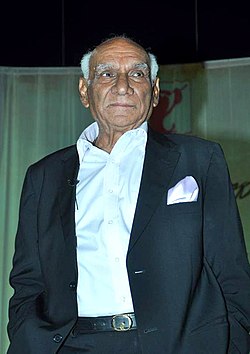
Yash Chopra, the founder of Yash Raj Films, pictured in 2012. He directed 13 films for the company between 1973 and 2012,
Yash Raj Films (abbreviated as YRF) is an Indian entertainment company, established by filmmaker Yash Chopra in 1970, that produces and distributes motion pictures. As of 2022, the company has produced over 80 Hindi films and one Tamil film. YRF started a film distribution business in 1997; in addition to distributing their own productions, the company has handled the domestic and/or international distribution of over 50 films from other companies. The most frequent collaborations of the company have been with the actors Amitabh Bachchan, Raakhee, Rishi Kapoor, Shah Rukh Khan, Kajol, Rani Mukerji, Anushka Sharma, Katrina Kaif, and Saif Ali Khan.
YRF's first release came in 1973 with the Chopra-directed Daag, a drama about bigamy, starring Rajesh Khanna, Raakhee and Sharmila Tagore. The company had four more releases in the 1970s, including the ensemble romantic drama Kabhi Kabhie and the action film Kaala Patthar, both of which starred Amitabh Bachchan and Raakhee. YRF's sole commercial success in the 1980s was the Sridevi-starring romantic musical Chandni. The year 1995 marked the directorial debut of Chopra's elder son Aditya Chopra with the highly successful romantic drama Dilwale Dulhania Le Jayenge. Starring Shahrukh Khan and Kajol, the film has the longest theatrical run in Indian cinema history. Other successful releases of the 1990s were Darr (1993) and Dil To Pagal Hai (1997), both starring Khan. (Full article...)
Eden Gardens during a day/night match
The Eden Gardens is a cricket ground in Kolkata, India. It is one of the main international cricket venues of India and often called the "Mecca of Indian cricket". It is the home of the Bengal cricket team and the Kolkata Knight Riders, as well as being a Test, One Day International (ODI) and Twenty20 International (T20I) venue. As of 2020, the Eden Gardens has hosted more than 40 Test matches, the first of which was in January 1934 when India played the touring England team. These include the first ever day/night Test match in India which was hosted between 22 and 24 November 2019, when India played the visiting Bangladesh team. The first ODI played at the ground was between India and Pakistan on 18 February 1987. As of 2020, 30 ODIs have been played at the ground.
The first Test century scored at the ground was in December 1948, by Everton Weekes of the West Indies. He scored 162 runs in the first innings. In the same match Syed Mushtaq Ali of India scored 106 in the fourth innings, thus becoming the first Indian to have scored a century at the Eden Gardens. To date, 77 Test centuries have been scored at the ground. VVS Laxman's 281, scored against Australia in March 2001, during the famous second test of Border-Gavaskar Trophy, is the highest individual Test score achieved at the ground. The highest individual Test score by an overseas player is 256, scored by Rohan Kanhai of the West Indies in December 1958. Mohammad Azharuddin and VVS Laxman have scored five Test centuries each, the highest number of Test centuries scored by an individual player at the ground. During the second Test of the India–South Africa Test series held in February 2010 at the ground, a total of seven centuries were scored between the two teams. This is the highest number of centuries scored in a single Test match at the ground. (Full article...)
Priyanka Chopra won several awards, including the National and Filmfare awards for Best Actress for her performance in Fashion
Fashion is a 2008 Indian drama film directed by Madhur Bhandarkar and produced by UTV Motion Pictures. The film features Priyanka Chopra in the lead role, with Kangana Ranaut, Mugdha Godse, Arbaaz Khan and Arjan Bajwa in supporting roles as well as several professional fashion models playing themselves. Bhandarkar co-wrote the film with Ajay Monga and Anuraadha Tewari. Deven Murdeshwar edited the film while the cinematography was provided by Mahesh Limaye. Salim–Sulaiman composed the musical score, with lyrics written by Irfan Siddiqui and Sandeep Nath. The film focuses on the transformation of Meghna Mathur, an aspiring fashion model played by Chopra, from a small-town girl to a supermodel in the Indian fashion industry.
Produced on a budget of ₹180 million (US$1.9 million), Fashion was released on 29 October 2008 to critical acclaim and box-office success. It grossed ₹600 million (US$6.3 million) and was noted for being commercially successful despite being a women-centric film with no male lead. Fashion received various awards and nominations, with praise for its direction, the performance of the cast, screenplay, editing, musical score, and costume design. (Full article...)- The National Film Award for Best Direction is an honour presented annually at India's National Film Awards ceremony by the National Film Development Corporation of India (NFDC), an organisation set up by the Indian Ministry of Information and Broadcasting. Since 1967, the award is given by a national panel appointed annually by the NFDC to a director for their work within Indian cinema. It is presented by the president of India at a ceremony held in New Delhi.
The winner is given a "Swarna Kamal" (Golden Lotus) certificate and a cash prize of ₹3,00,000. Including ties and repeat winners, the NFDC has presented a total of 53 Best Direction awards to 34 different directors. Although Indian cinema produces films in more than twenty languages, the performances of films that have won awards are of nine languages: Bengali (16 awards), Malayalam (14 awards), Hindi (11 awards), Tamil (4 awards), English, Kannada and Marathi (3 awards each), Assamese and Punjabi (1 each). (Full article...) 
Priyanka Chopra's performance in Mary Kom garnered her several awards and nominations
Mary Kom is a 2014 Indian biographical sports drama film directed by Omung Kumar and produced by Sanjay Leela Bhansali and Viacom 18 Motion Pictures. The film features Priyanka Chopra in the lead role as the boxer Mary Kom, with Darshan Kumar and Sunil Thapa in supporting roles as her husband and mentor, Onler Kom and M. Narjit Singh respectively. The film was written by Saiwyn Quadras, with the cinematography provided by Keiko Nakahara while Bhansali co-edited the film with Rajesh G. Pandey. The film follows Kom's journey of becoming a boxer to her victory at the 2008 World Boxing Championships in Ningbo, China.
Before its theatrical release on 5 September 2014, the film premiered at the 2014 Toronto International Film Festival, where it became the first Hindi film to be screened on the opening night of the film festival. The film received generally positive reviews from critics and was a commercial success. It grossed ₹1.05 billion (US$11 million) at the box-office against a budget of ₹150 million (US$1.6 million). Mary Kom has received various awards and nominations, with praise for its direction, Chopra's performance, screenplay, editing, background score, and costume design. As of August 2015, the film has won 20 awards. (Full article...)- Vishwaroopam is a 2013 Indian spy thriller film directed by Kamal Haasan. Besides starring in the lead role with Pooja Kumar, Haasan co-produced the film with S. Chandrahaasan and Prasad V. Potluri, and co-wrote the script with Atul Tiwari. Andrea Jeremiah, Rahul Bose, Shekhar Kapur and Nassar play supporting roles in the film. The film's story revolves around Wisam Ahmed Kashmiri, a spy from India's intelligence agency Research and Analysis Wing, stopping a group of Al-Qaeda terrorists led by Omar (Bose) from triggering a dirty bomb made by scraping caesium from oncological equipment in New York City. A bilingual film, made in Tamil and Hindi (as Vishwaroop), the soundtrack and score were composed by Shankar–Ehsaan–Loy. Sanu Varghese and Mahesh Narayanan were in charge of the film's cinematography and editing respectively. Lalgudi N. Ilaiyaraaja and Boontawee 'Thor' Taweepasas were in charge of art direction while Birju Maharaj handled the choreography.
Vishwaroopam was made on a budget of ₹950 million. The film was released on 25 January 2013 worldwide except Tamil Nadu where it was banned due to protest by Islamic organisations which cited that Muslims were depicted in a negative manner. The ban on the film was lifted and it released on 7 February 2013 after a mutual agreement between Haasan and the organisations; the Hindi version was released on 1 February 2013. Both versions received generally positive reviews and were commercial successes at the box office, collectively grossing ₹2.2 billion overall. (Full article...)
The Padma Bhushan is the third-highest civilian award of the Republic of India. Instituted on 2 January 1954, the award is given for "distinguished service of a high order", without distinction of race, occupation, position, or sex. The recipients receive a Sanad, a certificate signed by the President of India and a circular-shaped medallion with no monetary association. The recipients are announced every year on Republic Day (26 January) and registered in The Gazette of India, a publication used for official government notices and released weekly by the Department of Publication, under the Ministry of Urban Development. The conferral of the award is not considered official without its publication in the Gazette. The names of recipients whose awards have been revoked or restored, both of which require the authority of the President, are archived, and recipients who are struck from the register are required to surrender their medals; none of the conferments of Padma Bhushan during 1990–1999 have been revoked or restored. The recommendations are received from all the state and the union territory governments, as well as from Ministries of the Government of India, the Bharat Ratna and the Padma Vibhushan awardees, the Institutes of Excellence, the Ministers, the Chief Ministers and the Governors of State, and the Members of Parliament including private individuals.
When instituted in 1954, the Padma Bhushan was classified as "Dusra Varg" (Class II) under the three-tier Padma Vibhushan awards, which were preceded by the Bharat Ratna in hierarchy. On 15 January 1955, the Padma Vibhushan was reclassified into three different awards as the Padma Vibhushan, the Padma Bhushan and the Padma Shri. The criteria included "distinguished service of a high order in any field including service rendered by Government servants", but excluded those working with the public sector undertakings with the exception of doctors and scientists. The 1954 statutes did not allow posthumous awards; this was subsequently modified in the January 1955 statute. The design was also changed to the form that is currently in use; it portrays a circular-shaped toned bronze medallion 1+3⁄4 inches (44 mm) in diameter and 1⁄8 inch (3.2 mm) thick. The centrally placed pattern made of outer lines of a square of 1+3⁄16 inches (30 mm) side is embossed with a knob carved within each of the outer angles of the pattern. A raised circular space of diameter 1+1⁄16 inches (27 mm) is placed at the centre of the decoration. A centrally located lotus flower is embossed on the obverse side of the medal and the text "Padma" is placed above and the text "Bhushan" is placed below the lotus written in Devanagari script. The State Emblem of India is displayed in the centre of the reverse side, together with the national motto of India, "Satyameva Jayate" (Truth alone triumphs) in Devanagari script, which is inscribed on the lower edge. The rim, the edges and all embossing on either side is of standard gold with the text "Padma Bhushan" of gold gilt. The medal is suspended by a pink riband 1+1⁄4 inches (32 mm) in width with a broad white stripe in the middle. It is ranked fifth in the order of precedence of wearing of medals and decorations of the Indian civilian and military awards. (Full article...)Chopra in 2012
Yash Chopra (1932–2012) was an Indian film director and producer known for his works in Bollywood. Acknowledged as one of the country's greatest filmmakers, he was credited by the media for "changing the face of romance to become a brand" in the industry. He made his directorial debut with the family drama Dhool Ka Phool, which was produced by his elder brother B. R. Chopra. The film, released in 1959, became a commercial success worldwide and gave him critical acclaim. Chopra's next film, Dharmputra (1961), failed to perform well at the box office but won the National Film Award for Best Feature Film in Hindi. In 1965, he directed the drama Waqt about a family who are separated due to a natural disaster. A commercial success, it was one of the earliest Indian films to star an ensemble cast and won a first Best Director trophy for him at the Filmfare Awards.
The 1980s was the most unsuccessful period of his career. Following the failure of his romantic drama Silsila (1981), which he co-wrote, directed and produced, Chopra's popularity began to wane. According to his biographer, the British academic Rachel Dwyer, this was because action and crime films were more popular at the time while most of his films were romances. Chopra experimented with making two action films, Mashaal (1984) and Vijay (1988), which underperformed financially but were well received by critics. Chandni was his only box-office success of the decade. Starring Sridevi in the title role, the film tells the story of a young woman who is accused of being responsible for her lover's accident. Chopra's career began to revive since its premiere in 1989; the film was named the Best Popular Film Providing Wholesome Entertainment at the 37th National Film Awards and considered one of his best films. (Full article...)
The National Film Award for Best Actor in a Supporting Role is an honour presented annually at India's National Film Awards ceremony by the National Film Development Corporation of India (NFDC), an organisation set up by the Indian Ministry of Information and Broadcasting. A national panel appointed annually by the NFDC selects the actor who has given the best performance in a supporting role within Indian cinema. The award is presented by the President of India at a ceremony held in New Delhi. Since the 70th National Film Awards, the name was changed to "Best Actor in a Supporting Role".
The winner is given a "Rajat Kamal" (Silver Lotus) certificate and a cash prize of ₹2 lakh (US$2,100). Including ties and repeat winners, the government of India has presented a total of 32 Best Supporting Actor awards to 29 different actors. Although Indian cinema produces films in more than 20 languages, the actors whose performances have won awards have worked in one or more of seven major languages: Hindi (18 awards), Tamil (10 awards), Bengali (3 awards), Malayalam (5 awards), Marathi (3 awards), Telugu (1 award), Kannada (1 award). (Full article...)
The Indian Navy currently operates twenty-five air squadrons. Of these, eleven operate fixed-wing aircraft, ten are helicopter squadrons and the remaining three are equipped with unmanned aerial vehicles (UAV). Building on the legacy inherited from the Royal Navy prior to Indian independence, the concept of naval aviation in India started with the establishment of Directorate of Naval Aviation at Naval Headquarters (NHQ) in early 1948. Later that year officers and sailors from the Indian Navy were sent to Britain for pilot training. In 1951, the Fleet Requirement Unit (FRU) was formed to meet the aviation requirements of the navy. On 1 January 1953, the charge of Cochin airfield was handed over to the navy from the Directorate General of Civil Aviation. On 11 March, the FRU was commissioned at Cochin with ten newly acquired Sealand aircraft. The navy's first air station, INS Garuda, was commissioned two months later. From February 1955 to December 1958, ten Firefly aircraft were acquired. To meet the training requirements of the pilots, the indigenously developed HAL HT-2 trainer was inducted into the FRU. On 17 January 1959, the FRU was commissioned as Indian Naval Air Squadron (INAS) 550, to be the first Indian naval air squadron. In the following two years, three more naval air squadrons—INAS 300, INAS 310 and INAS 551—were commissioned. The first two operated from the newly purchased aircraft carrier INS Vikrant flying Sea Hawks and Alizés, whereas the latter one, equipped with Vampires, was used for training purposes.
Between 1961 and 1971, three helicopter squadrons were commissioned—INAS 321, INAS 330 and INAS 561. The first two were equipped with HAL Chetak and Sea King 42Bs for search and rescue and anti-submarine roles respectively, whereas the later one assumed a training role. In December 1971, the squadrons embarked on the aircraft carrier INS Vikrant saw action in the India–Pakistan war of 1971. Between 1976 and 1977, INAS 312 and INAS 315 were commissioned with Super Constellation and Ilyushin Il-38s respectively. In December 1980, another helicopter squadron intended for anti-submarine warfare—INAS 333—was commissioned. It was initially equipped with Ka-25s, and with Ka-28s in late 1980s. In 1984, one patrol and one helicopter squadron—INAS 318 and INAS 336—were commissioned. The patrol squadron was initially equipped with Islander aircraft, but they were replaced by Dornier 228s in 2000. In November 1990, another Sea King squadron—INAS 339—was commissioned. Later in 1993, the Sea Kings were replaced by Ka-28s, and in 2003, Ka-31s were inducted, making it the only Indian naval air squadron for the role of airborne early warning and control. (Full article...)
Mukerji in 2025
Hindi film actress Rani Mukerji made her screen debut in Biyer Phool (1996), a Bengali film directed by her father Ram Mukherjee. Her first leading role was that of a rape victim in the 1996 social drama Raja Ki Aayegi Baaraat. In 1998 she received wider recognition for her role alongside Aamir Khan in the action film Ghulam, and had her breakthrough as the romantic interest of Shah Rukh Khan's character in the romantic drama Kuch Kuch Hota Hai. The latter earned Mukerji her first Filmfare Award in the Best Supporting Actress category. She followed this by playing the leading lady in several films, including Hello Brother (1999) and Nayak: The Real Hero (2001), none of which helped propel her career forward.
Mukerji's career prospects improved in 2002 when she starred in Yash Raj Films' Saathiya, a romantic drama that gained her a Filmfare Critics Award for Best Actress. For her roles in the 2004 romantic comedy Hum Tum and the composite drama Yuva, Mukerji became the only actress to win both the Filmfare Award for Best Actress and Best Supporting Actress, respectively, in the same year. Also that year, she starred in Veer-Zaara—the highest-grossing Bollywood film of the year. In 2005, she received praise for portraying a blind, deaf and mute woman in the drama Black, and played a con woman in the crime comedy film Bunty Aur Babli. For her performance in Black, she was awarded the Best Actress and Best Actress (Critics) trophies at Filmfare. The following year, she played an unhappily married woman in the drama Kabhi Alvida Naa Kehna — the top-grossing Bollywood film in overseas at that point. (Full article...)
Mersal (transl. Zapped) is a 2017 Indian vigilante action film directed by Atlee Kumar, who co-wrote the screenplay with V. Vijayendra Prasad and S. Ramana Girivasan. Produced by N. Ramasamy and Hema Rukmani under the banner of Thenandal Studio Limited, Mersal features Vijay in triple roles for the first time in his career. Nithya Menen, S. J. Surya, Kajal Aggarwal and Samantha Akkineni play the other lead roles while Vadivelu, Kovai Sarala and Sathyaraj feature as supporting characters. A. R. Rahman composed the film's soundtrack, while also handling the background score along with Qutub-E-Kripa. Ruben and G. K. Vishnu were in charge of the editing and cinematography respectively. The film follows two brothers, Vetri (Vijay), a renowned magician, and Maaran (Vijay), a doctor who charges meagre amounts for his patients, who try to expose the corrupt dealings and medical crimes of another doctor, Daniel Arockiaraj (Surya), who also happens to be the same person that killed their parents, Vetrimaaran (Vijay) and Aishwarya (Menen).
Produced on a budget of ₹1.2 billion (about US$17.5 million in 2017), Mersal was released on 18 October 2017 and received positive reviews. It was also a commercial success, grossing ₹2.6 billion (about US$39.3 million in 2017) worldwide. The film won 35 awards from 57 nominations; its direction, screenplay, music and Vijay's performances received the most attention from award groups. (Full article...)- Paradesi (transl. Vagabond) is a 2013 Indian Tamil-language period drama film written, produced and directed by Bala. The film features Atharvaa and Vedhika in the lead roles, with Sai Dhanshika, Uday Karthik, Riythvika and Jerry in supporting roles. The soundtrack and score were composed by G. V. Prakash Kumar. The cinematography was handled by Chezhiyan, while Kishore Te and L. V. K. Das were in charge of the editing. Based on Paul Harris Daniel's 1969 novel Red Tea, the film's story revolves around Raasa (Atharvaa), an unemployed villager who is misled into bonded labour at a tea plantation after being promised generous accommodation and wages by its supervisor (Jerry).
Paradesi was made on a budget of ₹400 million and was released on 15 March 2013 to critical acclaim, but failed at the box office. The film won 37 awards from 59 nominations; its direction, performances of the cast members, music, cinematography, and costumes have received the most attention from award groups. (Full article...) - The Dirty Picture is a 2011 Indian biographical drama film directed by Milan Luthria and produced by Shobha and Ekta Kapoor. Inspired by the lives of such actresses as Silk Smitha and Disco Shanti, the film narrates the rise and fall of a dancing girl in Tamil cinema. The Dirty Picture features Vidya Balan in the lead role, and co-stars Emraan Hashmi, Tusshar Kapoor and Naseeruddin Shah. Rajat Arora wrote the screenplay, dialogues and lyrics for the film and Vishal–Shekhar composed the music.
Made on a budget between ₹170 million (US$1.8 million) and ₹180 million (US$1.9 million), The Dirty Picture was released worldwide on 2 December 2011, and earned ₹1.14 billion (US$12 million). The film garnered awards and nominations in several categories, with particular praise for Vidya's performance, the dialogues, and the costume design by Niharika Khan. As of 2012, the film has won 51 awards. (Full article...) 
Trisha Krishnan in 2022
Trisha Krishnan[a] is an Indian actress known for her work primarily in Tamil and Telugu cinema. She is the only South Indian actress to have sustained a successful career as a leading actress for over two decades in Tamil cinema. She was first seen in 1999 in a minor supporting role in Jodi and later appeared in 2000 in the music video of Falguni Pathak's song 'Meri Chunar Udd Udd Jaye'.
The first project she accepted as a lead actress was Priyadarshan's Lesa Lesa but a delay in the film's release meant that her first appearance in a lead role was in Ameer's directorial debut Mounam Pesiyadhe in 2002, which was a commercial success. The following year, Trisha portrayed a woman battling a terminal illness in Manasellam (2003). Her next release was Hari's action film, Saamy (2003) in which she played a soft-spoken Brahmin girl and attracted praise for her performance, and the film became a major commercial and critical success, resulting in Trisha receiving new offers, including those from several high-budget productions. Lesa Lesa, which was to have been her debut as a lead actress, was released next, earned her the ITFA Best New Actress Award. She starred in Alai (2003) and the Tamil-Telugu bilingual film Enakku 20 Unakku 18 (2003) (Nee Manasu Naaku Telusu) were commercially unsuccessful. Trisha's next Telugu release, Varsham (2004), was a major commercial and critical success, earning her the first Filmfare Award for Best Actress-Telugu and more Telugu film offers. Trisha starred in Ghilli (2004) as a damsel in distress, and the film became a major critical and commercial success. She starred in Mani Ratnam's political drama Aayutha Ezhuthu (2004). She starred in Thirupaachi (2005), which became a major commercial success. Trisha played a village girl in the romantic comedy Nuvvostanante Nenoddantana (2005), a commercial and critical success that earned her a second Filmfare Award for Best Actress and a Nandi Award for Best Actress. Athadu (2005), Aaru (2005), Stalin (2006), were major commercial successes. She reprised the role in the Tamil remake Unakkum Enakkum (2006) which was also successful. She played the titular role in Pournami (2006). Aadavari Matalaku Arthale Verule (2007) was a critical and commercial success, earning Trisha her third Filmfare Award for Best Actress and the same year Kireedam (2007) was a commercial success. Krishna (2008) and King (2008) became blockbusters, while Bheema (2008) was commercially unsuccessful, and Kuruvi (2008) and Bujjigadu (2008) emerged as hits. In Abhiyum Naanum (2008), Trisha's performance was widely praised,' and earned her Tamil Nadu State Film Award and a Filmfare nomination for Best Actress. Her 2009 films Sarvam and Sankham did not do well and became average grossers. The following year, Vinnaithaandi Varuvaayaa (2010) was a major success and a career breakthrough for Trisha, earning her a Filmfare nomination for Best Actress. She made her debut in Hindi cinema with the film Khatta Meetha (2010) Upon release, the film received mixed reviews from critics and box office India declared it an average performer at the box office. However, it earned her nomination for a Filmfare Award for Best Female Debut. Her sole Telugu release that year was Namo Venkatesa. Both her 2011 releases –Teen Maar and Mankatha were successful. She had two releases in 2012, Bodyguard and Dammu were successful. Her two Tamil films in 2013 the mystery thriller Samar, and Endrendrum Punnagai (2013), which earned her a Filmfare nomination for Best Actress. Her sole release in 2014 was Power, which marked her debut in Kannada cinema was a commercial success. (Full article...)
The Madhya Pradesh Legislative Assembly is the unicameral state legislature of the state of Madhya Pradesh in India. It is housed in the Vidhan Bhavan, a building located at the center of the Capital Complex, in the Arera Hill locality of Bhopal, the capital of the state. Madhya Pradesh is the second-largest state in India, covering 308,245 km2 (119,014 sq mi); and the sixth-most populous state with a population of 72.6 million. The term of the assembly is five years, unless it is dissolved early. Since 2001, it has had 230 members who are directly elected, from single-seat constituencies.
Since the independence of India, the Scheduled Castes (SC) and Scheduled Tribes (ST) have been given reservation status, guaranteeing political representation, and the Constitution lays down the general principles of positive discrimination for SCs and STs. The 2011 census of India stated that the Scheduled Castes and the Scheduled Tribes constitute a significant portion of the population of the state, at 15.6% and 21.1%, respectively. The Scheduled Tribes have been granted a reservation of 47 seats in the assembly, while 35 constituencies are reserved for candidates of the Scheduled Castes. (Full article...)


.jpg)

.jpg)


.jpg)


 Good article –

- Wazir (transl. Vizier) is a 2016 Indian Hindi-language neo-noir action thriller film directed by Bejoy Nambiar and produced by Vidhu Vinod Chopra. Written and edited by Abhijat Joshi and Chopra, the film stars Amitabh Bachchan and Farhan Akhtar alongside Aditi Rao Hydari, Manav Kaul and Neil Nitin Mukesh (as the title character). John Abraham makes a special appearance. The film's dialogues and additional dialogues were written by Abhijeet Deshpande and Gazal Dhaliwal, respectively. The music was composed by Shantanu Moitra, Ankit Tiwari, Advaita, Prashant Pillai, Rochak Kohli and Gaurav Godkhindi, with the background score composed by Rohit Kulkarni. Sanu Varghese served as the film's cinematographer.
Based on an original story by Chopra, Wazir follows the story of a suspended Anti-Terrorism Squad officer who befriends a chess player who is a wheelchair user. The idea of the film came to Chopra in the 1990s and he started writing it in English with Joshi over a period of four years starting in 2000. It was supposed to be Chopra's first Hollywood film, with Dustin Hoffman playing the protagonist. However, its producer died and the film was shelved for nearly eight years. Chopra and Joshi later re-wrote the script so it could be produced as a Hindi film. Principal photography began on 28 September 2014. (Full article...) 
The 2025 season was the 18th season for the Indian Premier League (IPL) cricket franchise Delhi Capitals. They were one of the ten teams that competed in the 2025 IPL. Ahead of the season, Axar Patel was appointed as the captain. The team was coached by Hemang Badani.
Delhi Capitals were the last team to be eliminated in the 2025 IPL league stage after their loss to Mumbai Indians. They finished the season in fifth place with seven wins from 14 matches. KL Rahul scored the most runs (539) while Kuldeep Yadav took the most wickets (15) for Delhi in the 2025 season. (Full article...)
Raja Harishchandra (transl. King Harishchandra) is a 1913 Indian silent film directed and produced by Dadasaheb Phalke. It is often considered the first full-length Indian feature film. Raja Harishchandra features Dattatraya Damodar Dabke, Anna Salunke, Bhalchandra Phalke and Gajanan Vasudev Sane. It is based on the legend of Harishchandra, with Dabke portraying the title character. The film, being silent, had English, Marathi, and Hindi-language intertitles.
Phalke decided to make a feature film after watching The Life of Christ (1906) at a theatre in Bombay in April 1911. In February 1912, he went to London for two weeks to learn filmmaking techniques and upon return founded Phalke Films Company. He imported the hardware required for filmmaking and exhibition from England, France, Germany, and the United States. Phalke shot a short film Ankurachi Wadh (Growth of a Pea Plant) to attract investors for his venture. He published advertisements in various newspapers calling for the cast and crew. As no women were available to play female roles, male actors performed the female roles. Phalke was in charge of scriptment, direction, production design, make-up, film editing, along with film processing. Trymbak B. Telang handled the camera. Phalke completed filming in six months and 27 days producing a film of 3,700 feet (1,100 m), about four reels. (Full article...)
Tawang Monastery is a Buddhist monastery located in Tawang, Arunachal Pradesh, India. It is the largest monastery in the country. It is situated in the valley of the Tawang Chu, in close proximity to the Chinese and Bhutanese border.
Tawang Monastery is known in Tibetan as Gaden Namgyal Lhatse, which translates to "the divine paradise of complete victory". It was founded by Merak Lama Lodre Gyatso in 1680–1681 in accordance with the wishes of the 5th Dalai Lama, Ngawang Lobsang Gyatso. It belongs to the Gelug school of Vajrayana Buddhism and had a religious association with Drepung Monastery of Lhasa, which continued during the period of British rule. (Full article...)
The siege of Trichinopoly (14 March 1743 – 29 August 1743) was part of an extended series of conflicts between the Nizam of Hyderabad and the Maratha Empire for control of the Carnatic region. On 29 August 1743, after a six-month siege, Murari Rao surrendered, giving Nizam ul Mulk (Nizam) the suzerainty of Trichinopoly. By the end of 1743, the Nizam had regained full control of Deccan. This stopped the Maratha interference in the region and ended their hegemony over the Carnatic. The Nizam resolved the internal conflicts among the regional hereditary nobles (Nawabs) for the seat of governor (Subedar) of Arcot State, and monitored the activities of the British East India company and French East India Company by limiting their access to ports and trading. (Full article...)
Rohit Gurunath Sharma (born 30 April 1987) is an Indian international cricketer and the former captain of the India national cricket team in all formats of the game. He is a right-handed top-order batter. He represents Mumbai in domestic cricket and Mumbai Indians in the Indian Premier League. Sharma was a member of the teams that won the 2007 T20 World Cup, the 2013 ICC Champions Trophy and was the winning captain of the 2024 T20 World Cup and the 2025 ICC Champions Trophy.
Sharma holds several batting records which include most runs in T20 Internationals, most sixes in international cricket, most double centuries in ODI cricket (3), most centuries at Cricket World Cups (7) and joint most hundreds in Twenty20 Internationals (5). He also holds the world record for the highest individual score (264) in a One Day International (ODI) and also holds the record for scoring most hundreds (five) in a single Cricket World Cup, for which he won the ICC Men's ODI Cricketer of the Year award in 2019. He is the first and only captain to lead a team in all ICC tournament finals. (Full article...)
Chhinnamasta (Sanskrit: छिन्नमस्ता, Chinnamastā :"She whose head is severed"), often spelled Chinnamasta, and also called Chhinnamastika, Chhinnamasta Kali, Prachanda Chandika and Jogani Maa (in western states of India), is a Hindu goddess (Devi). She is one of the Mahavidyas, ten goddesses from the esoteric tradition of Tantra, and a ferocious aspect of Mahadevi, the Hindu mother goddess. The self-decapitated nude goddess, usually standing or seated on a divine copulating couple, holds her own severed head in one hand and a scimitar in another. Three jets of blood spurt out of her bleeding neck and drunk by her severed head and two attendants.
Chhinnamasta symbolises both the life-giving and life-slaying aspects of Devi. She is considered both a symbol of sexual self-control and an embodiment of sexual energy, depending upon interpretation. She represents death, temporality, and destruction as well as life, immortality, and recreation. The goddess conveys spiritual self-realization and the awakening of the kundalini : spiritual energy. The legends of Chhinnamasta emphasise her self-sacrifice — sometimes coupled with a maternal element — sexual dominance, and self-destructive fury. (Full article...)
Murali Vijay (born 1 April 1984) is a former Indian international cricketer. He was a right-handed opening batter and an occasional right-arm off break bowler. He has represented the Indian cricket team and played for Tamil Nadu in domestic first-class cricket. He was a member of the Indian team that won the 2013 ICC Champions Trophy.
In 2001, Vijay started playing cricket at the college level before he was selected for the Tamil Nadu under-22 cricket team. He made his first-class debut for Tamil Nadu in 2006 and was amongst the top run-scorers in the 2006–07 Ranji Trophy, which was his maiden first-class tournament. In 2008, he was called up to the South Zone cricket team that played for the Duleep Trophy and later to the India A team that faced the touring New Zealand A team. He made his test debut against Australia in November 2008 when the team's regular opener Gautam Gambhir was not available. After a brief run in the team playing test cricket, he played his first ODI against the touring South African team in February 2010. (Full article...)- Mozaffar-Hosayn Mirza (Persian: مظفر حسین میرزا; 1563–1600) was an Iranian nobleman from the Safavid dynasty that held the governorship of Qandahar from 1578 until his defection to India in 1595. His rule was characterized by his constant conflict with his younger brother, Rustam Mirza, and his regent, Kur Hamza Beg. In 1593, he killed Hamza Beg and captured Rustam's lands. He was then faced with raids from the Uzbek of Bukhara and the Mughal emperor Akbar wanting to conquer Qandahar. Unable to drive the Uzbeks away, he surrendered Qandahar to Akbar and defected to India. He was honoured greatly by Akbar and his daughter, Kandahari Begum, was married to Akbar's son, the future Shah Jahan. His son and grandson became high-ranking officials in the Mughal bureaucracy. (Full article...)

Mango fruits – single and halved
A mango is an edible stone fruit produced by the tropical tree Mangifera indica. It originated in the northeastern part of the Indian subcontinent, in what is now Bangladesh, northeastern India and Myanmar. M. indica has been cultivated in South and Southeast Asia since ancient times, resulting in two modern mango cultivar lineages: the "Indian" and the "Southeast Asian" types. Other species in the genus Mangifera also produce edible fruits called "mangoes," most of which are found in the Malesian ecoregion.
There are several hundred cultivars of mango worldwide. Depending on the cultivar, mango fruit varies in size, shape, sweetness, skin colour, and flesh colour, which may be pale yellow, gold, green, or orange. Mango is the national fruit of India, Pakistan, and the Philippines, while the mango tree is the national tree of Bangladesh. (Full article...)
The Tala tank, also spelled Tallah tank (Bengali pronunciation: [ˈʈala tæŋk]), is a water tower in Kolkata, West Bengal, India. Construction started in 1909 and it was inaugurated in May 1911 by Edward Norman Baker, the Lieutenant Governor of Bengal. The tank, which is owned by Kolkata Municipal Corporation, is fed by Palta Water Works near Barrackpore. More than 110 years after construction, the tower remains the major water supplier to the city of Kolkata.
The water tower, which is claimed to be the world's largest overhead water reservoir, covers 3–4 acres (12,000–16,000 m2), has a capacity of 9.9 million imperial gallons (45,000 cubic metres), stands 110 ft (34 m) off the ground and weighs 44 thousand tonnes – including water – at maximum capacity. The tank has four individually isolated chambers and a single pipeline for the water source from Palta and to send the water supply to the city. (Full article...)
The Pratapgarh Kingdom (Bengali: প্রতাপগড় রাজ্য) was a medieval state in the north-east of the Indian subcontinent. Composed of the present-day Indian district of Karimganj, as well as parts of Tripura State and Sylhet, Bangladesh, the kingdom was ruled by a line of Muslim monarchs over a mixed population of Hindu and Islamic adherents. It was bordered by the larger kingdoms of Kachar, Tripura and Bengal.
Centred around the hilly, forested region which forms the modern border between eastern Bangladesh and India, the lands which later formed Pratapgarh were initially under the control of the rulers of Tripura and were principally inhabited by Hindu tribes. It is believed that during the latter years of the 15th century AD, the area was seceded by Malik Pratap, a landowner of mixed native and Persian ancestry, who established the kingdom and from whom it may have received its name. Under the rule of his grandson, Sultan Bazid, the influence of Pratapgarh reached its zenith, developing into a significant cultural centre. It also became a notable military power, defeating the stronger kingdom of Kachar as well as engaging against the dominance of Bengal. It was during this time that the state enjoyed its territorial peak, having briefly captured Sylhet from the latter. (Full article...)
Abu'l Hasan, Emperor Jahangir at the jharoka window of the Agra Fort, c. 1620, Aga Khan Museum
Jharokha Darshan (Persian: جهروکه درشن) was a daily practice of addressing the public audience (darshan) at the balcony (jharokha) at the forts and palaces of medieval kings in India. It was an essential and direct way of communicating face-to-face with the public, and was a practice which was adopted by the Mughal emperors. The balcony appearance in the name of Jharokha Darshan also spelled jharokha-i darshan was adopted by the 16th-century Mughal Emperor Akbar, even though it was contrary to Islamic injunctions. Earlier, Akbar's father Emperor Humayun had also adopted this Hindu practice of appearing before his subjects at the jharokha to hear their public grievances.
Darshan is a Sanskrit word which means "sight" and "beholding" (also means: "the viewing of an idol or a saint") which was adopted by Mughals for their daily appearance before their subjects. This also showed a Hindu influence, It was first practiced by Humayun before Akbar adopted it as a practice at sunrise. Jharokha is an easterly facing "ornate bay-window", canopied, throne-balcony, the "balcony for viewing" (an oriel window projecting out of the wall) provided in every palace or fort where the kings or emperors resided during their reign. Its architecture served not only the basic need for lighting and ventilation but also attained a divine concept during the reign of Mughals. The jharokha appearances by the Mughals have been depicted by many paintings. (Full article...)- Maine Pyar Kiya (transl. 'I've loved'), also known by the initialism MPK, is a 1989 Indian Hindi-language action romance film directed by Sooraj Barjatya in his directorial debut. Produced by Tarachand Barjatya, the film was co-written by S. M. Ahale, and Sooraj Barjatya, and distributed by Rajshri Productions. The film stars Salman Khan in his first lead role alongside Bhagyashree in her Big screen debut. It also features Alok Nath, Mohnish Bahl, Reema Lagoo, Rajeev Verma, Ajit Vachani, and Laxmikant Berde in supporting roles. Maine Pyar Kiya tells the story of two individuals whose journey from friendship to love is complicated by family differences, ultimately challenging them to fight for their relationship.
Principal photography took place in Mumbai and various locations in Ooty. The film features a score and soundtrack composed by Raamlaxman, while Asad Bhopali wrote the lyrics. Maine Pyar Kiya is considered to be one of Khan's most iconic and loved films, and it became a cult favorite because of its songs, dialogues, and chemistry between Khan and Bhagyashree. The film also established the careers of the supporting cast including Mohnish Bahl and Laxmikant Berde. (Full article...) - NH10 is a 2015 Indian Hindi-language thriller film directed by Navdeep Singh and written by Sudip Sharma. It stars Anushka Sharma, Neil Bhoopalam, Darshan Kumar, and Deepti Naval. NH10 was jointly produced by Clean Slate Filmz, Phantom Films, Eros International and marked the production debut of Sharma. It tells the story of a young couple whose road trip goes awry after an encounter with a group of violent criminals. The title refers to the National Highway 10 that connects Delhi to the town of Fazilka and passes through Haryana (where honor killing was prevalent).
The film was conceived by Singh and written by Sudip Sharma, who were inspired by some real-life honour killing murder cases. The soundtrack album was composed by Sanjeev-Darshan, Bann Chakraborty, Abhiruchi Chand, Ayush Shrestha, Savera Mehta and Samira Koppikar. Arbind Kannabiran served as the film's cinematographer and Jabeen Merchant was its editor. (Full article...)
Tamil Nadu is the southernmost state of India. The tenth largest Indian state by area and the sixth largest by population, it is the home of the Tamils, who speak the Tamil language, the state's official language and the first to be recognised as a classical language in India. Chennai is the state's largest city and capital.
Located on the south-eastern coast of the Indian peninsula, Tamil Nadu is straddled by the Western Ghats and Deccan Plateau in the west, the Eastern Ghats in the north, the Eastern Coastal Plains lining the Bay of Bengal in the east, the Gulf of Mannar and the Palk Strait to the south-east, the Laccadive Sea at the southern cape of the peninsula, with the river Kaveri bisecting the state. Politically, Tamil Nadu is bound by the Indian states of Kerala, Karnataka, and Andhra Pradesh, and encloses a part of the union territory of Puducherry. It shares an international maritime border with the Northern Province of Sri Lanka at Pamban Island. (Full article...)
Kubera (Sanskrit: कुबेर, IAST: Kubera) also known as Kuvera, Kuber and Kuberan, is the god of wealth, and the god-king of the semi-divine yakshas in Hinduism. He is regarded as the regent of the north (Dikpala), and a protector of the world (Lokapala). His many epithets extol him as the overlord of numerous semi-divine species, and the owner of the treasures of the world. Kubera is often depicted with a plump body, adorned with jewels, and carrying a money-pot and a club.
Originally described as the chief of evil spirits in Vedic-era texts, Kubera acquired the status of a deva (god) only in the Puranas and the Hindu epics. The scriptures describe that Kubera once ruled Lanka, but was overthrown by his half-brother Ravana, later settling in the city of Alaka in the Himalayas. Descriptions of the "glory" and "splendour" of Kubera's city are found in many scriptures. (Full article...)
Nyctibatrachus radcliffei, also known as Radcliffe's night frog or the Thiashola wrinkled frog, is a species of frog in the robust frog family Nyctibatrachidae. It was described in 2017, along with six other species in its genus, by the herpetologist Sonali Garg and her colleagues. A medium-sized frog for its genus, it has an adult male snout–vent length of 32.8–38.3 mm (1.29–1.51 in). It is mainly reddish-brown, with a light flesh-red coloured underside, light brown limbs, and dark grey hands and feet. When preserved in ethanol, it is mostly dark grey, with grayish-white undersides.
The species is endemic to the Western Ghats of India, where it is known only from the Thiashola estate in the Nilgiri Mountains, where the specimens used to describe the species were originally collected. It is found in hill streams at elevations of around 1,920 m (6,300 ft). The species may be threatened by habitat degradation and fragmentation, but has not been assigned a conservation status by the IUCN. (Full article...)
Vidyasagar Setu, also known as the Second Hooghly Bridge, is an 822.96-metre-long (2,700 ft) cable-stayed six-laned toll bridge over the Hooghly River in West Bengal, India, linking the cities of Kolkata and Howrah. Opened in 1992, Vidyasagar Setu was the first and longest cable-stayed bridge in India at the time of its inauguration. It was the second bridge to be built across the Hooghly River in Kolkata metropolitan region and was named after the education reformer Pandit Ishwar Chandra Vidyasagar. The project had a cost of ₹388 crore to build. The project was a joint effort between the public and private sectors, under the control of the Hooghly River Bridge Commissioners (HRBC).
The importance of the bridge has increased manifold since 2013, as the West Bengal State Secretariat had shifted its office to Nabanna, located adjacent to the bridge on the Howrah side. (Full article...)
The Stephen Court fire was a major fire in a historical building, Stephen Court, that occurred in March 2010 in Kolkata, West Bengal, India. The fire started by a short circuit in the lifts at 2:15 p.m. IST, rapidly engulfing the fifth and sixth floors. A delay in the start of rescue operations was experienced due to the inadequate planning and preparedness of the fire-service department. Many occupants of the building were forced onto narrow ledges on the sides of the building. 43 people died in the fire. More than 300 firemen and 40 fire tenders were involved in bringing the blaze under control. Later a charge-sheet was prepared by the police which held the directors and caretakers responsible for the mishap. A probe by the government into this incident revealed that illegal construction of two floors and the lack of adequate fire-fighting equipment were major factors that contributed to the blaze getting out of control. In 2016, the Stephen Court Welfare Association, an unregistered company, reconstructed the building. (Full article...)
The Asian elephant (Elephas maximus), also known as the Asiatic elephant, is the only living species in the genus Elephas. It is the largest living land animal in Asia and the second largest living elephantid in the world. It is characterised by its long trunk with a single finger-like process; large tusks in males; laterally folded large ears and wrinkled grey skin that is partly depigmented on the trunk, ears or neck. Adult males average 4 t (4.4 short tons) in weight and females 2.7 t (3.0 short tons). It has a large and well developed neocortex of the brain, is highly intelligent and self-aware, being able to display behaviours associated with grief, learning and greeting. Three subspecies are recognised—E. m. maximus, E. m. indicus and E. m. sumatranus.
The Asian elephant is distributed in the Indian subcontinent and Southeast Asia, from India in the west to Borneo in the east, and Nepal in the north to Sumatra in the south. It inhabits grasslands, tropical evergreen forests, semi-evergreen forests, moist deciduous forests, dry deciduous forests and dry thorn forests. It is herbivorous, eating about 150 kg (330 lb) of vegetation per day. Cows and calves form groups, while males remain solitary or form "bachelor groups" with other males. During the breeding season, males temporarily join female groups to mate. Wild Asian elephants live to be about 60 years old. While female captive elephants are recorded to have lived beyond 60 years when kept in semi-natural surroundings, Asian elephants die at a much younger age in captivity; captive populations are declining due to a low birth and high death rate. (Full article...)- Lekin... (transl. But...) is a 1991 Hindi drama mystery film, loosely based on the 1895 short story Kshudhit Pashaan ("The Hungry Stones") by Rabindranath Tagore and directed by Gulzar. It stars Vinod Khanna, Dimple Kapadia, Amjad Khan, Alok Nath, and Beena Banerjee, and features a special appearance by Hema Malini. The film tells the story of Reva, a restless ghost who seeks liberation and haunts the ancient palace of Raja Param Singh in Rajasthan when she is discovered by Sameer, a museum curator sent by the government to salvage valuables in the region. As she recreates a visual representation of the history of the palace which reveals her tragic story, Sameer becomes determined to help set her free.
Produced by Indian singer Lata Mangeshkar (and co-produced by Hridaynath Mangeshkar and Bal Phule), the film took four years to release in theaters. It opened to positive reviews, with particular praise directed at Dimple Kapadia's performance. The soundtrack, composed by Hridaynath, was well-received, with Lata's rendition of "Yaara Seeli Seeli" becoming particularly popular. At the 38th National Film Awards, the film won five awards, a record for that year, including Best Music Direction for Hridaynath, Best Female Playback Singer for Lata, and Best Lyricist for Gulzar. At the 37th Filmfare Awards, the film won the Best Lyricist award, and Kapadia was nominated for Best Actress for her performance. (Full article...)
Dhumavati (Sanskrit: धूमावती, Dhūmāvatī, literally "the smoky one") is one of the Mahavidyas, a group of ten Hindu Tantric goddesses. Dhumavati represents the fearsome aspect of Mahadevi, the supreme goddess in Hindu traditions such as Shaktism. She is often portrayed as an old woman and is associated with things considered inauspicious and unattractive in Hinduism, such as the crow and the chaturmasya period. The goddess is often depicted carrying a winnowing basket on a horseless chariot or riding a crow, usually in a cremation ground.
Dhumavati is said to manifest herself at the time of cosmic dissolution (pralaya) and is "the Void" that exists before creation and after dissolution. While Dhumavati is generally associated with only inauspicious qualities, her thousand-name hymn relates her positive aspects as well as her negative ones. She is often called tender-hearted and a bestower of boons. Dhumavati is described as a great teacher, one who reveals ultimate knowledge of the universe, which is beyond the illusory divisions, like auspicious and inauspicious. Her ugly form teaches the devotee to look beyond the superficial, to look inwards and seek the inner truths of life. (Full article...)- Chirand is an archaeological site in the Saran district of Bihar, India, situated on the northern bank of the Ganga River. Evidences of wheat were found. It has a large pre-historic mound which is known for its continuous archaeological record from the Neolithic age (about 2500–1345 BC) to the reign of the Pal dynasty who ruled during the pre-medieval period. The excavations in Chirand have revealed stratified Neolithic, Chalcolithic, and Iron Age settlements, and transitions in human habitation patterns dating from 2500 BC to 30 AD.
The river Ghaghara joins Ganga a short distance away from the village, near Revelganj. The Sone River also joins Ganga about a few kilometres away from Chirand. About 2.5 kilometres (1.6 mi) to the north of the mound there is a dry river bed which is inferred as one of the meandering dry loops of the Gandaki River. Thus, there are four rivers in the vicinity of Chirand. The village has undergone erosion due to which the mound abutting the Ganga River bank is exposed, revealing brick features and potsherds. On the top of the mound there is a mosque, which was built by Sultan Abul Muzaffar Hussain Shah of Bengal in 1503 AD. This mosque reveals ruins of pilasters of Hindu temples. (Full article...) - Company is a 2002 Indian Hindi-language crime drama film directed by Ram Gopal Varma and written by Jaideep Sahni. The film stars Mohanlal, Ajay Devgn, Vivek Oberoi, Manisha Koirala, Antara Mali, and Seema Biswas. It marked Mohanlal's debut in Hindi cinema. It is the second instalment in Varma's Gangster trilogy. The film follows Chandu, a henchman of a gangster named Malik, with whom he forms a rapport that eventually falls apart after tension arises between them.
Varma conceived the idea of the film after meeting a man named Haneef, who had been in prison for five years after the 1993 Bombay bombings and was a close aid of the underworld don Dawood Ibrahim in his D-Company. Haneef told Varma about the fallout between Ibrahim and Chhota Rajan. Varma also had much information that he used in the film, especially about police procedures he could not use in Satya since it was too much for one film. The film was made in several locations in Mumbai, Mombasa, Nairobi, Hong Kong, and Switzerland. Hemant Chaturvedi served as the director of photography, while Chandan Arora edited the film. (Full article...)

.jpg)
.jpg)

.jpg)

.jpg)

.jpg)

.jpg)


.jpg)


.jpg)

News
- 29 April 2026 –
- At least 16 people, including 6 children and 7 women, are killed, and around 25 others are injured after a pickup truck carrying 46 laborers overturns and collides with an SUV in Dhar, Madhya Pradesh, India. (Hindustan Times) (Awaz The Voice) (The Statesman)
- Seven people are killed and four others are injured after a wall collapses at a hospital in Bengaluru, Karnataka, India. (Reuters)
- 28 April 2026 – Economic impact of the 2026 Iran war
- Air India, IndiGo, and SpiceJet inform the Indian government that the country's airline industry is on the verge of "stopping operations" because of cost increases related to the Strait of Hormuz closure and the Iran war. (Al Jazeera)
- 23 April 2026 – Middle Eastern crisis
- The U.S. Indo-Pacific Command conducts a boarding operation on the stateless tanker M/T Majestic in the Indian Ocean, alleged to be carrying US-sanctioned Iranian oil. (Al Jazeera)
- 23 April 2026 –
- Eight people are killed and two others are injured when a vehicle loses control and plunges into a gorge in Tehri Garhwal district, Uttarakhand, India. (Hindustan Times)
Did you know...
- ... that Mother Solomon returned to Ohio 22 years after the Indian Removal Act forced her people, the Wyandots, into Kansas?
- ... that in the span of five years, Elsie Chin was a nurse during the Battle of Hong Kong, served with the Chinese Red Cross, trained soldiers on first aid in India, and joined the U.S. Army Nurse Corps?
- ... that in 1884 Motibai Kapadia's father allowed her to study alongside men in India?
- ... that the India national team were victorious in football at the 1951 and 1962 Asian Games?
- ... that the restoration of Neknampur Lake was recognised "as the best model of lake restoration in India"?
- ... that Indian field hockey player Sukhbir Singh Gill continued to play professionally after being diagnosed with a brain tumor in 2006?
Topics related to India
Timeline of Indian history, Indus Valley Civilisation, Dholavira, Science and technology in ancient India, Meluhha, Aryan invasion theory, Out of India theory, Greek conquests in India, Indian maritime history, Maurya Empire, Ashoka, Shunga Empire, Hoysala Empire, Vijayanagara, Satavahana dynasty, Indo-Greek Kingdom, Indo-Scythians, Indo-Parthian Kingdom, Kushan Empire, Western Satraps, Gupta Empire, Chola dynasty, Pala Empire, Islamic incursions in India, Mughal Empire, Maratha Empire, British Raj, East India Company, Governor-General, Viceroy, War of Independence, 1857, Indian independence movement, Indian National Army, Azad Hind, Quit India Movement, Partition of India, History of Republic of India, Non-Aligned Movement, Sino-Indian War, Indo-Pakistani War of 1947–1948, Indo-Pakistani War of 1965, Indo-Pakistani War of 1971, Kargil War, 2001–02 India–Pakistan standoff, Military, Demographic
Law, Hindu law, Constitution, Political parties (Indian National Congress, Bharatiya Janata Party), Foreign relations, Elections, Political divisions, Reservation in India
Government agencies, Legislative branch (Lok Sabha, Rajya Sabha) Executive branch (President & Vice President, Prime Minister & Deputy Prime Minister, Cabinet Ministers, Cabinet Secretary, Election Commission, Foreign Minister; Law enforcement: CBI, CID, Intelligence: IB, RAW), Directorate General of Income Tax Investigation Judicial branch (Supreme Court), Armed Forces (Army, Navy, Air Force, Border Security Force, Coast Guard)
Himalayas, Western Ghats, Eastern Ghats, Indo-Gangetic Plain, Deccan Plateau, Thar Desert, Ganges, Rann of Kutch, Brahmaputra River, Northeast India; Mountains, Valleys, Islands, Rivers; States and union territories, Cities, Districts, Regions, Fauna, Flora
Rupee, Bombay Stock Exchange, National Stock Exchange, Standard of living, Companies, Reserve Bank of India, Energy policy (Solar, Wind, Nuclear), Tourism, Transport (Expressways, Rail transport, Auto rickshaw),
Languages, Standard of living, Religion
Music (Carnatic, Hindustani, Indi-pop), Dance, Languages, Literature, Architecture, Film & TV, Cuisine, Holidays, Folklore, Education, Media, Indian martial arts
Indian Council of Agricultural Research (ICAR), Indian Institute of Astrophysics, National Centre for Software Technology, AIIMS, IISc, IIT, NIT, BITS-Pilani, INRegistry, Indian numbering system, Indian Space Research Organisation, National Internet Exchange of India, ICRISAT, International Institute of Information Technology, Hyderabad
Indian English, Indian nationality law, Numbering system, Indian Space Research Organisation, Telecommunications, National Highways Development Project, Flag, Vehicle registration plates, Indian nationalism, Metrication in India
Categories

Related portals


.svg)
Religions in India


.svg)

Regions


_in_Amritsar,_India.jpg)
Cities


Other topics


Indian Subcontinent


Other countries


Wikipedias in Indian languages
- অসমীয়া (Assamese)
- বাংলা (Bengali)
- भोजपुरी (Bhojpuri)
- বিষ্ণুপ্রিয়া মণিপুরী (Bishnupriya Manipuri)
- गोंयची कोंकणी / Gõychi Konknni (Konkani)
- ગુજરાતી (Gujarati)
- हिन्दी (Hindi)
- ಕನ್ನಡ (Kannada)
- कॉशुर/كشميري (Kashmiri)
- मैथिली (Maithili)
- മലയാളം (Malayalam)
- मराठी (Marathi)
- नेपाली (Nepali)
- नेपाल भाषा
- (Newari)
- ଓଡ଼ିଆ (Odiya)
- ਪੰਜਾਬੀ (Punjabi)
- पालि (Pali)
- संस्कृत (Sanskrit)
- ᱥᱟᱱᱛᱟᱲᱤ (Santali)
- سنڌي (Sindhi)
- தமிழ் (Tamil)
- తెలుగు (Telugu)
- ತುಳು (Tulu)
- اردو (Urdu)
Associated Wikimedia
The following Wikimedia Foundation sister projects provide more on this subject:
-
 Commons
Free media repository -
 Wikidata
Free knowledge base -
 Wikiquote
Collection of quotations -
 Wikisource
Free-content library -
 Wikiversity
Free learning tools -
 Wikivoyage
Free travel guide -
 Wiktionary
Dictionary and thesaurus


- In this Indian name, the name Krishnan is a patronymic, and the person should be referred to by the given name, Trisha.