Portal:Liberalism
Wikipedia portal for content related to Liberalism
From Wikipedia, the free encyclopedia

The Liberalism portal
Liberalism is a political and moral philosophy based on the rights of the individual, liberty, consent of the governed, political equality, right to private property, and equality before the law. Different liberals espouse various and sometimes conflicting views depending on their understanding of these principles but generally support liberal democracy, private property, market economies, individual rights (including civil rights and human rights), secularism, rule of law, economic and political freedom, freedom of speech, freedom of the press, freedom of assembly, and freedom of religion. Liberalism is frequently cited as the dominant ideology of modern history.
Liberalism became a distinct movement in the Age of Enlightenment, gaining popularity among Western philosophers and economists. Liberalism sought to replace the norms of hereditary privilege, state religion, absolute monarchy, the divine right of kings, and traditional conservatism with representative democracy, rule of law, and equality under the law. Liberals also ended mercantilist policies, royal monopolies, and other trade barriers, instead promoting free trade and marketization. The philosopher John Locke is often credited with founding liberalism as a distinct tradition based on the social contract, arguing that each man has a natural right to life, liberty and property, and governments must not violate these rights. While the British liberal tradition emphasized expanding democracy, French liberalism emphasized rejecting authoritarianism. (Full article...)
Selected article -

The New Deal was a 1933–1938 series of economic, social, and political reforms in response to the Great Depression in the United States under President Franklin D. Roosevelt. He introduced the phrase when accepting the Democratic Party presidential nomination in the 1932 United States presidential election, winning in a landslide over incumbent Herbert Hoover, whose administration was widely viewed as ineffective. Roosevelt attributed the Depression to inherent market instability and inadequate aggregate demand (following the Keynesian economic model), and argued that stabilizing and rationalizing the economy required massive government intervention.
During Roosevelt's first hundred days in office in 1933 until 1935, Roosevelt introduced what historians refer to as the "First New Deal", which focused on the "3 R's": relief for the unemployed and for the poor, recovery of the economy back to normal levels, and reforms of the financial system to prevent a repeat depression. Roosevelt signed the Emergency Banking Act, which authorized the Federal Reserve to insure deposits to restore confidence, and the 1933 Banking Act made this permanent with the Federal Deposit Insurance Corporation (FDIC). Other laws created the National Recovery Administration (NRA), which allowed industries to create "codes of fair competition"; the Securities and Exchange Commission (SEC), which protected investors from abusive stock market practices; and the Agricultural Adjustment Administration (AAA), which raised rural incomes by controlling production. Public works were undertaken in order to find jobs for the unemployed (25 percent of the workforce when Roosevelt took office): the Civilian Conservation Corps (CCC) enlisted young men for manual labor on government land, and the Tennessee Valley Authority (TVA) promoted electricity generation and other forms of economic development in the drainage basin of the Tennessee River. (Full article...)
Selected biography -
Norberto Bobbio (Italian: [norˈbɛrto ˈbɔbbjo]; 18 October 1909 – 9 January 2004) was an Italian philosopher of law and political sciences and a historian of political thought. He also wrote regularly for the Turin-based daily La Stampa. Bobbio was a social liberal in the tradition of Piero Gobetti, Carlo Rosselli, Guido Calogero, and Aldo Capitini. He was also strongly influenced by Hans Kelsen and Vilfredo Pareto. He was considered one of the greatest Italian intellectuals of the 20th century. (Full article...)
List of selected biographies |
|---|
Selected quote

General images
 GDP per capita in Chile and Latin America 1950–2010 (time under Pinochet highlighted) (from Neoliberalism)
 Unemployment in Chile and South America (1980–1990) (from Neoliberalism)
 As a liberal nationalist, K. J. Ståhlberg (1865–1952), the President of Finland, anchored the state in liberal democracy, guarded the fragile germ of the rule of law, and embarked on internal reforms. (from Liberalism)
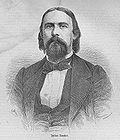 Julius Faucher (from Liberalism)
 John Maynard Keynes, one of the most influential economists of modern times and whose ideas, which are still widely felt, formalized modern liberal economic policy (from Liberalism)
 The US federal minimum wage if it had kept pace with productivity compared to the actual wage (from Neoliberalism)
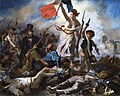 The iconic painting Liberty Leading the People by Eugène Delacroix, a tableau of the July Revolution in 1830 (from Liberalism)
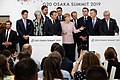 The European Union–Mercosur free trade agreement, which would form one of the world's largest free trade areas, has been denounced by environmental activists and indigenous rights campaigners. (from Neoliberalism)
 Sismondi, who wrote the first critique of the free market from a liberal perspective in 1819 (from Liberalism)
 T. H. Green, an influential liberal philosopher who established in Prolegomena to Ethics (1884) the first major foundations for what later became known as positive liberty and in a few years, his ideas became the official policy of the Liberal Party in Britain, precipitating the rise of social liberalism and the modern welfare state (from Liberalism)
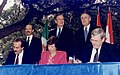 U.S. President Bush, Canadian PM Mulroney, and Mexican President Salinas participate in the ceremonies to sign the North American Free Trade Agreement (NAFTA). (from Neoliberalism)
 United States incarceration rate per 100,000 population, 1925–2014 (from Neoliberalism)

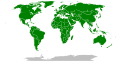 Member nations of the International Monetary Fund (from Neoliberalism)
 Gustave de Molinari (from Liberalism)
 Builders in West Berlin, 1952 (from Neoliberalism)
 John Locke was the first to develop a liberal philosophy, including the right to private property and the consent of the governed. (from Liberalism)
 Execution of José María de Torrijos y Uriarte and his men in 1831 as Spanish King Ferdinand VII took repressive measures against the liberal forces in his country (from Liberalism)
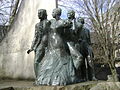 Monument to the liberals of the 19th century in Agra del Orzán neighborhood, La Coruña, Galicia (Spain) (from Liberalism)
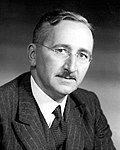 Friedrich Hayek (from Neoliberalism)
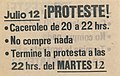 Pamphlet calling for a protest of economic policy in 1983 following the economic crisis (from Neoliberalism)
 Per capita income during the Great Depression (from Neoliberalism)
 The 2017–2018 Russian protests were organized by Russia's liberal opposition. (from Liberalism)
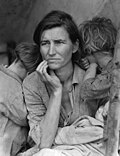 The Great Depression, with its periods of worldwide economic hardship, formed the backdrop against which the Keynesian Revolution took place (the image is Dorothea Lange's Migrant Mother depiction of destitute pea-pickers in California, taken in March 1936). (from Liberalism)
 Ronald Reagan (left) and Margaret Thatcher (right) were responsible for the popularisation of Neoliberalism. (from Neoliberalism)
 Franklin D. Roosevelt (from Liberalism)
 Benjamin Constant, a Franco-Swiss political activist and theorist (from Liberalism)
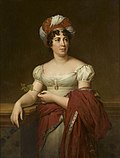 Madame de Staël (from Liberalism)
 Raif Badawi, a Saudi Arabian writer and the creator of the website Free Saudi Liberals, who was sentenced to ten years in prison and 1,000 lashes for "insulting Islam" in 2014 (from Liberalism)
 Ludwig Erhard (from Neoliberalism)
 Chilean (orange) and average Latin American (blue) rates of growth of GDP (1971–2007) (from Neoliberalism)
 Wealth inequality in the United States increased from 1989 to 2013. (from Neoliberalism)


_b_269.jpg)


.jpg)

.jpg)
.png)


.jpg)


.jpg)

.jpg)
_(1).jpg)
,_écrivain_et_homme_politique_-_P1679_-_Musée_Carnavalet_(cropped).jpg)


.jpg)


Subcategories

Related portals


WikiProjects

Topics
Recognized content


Associated Wikimedia
The following Wikimedia Foundation sister projects provide more on this subject:
-
 Commons
Free media repository -
 Wikidata
Free knowledge base -
 Wikiquote
Collection of quotations -
 Wikisource
Free-content library -
 Wikiversity
Free learning tools -
 Wiktionary
Dictionary and thesaurus


