Portal:Mountains
From Wikipedia, the free encyclopedia

 Portal Portal |
 WikiProject WikiProject |
 Discussion Discussion |
Introduction


A mountain is an elevated portion of the surface of a planet, generally with steep sides that show significant exposed bedrock. Although there are no universally accepted definitions, a mountain is usually considered higher than a hill. By definition, mountains are often thought of as being a landform which is higher than 2,000 feet (610 m). It may either have a limited summit area or be a smaller plateau with high elevation and steep sides. A few mountains are isolated summits, but most occur in mountain ranges.[page needed]
Mountains are formed through tectonic forces, erosion, or volcanism,[page needed] which act on time scales of up to tens of millions of years. Once mountain building ceases, mountains are slowly leveled through the action of weathering, through slumping and other forms of mass wasting, as well as through erosion by rivers and glaciers.
High elevations on mountains produce colder climates than at sea level at similar latitude. These colder climates strongly affect the ecosystems of mountains: different elevations have different plants and animals. Because of the less hospitable terrain and climate, mountains tend to be used less for agriculture and more for resource extraction, such as mining and logging, along with recreation, such as mountain climbing and skiing.
The highest mountain on Earth is Mount Everest in the Himalayas of Asia, whose summit is 8,850 m (29,035 ft) above mean sea level. The highest known mountain on any planet in the Solar System is Olympus Mons on Mars at 21,171 m (69,459 ft). The highest mountain on Earth from base to peak is Mauna Kea in Hawaii, which rises 9,330 m (30,610 ft) from its base at the bottom of the ocean; some scientists consider it to be the tallest on Earth. (Full article...)
Selected mountain-related landform

A moulin (or glacier mill) is a roughly circular, vertical (or nearly vertical) well-like shaft formed where a surface meltstream exploits a weakness in the ice. The term is derived from the French word for mill.
They can be up to 10 meters wide and are typically found on ice sheets and flat areas of a glacier in a region of transverse crevasses. Moulins can reach the bottom of the glacier, hundreds of meters deep, or may only reach the depth of common crevasse formation (about 10–40 m) where the stream flows englacially. They are the most typical cause for the formation of a glacier cave. (Full article...)
Selected mountain range

The Cumberland Mountains are a mountain range in the southeastern section of the Appalachian Mountains. They are located in western Virginia, southwestern West Virginia, the eastern edges of Kentucky, and eastern middle Tennessee, including the Crab Orchard Mountains. Their highest peak, with an elevation of 4,223 feet (1,287 m) above mean sea level, is High Knob, which is located near Norton, Virginia.
According to the USGS, the Cumberland Mountain range is 131 miles (211 km) long and 20 miles (32 km) wide, bounded by the Russell Fork on the northeast, the Pound River and Powell River on the southeast, Cove Creek on the southwest, and Tackett Creek, the Cumberland River, Poor Fork Cumberland River, and Elkhorn Creek on the northwest. The crest of the range forms the Kentucky and Virginia boundary from the Tennessee border to the Russell Fork River. (Full article...)
Selected mountain type

An inselberg or monadnock (/məˈnædnɒk/ mə-NAD-nok) is an isolated rock hill, knob, ridge, or small mountain that rises abruptly from a gently sloping or virtually level surrounding plain. If the inselberg is dome-shaped and formed from granite or gneiss, it can also be called a bornhardt, though not all bornhardts are inselbergs. An inselberg results when a body of rock resistant to erosion, such as granite, occurring within a body of softer rocks, is exposed by differential erosion and lowering of the surrounding landscape. (Full article...)
Selected climbing article

Lead climbing (or leading) is a technique in rock climbing where two climbers work together to ascend a climbing route. The 'lead climber'—who climbs—clips their rope into pieces of protection as they ascend the route. The 'second' (or 'belayer') stands at the base of the route controlling the other end of the rope, which is called belaying (e.g. if the lead climber falls, the second locks the rope). The term distinguishes between the two roles and the greater effort and increased risk of the role of the lead climber.
Leading a route is in contrast with the alternative rock climbing technique of top roping, where even though there is still a second belaying the rope, the lead climber faces no risk in the event of a fall and does not need to clip into any protection as the rope is already anchored to the top of the route (e.g. if they fall they will just hang from the static rope). Leading a climbing route is a core activity in rock climbing, and first ascents (FA) and first free ascents (FFA) of new routes must be done via lead climbing. (Full article...)
Related portals


General images


 Treeline elevation by latitude (from Montane ecosystem)
 Mountaineers, c. 1900 (from Mountaineering)
 K2, the second highest mountain in the world (from Mountaineering)
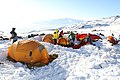 Winter campers bivouaced in the snow (from Mountaineering)
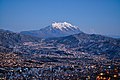
 The Andes, the longest mountain range on the surface of the Earth, have a dramatic impact on the climate of South America (from Mountain range)
 The Ocean Ridge, the world's longest mountain range (chain) (from Mountain range)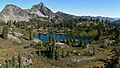


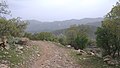 Iranian oak scrub in the Zagros Mountains (from Montane ecosystem)
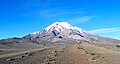 Chimborazo, Ecuador, whose summit is the point farthest away from the Earth's center (from Mountain)
 Edmund Hillary (left) and Tenzing Norgay after successfully completing the first ascent of Mount Everest, 29 May 1953
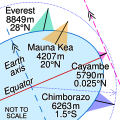 Everest is highest from sea level (green), Mauna Kea is highest from its base (orange), Cayambe is farthest from Earth's axis (pink) and Chimborazo is farthest from Earth's centre (blue) (from Mountain)
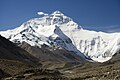 Mount Everest, Earth's highest mountain (from Mountain)
 Climber approaching the summit of Manaslu at 8,163 metres (from Mountaineering)
 British mountaineer William Cecil Slingsby became known as the father of Norwegian mountaineering and contributed greatly to its popularization with his classic book Norway, the Northern Playground. (from Mountaineering)
 The Namcha Barwa Himal, east part of the Himalayas as seen from space by Apollo 9 (from Mountain range)
 Stretcher box in Cumbria, England, prepositioned equipment saves mountain rescue teams having to trudge up mountains with it. (from Mountain rescue)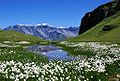
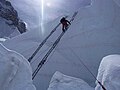 Fixed lines and ladders are distinguishing characteristics of expedition style mountaineering. (from Mountaineering)
 The northern Urals at high latitude and elevation have an alpine climate and barren ground. (from Mountain)
 A stand of mountain birch at around 750 m in Trollheimen, typical of Scandinavian subalpine forests (from Montane ecosystem)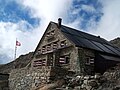

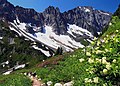 Alpine flora near Cascade Pass (from Montane ecosystem)
 Fuji volcano (from Mountain)
 Edelweiss, a plant associated with mountain sports (from Mountaineering)
 Antique climbing tools (from Mountaineering)
 Mountaineers proceed across snow fields on South Tyrol; other climbers are visible further up the slopes. (from Mountaineering)
 Distribution of mountains by location and elevation (from Mountain)
 This 1848 "Sketch showing the actual elevation of the Snow Line in different Latitudes" by Alexander Keith Johnston shows the snow lines of mountains in America, Europe and Asia. (from Snow line)
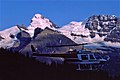 Choppering out the injured – with Mt. Forbes in the background (from Mountain rescue)
 Coverage of important mountain biodiversity sites in protected areas by country (from Montane ecosystem)
 Car of Horská služba (Czech Republic) (from Mountain rescue)


.jpg)


.jpg)
.jpg)


.jpg)


Selected skiing article

A hybrid lift is a type of ski lift that combines the elements of a chairlift and a gondola lift. First introduced by Poma, who refers to them as Telemix, they have since been built by most lift manufacturers who refer to them by a variety of names; Doppelmayr refers to them as a combined lift, Bartholet refers to them with the French name, téléporté mixte, while the more generic terms chondola and telecombi are common in North America.
Both chairs and gondolas have advantages for lift operations. Gondolas offer protection from the elements and are particularly useful in rain or very cold conditions. They can also be used during the summer for walk-on guests, cyclists or wheelchairs, and in the winter for snowshoers. In the winter, gondolas require skiers and snowboarders to remove their equipment and walk into the cabin. Chairs are generally more convenient and easier to board for skiers. Some lifts have so-called 'bubble' chairs, which add a retractable acrylic glass dome to protect passengers from weather. (Full article...)
Subcategories
Need help?
Do you have a question about Mountains that you can't find the answer to? Consider asking it at the Wikipedia reference desk.
Get involved
For editor resources and to collaborate with other editors on improving Wikipedia's Mountains-related articles, see WikiProject Mountains.
Topics

- Africa: Atlas • Kilimanjaro • Mount Kenya massif • Ruwenzori Mountains
- America: Andes • Appalachians • Cascades • Cordilleras • Rockies • Sierra Nevada
- Antarctica: Sentinel Range
- Asia: Altai • Himalaya • Hindu Kush • Caucasus • Karakoram • Pamir
- Australia and Oceania: Maoke Mountains • New Zealand Alps • Snowy Mountains
- Europe: Alps • Ardennes • Balkans • Highlands • Jura • Carpathians • Pyrenees • Scandinavian Mountains • Urals • Vosges

- Alps: Piz Badile • Mont Blanc • Petit Dru • Dufourspitze • Eiger • Großglockner • Grandes Jorasses • Jungfrau • Königspitze • Matterhorn • Mönch • Ortler • Watzmann • Drei Zinnen • Zugspitze
- Andes: Aconcagua • Alpamayo • Chimborazo • Cotopaxi • Fitz Roy • Nevado Huascarán • Illimani • Sajama • Ojos del Salado • Siula Grande • Cerro Torre • Yerupaja

- Himalayas: Eight-thousanders – Mount Everest • K2 • Kangchenjunga • Lhotse • Makalu • Cho Oyu • Dhaulagiri • Manaslu • Nanga Parbat • Annapurna I • Hidden Peak • Broad Peak • Gasherbrum II • Shishapangma – Other – Ama Dablam • Chogolisa • Masherbrum • Shivling
- Rocky Mountains: Mount Chephren • Mount Elbert • Mount Logan • Denali • Mount Robson
- Volcanos: Etna • Eldfell • Hohentwiel • Mauna Kea • Pinatubo • Puʻu ʻŌʻō • Mount St. Helens • Stromboli • Mount Unzen
Flora and fauna

- Plants: Alpine Rock-Jasmine • Hairy Alpenrose • Edelweiss • Great Yellow Gentian • Glacier Crowfoot • Wulfenia • Dwarf Willow • Queen of the Andes • Arolla Pine
- Animals: Red-billed Chough • Alpine marmot • Alpine Salamander • Rock Ptarmigan • Alpine Ibex • Andean Condor • Bearded Vulture • Alpine Chough • Chamois • Mountain Burnet • European Viper • Himalayan Tahr • Wallcreeper • White-winged Snowfinch • Golden Eagle • Northern Bald Ibis • Yak

- Equipment: Ascenders • Belay devices • Carabiners • Maillons • Harnesses • Hexes • Nuts • Quickdraws • Ropes • Shoes • SLCDs • Slings • Tricams
- Techniques: Abseiling • Redpointing • Anchor • Mantle • Top roping • Climbing grade • Climbing route
- Types of climbing: Big wall climbing • Bouldering • Competition climbing • Free climbing • Ice climbing • Mountain climbing • Rock climbing • Schrofen • Sport climbing
- Klettersteigs: Mannlgrat
- Climbers: Kurt Albert • Pierre Allain •John Bachar • Henry Barber • Catherine Destivelle • Patrick Edlinger • John Gill • Stefan Glowacz • Wolfgang Güllich • Lynn Hill • Alex Honnold • Alexander Huber • John Long • Jeff Lowe • Magnus Midtbø • Adam Ondra • Dean Potter • Alain Robert • Chris Sharma • Todd Skinner • Ueli Steck • Other climbers

- Mountaineering: Alpine Clubs • Boots • Crampons • Ice axes • Mountain huts • Mountain rescue • Ropes • Rucksacks
- Pioneers: Christian Almer • Melchior Anderegg • Hermann von Barth • Walter Bonatti • Meta Brevoort • William Martin Conway • Angelo Dibona • Hans Dülfer • Paul Grohmann • Adolphus Warburton Moore • Paul Preuss • Ludwig Purtscheller • Schlagintweit brothers • Leslie Stephen • Gottlieb Samuel Studer • Tenzig Norgay • Herbert Tichy • Lucy Walker • Edward Whymper • Georg Winkler • Matthias Zurbriggen
- High-altitude mountaineers: Chris Bonington • Hermann Buhl • Kurt Diemberger • Ralf Dujmovits • Günther Dyhrenfurth • Maurice Herzog • Sir Edmund Hillary • Sandy Irvine • Gerlinde Kaltenbrunner • George Mallory • Nives Meroi • Reinhold Messner • Simone Moro • Oh Eun-sun • Edurne Pasaban • Wanda Rutkiewicz • Lionel Terray • Um Hong-Gil • Stephen Venables • Ed Viesturs • Other mountaineers
- Publicists: Karl Blodig • W. A. B. Coolidge • David Breashears • Jon Krakauer • Gaston Rébuffat
- Alps: Eiger climbing history • Exploration of the High Alps • Golden age of alpinism • Silver age of alpinism • Timeline of climbing the Matterhorn
- Himalayas: 1922 British Mount Everest expedition • 1924 British Mount Everest expedition • 1953 British Mount Everest expedition • 1986 K2 disaster • 1996 Mount Everest disaster • 2008 K2 disaster • Timeline of climbing Mount Everest
- Museums: Alpine Club Museum • Messner Mountain Museum
Lists of mountains
Recognized content
- Featured content

- Good content
 Amak Volcano
- Ben Nevis
- Gerlachovský štít
- Glacier Peak
- Hualālai
- Huangshan
- Kohala (mountain)
- Mont Aiguille
- Mont Blanc massif
- Montpelier Hill
- Mount Adams (Washington)
- Mount Bailey (Oregon)
- Mount Baker
- Mount Cleveland (Alaska)
- Mount Edziza volcanic complex
- Mount Elbert
- Mount Garibaldi
- Mount Hood
- Mount Kenya
- Mount Rainier
- Mount Redoubt
- Mount Tehama
- Mount Thielsen
- Mount Vesuvius
- Pinkham Notch
- Roxy Ann Peak
- Silverthrone Caldera
- Snowdon
- Wells Gray-Clearwater volcanic field
- Wilkins Peak
- Yamsay Mountain

Associated Wikimedia
The following Wikimedia Foundation sister projects provide more on this subject:
-
 Commons
Free media repository -
 Wikidata
Free knowledge base -
 Wikiquote
Collection of quotations -
 Wikisource
Free-content library -
 Wikiversity
Free learning tools -
 Wikivoyage
Free travel guide -
 Wiktionary
Dictionary and thesaurus


